

Most to least prompting is a systematic teaching procedure where you begin with the most intrusive prompt necessary to ensure correct responding, then gradually fade to less assistance. This approach minimizes errors during skill acquisition and builds behavioral momentum through initial success.
Table of Contents
- most to least prompting: What is Most-to-Least Prompting? Definition and Rationale
- Implementing Most-to-Least Prompting: A Step-by-Step Guide
- Most-to-Least Prompting in Action: Worked ABA Examples
- BCBA Exam Focus: Application and Common Pitfalls
- Ethical Considerations and Clinical Decision-Making
- Summary and Key Takeaways for BCBA Candidates
most to least prompting: What is Most-to-Least Prompting? Definition and Rationale
This procedure involves starting with maximum support and systematically reducing assistance as the learner demonstrates competence. The primary goal is to prevent error patterns from developing during early learning stages.
Unlike least-to-most prompting, which begins with minimal assistance and increases as needed, most-to-least provides immediate success. This contrast is crucial for BCBA exam questions about errorless learning procedures.
The Core Principle: Errorless Learning
Errorless learning minimizes incorrect responses by ensuring the learner contacts reinforcement for correct behavior from the start. This prevents practicing incorrect responses that could become habitual.
The procedure builds behavioral momentum by creating a history of success. This increases the likelihood of continued engagement and reduces escape-maintained behaviors that might emerge from repeated failure.
Implementing Most-to-Least Prompting: A Step-by-Step Guide
Effective implementation requires careful planning and data-based decision making. Follow these steps to ensure proper application.
Step 1: Conduct a Task Analysis and Baseline
Begin by breaking the target skill into discrete steps using a task analysis. This provides the framework for prompting each component.
Collect baseline data to determine the learner’s current performance level. This informs your starting prompt level selection and helps track progress objectively.
Step 2: Select and Apply the Prompt Hierarchy
Choose a prompt hierarchy that progresses from most to least intrusive. Common hierarchies include:
- Full physical guidance – Hand-over-hand assistance
- Partial physical – Gentle touch or guidance
- Model prompt – Demonstrating the correct response
- Gesture prompt – Pointing or indicating
- Verbal prompt – Specific instructions
- Independent – No assistance needed
Start at the prompt level that guarantees correct responding on the first trial.
Step 3: Systematically Fade Prompts
Establish clear criteria for moving to less intrusive prompts. Common criteria include 2-3 consecutive correct responses at the current prompt level.
Monitor data closely to determine when to fade. Avoid fading too quickly, which could lead to errors, or too slowly, which might create prompt dependency.
Most-to-Least Prompting in Action: Worked ABA Examples
These practical examples demonstrate how most-to-least prompting functions in real clinical scenarios, complete with ABC data and hypothesized functions.
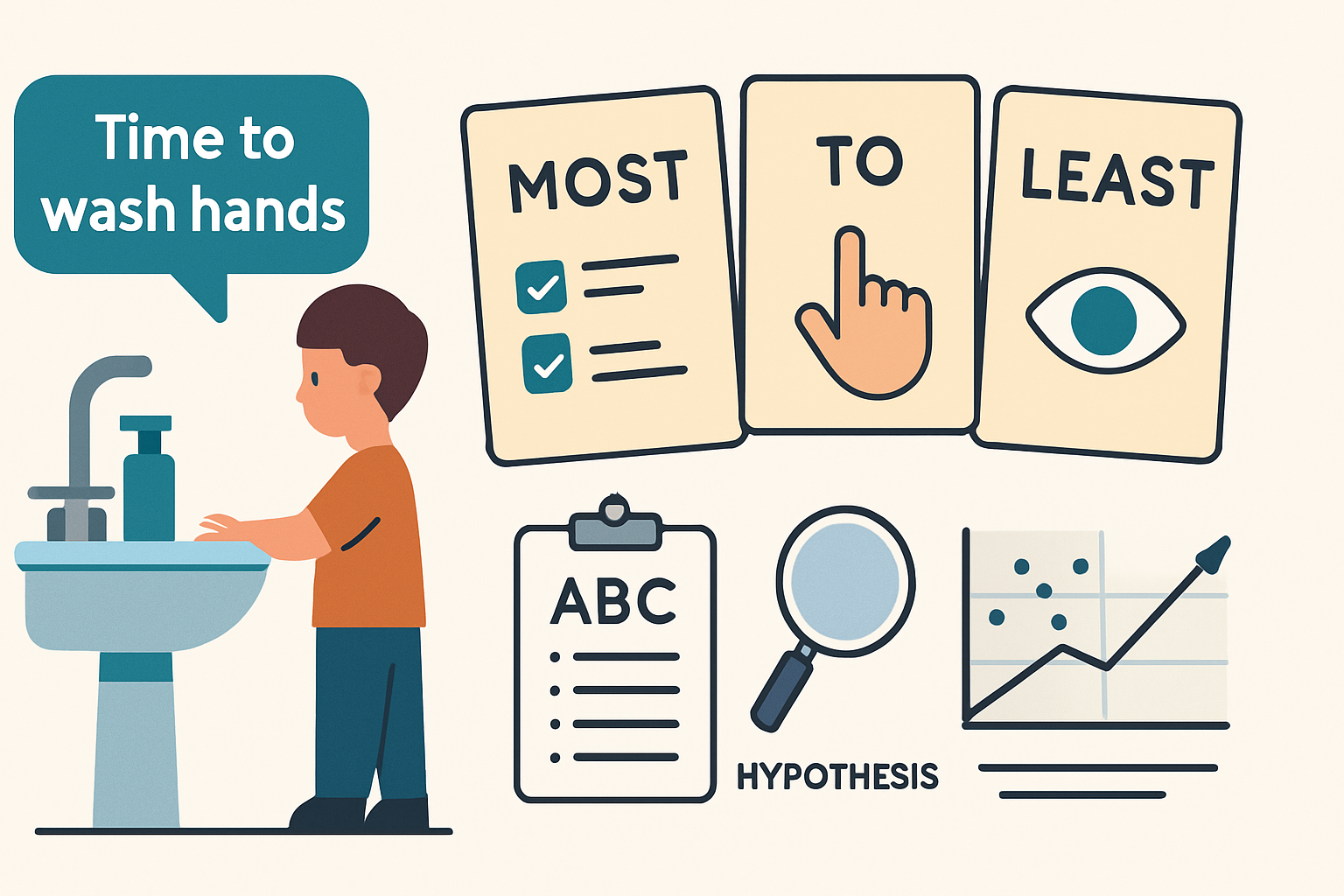
Example 1: Teaching Hand Washing to a Young Learner
Antecedent: “Time to wash hands” presented at sink with soap and towel available
Behavior: 8-step hand washing task analysis (turn on water, wet hands, get soap, etc.)
Consequence: Full physical prompt provided for all steps initially, with praise after completion
Hypothesized function: Escape from task demand (initially) transitioning to access to tangible (soap bubbles) and social reinforcement (praise)
Over 5 sessions, prompts faded systematically: full physical → partial physical → model → gesture → independent. Data showed 100% accuracy maintained throughout fading process.
Example 2: Vocational Skill: Assembling a Package
Antecedent: Workstation with components and visual checklist for package assembly
Behavior: 6-step assembly sequence (select box, insert item, add padding, seal, label, stack)
Consequence: Model prompt provided for each step, with tangible reinforcement (break token) after correct completion
Hypothesized function: Negative reinforcement (avoiding work rejection/correction) and access to break tokens
Prompt hierarchy: model → gesture → verbal → independent. Data across 10 trials showed zero errors during prompt fading, preventing practice of incorrect assembly that could lead to work rejection.
BCBA Exam Focus: Application and Common Pitfalls
Understanding how most-to-least prompting appears on the BCBA exam can help you avoid common mistakes and select correct answers efficiently.
Distinguishing Most-to-Least from Other Procedures
Key differences to remember for exam questions:
- Most-to-least vs. least-to-most: Starting point is the critical distinction
- Graduated guidance: Continuous physical prompts that fade within a trial
- Time delay: Systematic delay between instruction and prompt
- Stimulus fading: Gradually changing stimulus properties
Most-to-least is specifically designed for acquisition tasks where error prevention is paramount.
Exam Traps and How to Avoid Them
Common mistakes candidates make include:
- Confusing most-to-least with least-to-most prompting (remember the starting point)
- Selecting a starting prompt that’s too weak, leading to initial errors
- Fading prompts without data-based criteria or too rapidly
- Applying the procedure to behavior reduction instead of skill acquisition
- Forgetting to include reinforcement for prompted correct responses
For more on related procedures, see our guide on errorless learning in ABA.
Ethical Considerations and Clinical Decision-Making
Ethical implementation requires balancing assistance with the goal of independence and considering client dignity throughout the process.
Balancing Assistance with Independence
The ethical imperative is to fade prompts as quickly as possible while maintaining accuracy. Prompt dependency violates the principle of promoting client autonomy.
Consider the learner’s developmental level and preferences when selecting prompt types. Some individuals may find certain prompts (like full physical) aversive, requiring alternative approaches.
Quick Implementation Checklist
Use this checklist before implementing most-to-least prompting:
- Is the skill appropriate for most-to-least prompting? (acquisition task, error prevention needed)
- Is the task analysis complete and validated?
- Have you collected baseline data on current performance?
- Does your starting prompt guarantee initial success?
- Is your prompt hierarchy clearly defined?
- Do you have data-based criteria for fading prompts?
- Is your reinforcement plan established for correct prompted responses?
- Have you considered client preferences and dignity in prompt selection?
For ethical guidance, review the ethics in ABA practice guide.
Summary and Key Takeaways for BCBA Candidates
Most-to-least prompting is a powerful errorless learning procedure for teaching new skills. Remember these key points:
- Start with the most intrusive prompt necessary for success
- Systematically fade to less assistance using data-based criteria
- Prevents error patterns and builds behavioral momentum
- Contrast with least-to-most prompting on the exam
- Always pair with reinforcement for correct prompted responses
- Monitor for and prevent prompt dependency
- Consider client dignity and preferences in prompt selection
For comprehensive exam preparation, explore our BCBA exam prep guide and additional resources on BACB ethics standards.


