

Latency in ABA: What is Latency in Applied Behavior Analysis?
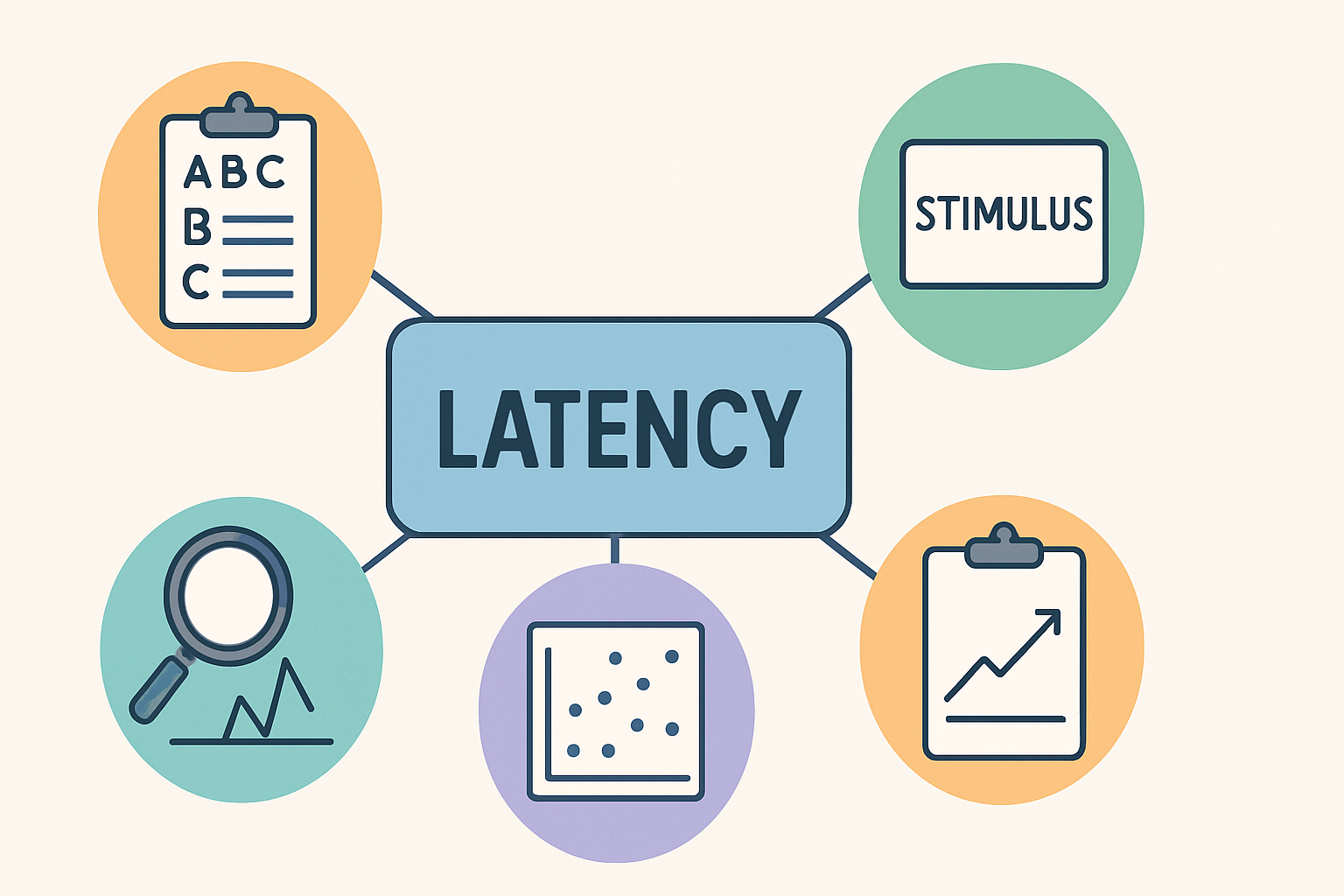
In Applied Behavior Analysis, latency refers to the precise measurement of time between two specific events. This temporal dimension provides critical information about how quickly a behavior occurs following a particular stimulus or antecedent condition.
Table of Contents
- Latency in ABA: What is Latency in Applied Behavior Analysis?
- Measuring and Recording Latency: A Step-by-Step Guide
- Latency in Action: Worked ABA Examples
- Latency on the BCBA Exam: Relevance and Common Traps
- Quick-Study Checklist and Summary
Understanding latency in ABA is essential for both clinical practice and exam preparation, as it represents one of the fundamental ways we quantify behavioral responses.
The Official Definition and Key Characteristics
Latency is formally defined as the elapsed time between the onset of a specific antecedent stimulus and the initiation of the target behavioral response. This measurement falls under the category of temporal locus, which examines when behaviors occur relative to environmental events.
Key characteristics include:
- Always measured in units of time (seconds, minutes, hours)
- Focuses on response initiation, not completion
- Provides data on behavioral fluency and efficiency
- Helps identify motivational variables affecting responding
Latency vs. Duration vs. IRT: Avoiding Common Confusion
These three temporal measures often confuse students, but each serves a distinct purpose in behavioral measurement.
- Latency: Time from stimulus onset to response initiation
- Duration: How long a behavior lasts from start to finish
- Interresponse Time (IRT): Time between the end of one response and the start of the next
For example, when measuring compliance to instructions, latency tells us how quickly someone begins following directions, while duration would measure how long they continue the behavior.
Measuring and Recording Latency: A Step-by-Step Guide
Accurate latency measurement requires systematic procedures and appropriate tools. Proper data collection ensures reliable information for clinical decision-making and intervention planning.
Tools of the Trade: Stopwatches and Data Sheets
Effective latency measurement begins with the right equipment. Most practitioners use simple, reliable tools that provide precise timing data.
- Digital stopwatches with lap functions
- Timer applications on mobile devices
- Specialized data collection software
- Standardized latency recording sheets
When creating data sheets, include columns for the antecedent stimulus, target behavior, latency measurement, and any relevant environmental conditions.
Interpreting Latency Data: What the Numbers Tell You
Latency data provides valuable insights into behavioral patterns and intervention effectiveness. Proper interpretation requires understanding what different latency patterns indicate.
Decreasing latency typically suggests improved behavioral fluency, stronger stimulus control, or increased motivation to respond. This often occurs during skill acquisition when responses become more efficient.
Increasing latency may indicate weakening response strength, developing avoidance behaviors, or changes in motivating operations. This pattern requires careful analysis to determine the underlying cause.
Latency in Action: Worked ABA Examples
Real-world examples demonstrate how latency measurement applies across different behavioral contexts and functions. These scenarios illustrate the practical application of latency data in assessment and intervention.
Example 1: Instructional Compliance
Antecedent: Therapist presents a clear instruction: ‘Please hand me the blue crayon.’
Behavior: Client reaches for and picks up the blue crayon.
Latency: 3 seconds
This short latency suggests strong instructional control and likely socially mediated positive reinforcement for compliance. The client demonstrates efficient responding to the discriminative stimulus.
Example 2: Elopement Following a Demand
Antecedent: Parent places a difficult homework assignment on the table.
Behavior: Child immediately stands up and leaves the room.
Latency: 1 second
The extremely brief latency indicates automatic escape behavior maintained by negative reinforcement. This pattern suggests the demand functions as an aversive stimulus triggering rapid avoidance.
Example 3: Manding for a Preferred Item
Antecedent: Preferred snack is visible but out of reach during snack time.
Behavior: Child says ‘cookie’ using verbal approximation.
Latency: 7 seconds
This moderate latency suggests the child is learning to use functional communication for tangible reinforcement. The behavior is likely under developing stimulus control of the motivating operation (hunger) and the discriminative stimulus (visible snack).
Latency on the BCBA Exam: Relevance and Common Traps
Latency measurement appears frequently on the BCBA examination, often in scenarios testing your ability to distinguish between different temporal dimensions of behavior. Understanding common exam traps can significantly improve your performance.
Identifying Latency Measurement in Vignettes
Exam questions often present detailed scenarios where you must identify which behavioral dimension is being measured. Look for these key indicators:
- References to time measurements between events
- Descriptions of stimulus presentation followed by behavior initiation
- Phrases like ‘how long it took to begin’ or ‘time until starting’
- Data presented in seconds or minutes from antecedent to response
Practice identifying these patterns in mock exam questions to build recognition skills.
Trap Questions: Distractors Involving Duration and IRT
The most common exam traps involve confusing latency with other temporal measures. Watch for these specific distractors:
- Questions describing latency scenarios but asking about duration
- Scenarios involving multiple responses that actually test interresponse time
- Items using similar terminology but different measurement focus
- Questions that switch between response initiation and response completion
Always re-read the question stem carefully and verify whether it asks about when the behavior started (latency) versus how long it lasted (duration). For more on behavioral measurement, see our guide on data collection methods.
Quick-Study Checklist and Summary
Use this checklist to ensure you’ve mastered all key aspects of latency measurement for both clinical practice and exam preparation.
- ✓ Define latency as time from stimulus to response initiation
- ✓ Distinguish latency from duration and interresponse time
- ✓ Identify appropriate measurement tools and procedures
- ✓ Interpret decreasing latency as improved fluency
- ✓ Recognize increasing latency as potential problem indicator
- ✓ Apply latency measurement to real-world scenarios
- ✓ Avoid common exam traps with temporal dimensions
- ✓ Practice with multiple examples across behavioral functions
Latency remains a fundamental measurement dimension in Applied Behavior Analysis, providing critical information about behavioral efficiency and stimulus control. Mastery of this concept supports both effective clinical practice and successful performance on the BCBA examination. For comprehensive exam preparation, explore our BCBA exam prep guide and additional resources on behavioral measurement from authoritative sources like the Behavior Analyst Certification Board.


