
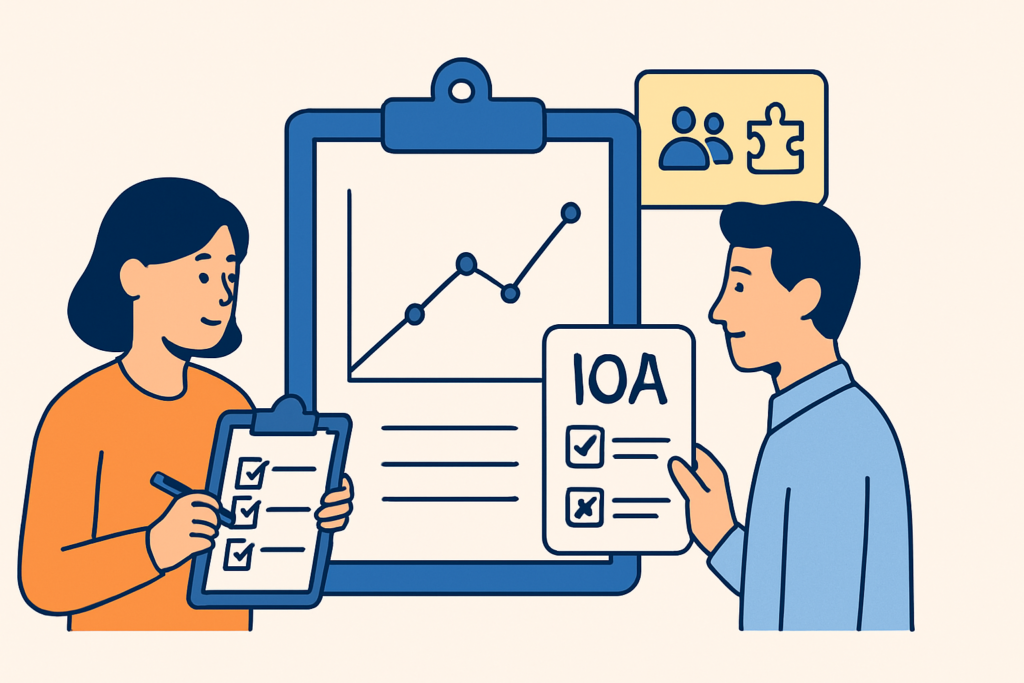
Interobserver Agreement IOA: What is Interobserver Agreement (IOA) in ABA?
Interobserver agreement (IOA) represents the degree of consistency between two or more independent observers measuring the same behavioral events. This measurement reliability concept serves as a critical quality check for data collection systems in applied behavior analysis.
Table of Contents
- Interobserver Agreement IOA: What is Interobserver Agreement (IOA) in ABA?
- Calculating and Interpreting IOA
- IOA in Practice: Worked Examples from Measurement Systems
- IOA on the BCBA Exam: Common Traps and How to Avoid Them
- Quick-Reference IOA Checklist for BCBA Candidates
- Summary and Key Takeaways
The Core Definition and Purpose
IOA quantifies how often different observers record the same values when measuring identical behavioral occurrences. This reliability metric helps practitioners identify potential observer drift and ensures the data they collect accurately reflects what actually occurred during sessions.
High IOA percentages indicate that measurement procedures are being implemented consistently, which is essential for making valid treatment decisions based on data.
Why IOA Matters for Practitioners and Candidates
The BACB Ethics Code requires behavior analysts to base their decisions on accurate data. Without reliable measurement through adequate IOA, practitioners risk making clinical decisions based on potentially flawed information.
For BCBA exam candidates, understanding IOA is crucial for sections covering measurement systems, experimental design, and data interpretation. Many exam questions test your ability to calculate, interpret, and apply IOA standards appropriately.
Calculating and Interpreting IOA
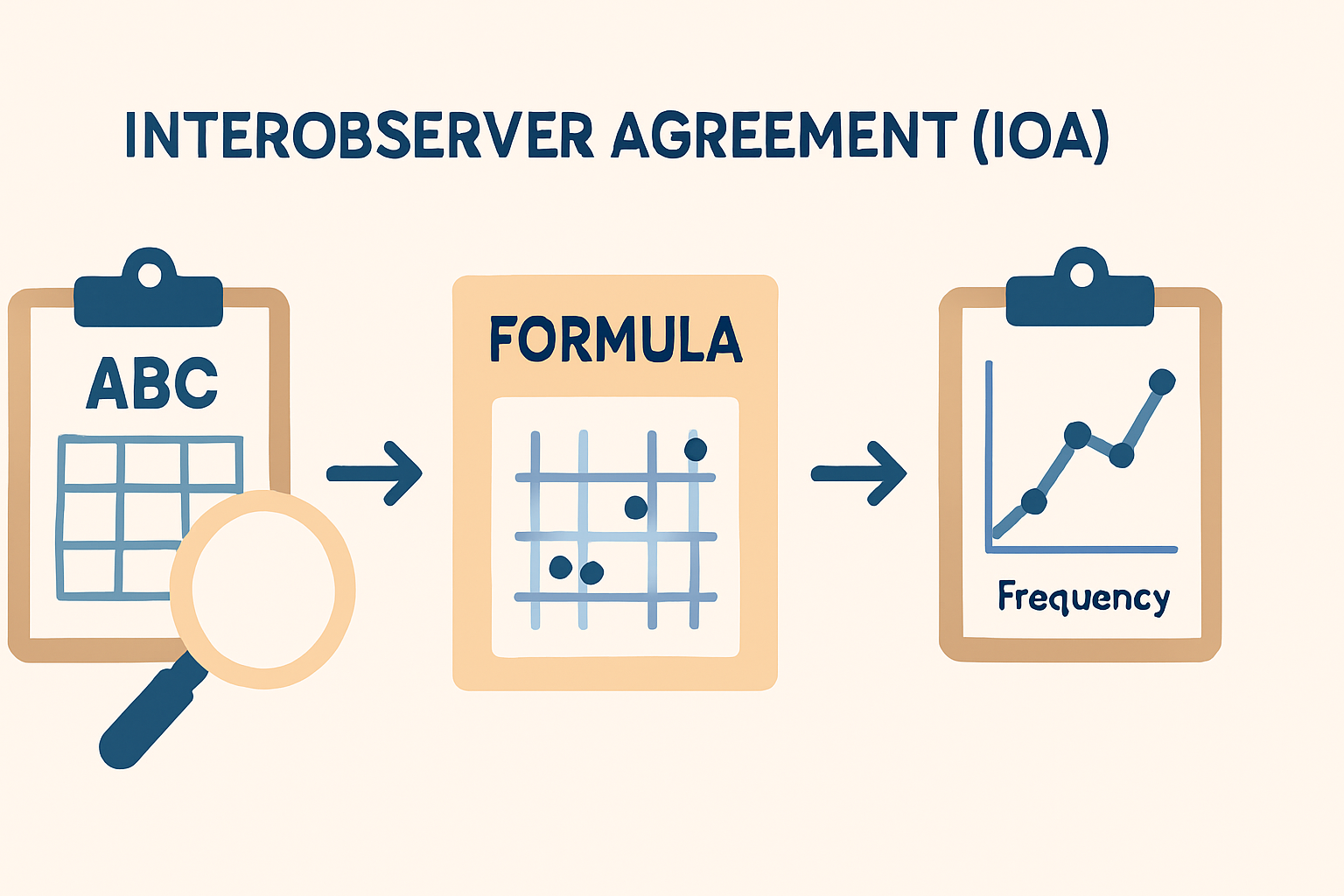
Different measurement systems require specific IOA calculation methods. Understanding which formula to apply is essential for accurate reliability assessment.
Total Count IOA: The Simple Ratio
This basic method works well for frequency data and rate calculations. The formula is straightforward: (Smaller Count ÷ Larger Count) × 100.
Example: Observer A records 15 instances of hand-raising during a 30-minute session. Observer B records 12 instances. Total Count IOA = (12 ÷ 15) × 100 = 80%.
Mean Count-per-Interval IOA
For interval recording systems, this method calculates agreement within each interval, then averages across intervals. It’s particularly useful for partial interval and whole interval recording.
- Divide session into equal intervals (e.g., 10-second intervals)
- Calculate agreement per interval using: (Smaller count ÷ Larger count) × 100
- Average the agreement percentages across all intervals
Exact Agreement per Interval IOA
This stricter method only counts intervals where both observers recorded the exact same value. It’s commonly used with occurrence/non-occurrence data in interval systems.
Example: If Observer A marks interval 3 as “occurrence” and Observer B marks it as “non-occurrence,” that interval counts as a disagreement regardless of how close the counts might be.
IOA in Practice: Worked Examples from Measurement Systems
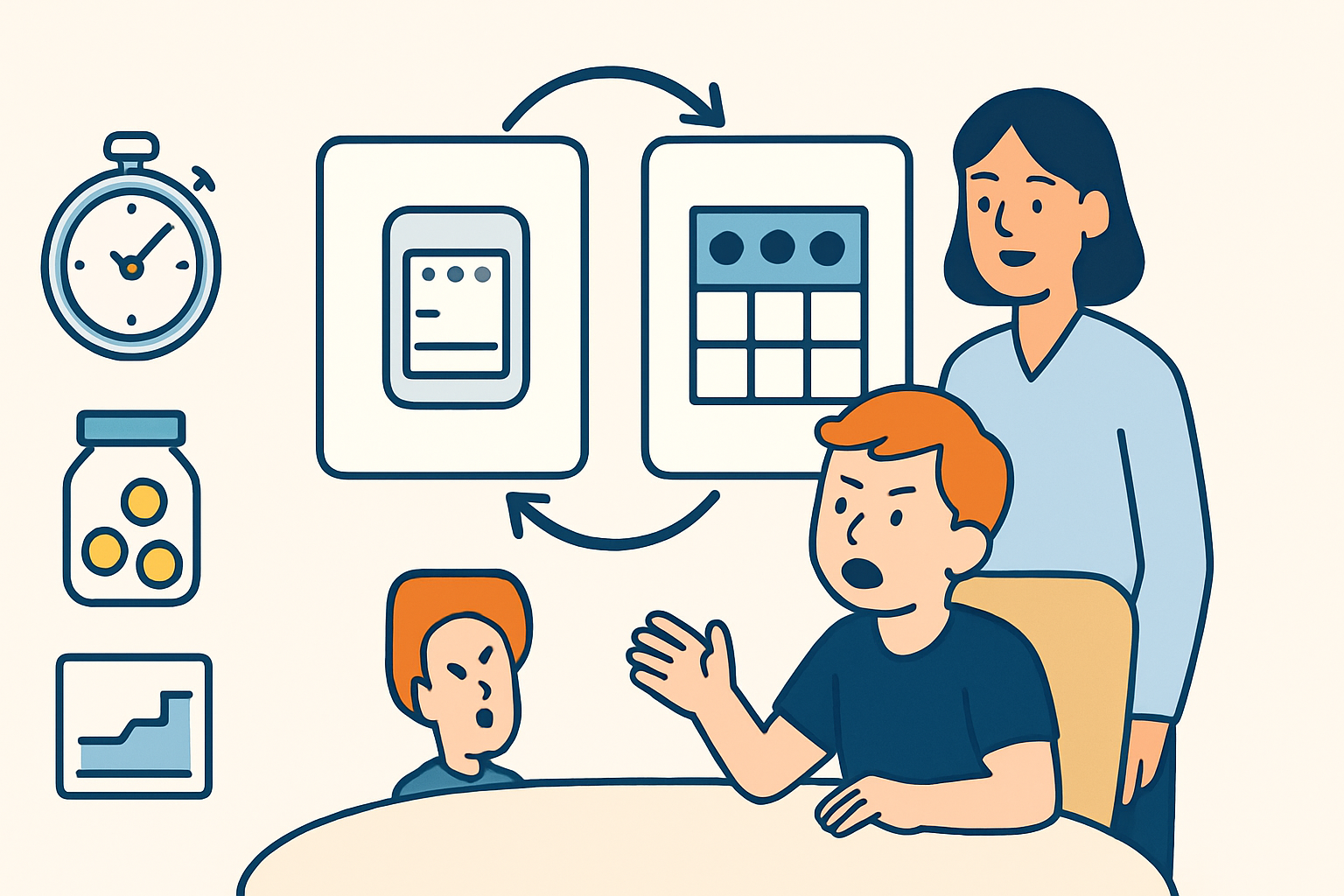
Applying IOA concepts to real measurement scenarios helps solidify understanding for both practice and exam preparation.
Example 1: Frequency & Rate Data for Attention-Maintained Behavior
Scenario: Behavior: Vocal interruptions (antecedent: group work, consequence: adult attention). Function: Access to adult attention.
Observer A records frequencies: Session 1: 8, Session 2: 12, Session 3: 10
Observer B records frequencies: Session 1: 7, Session 2: 11, Session 3: 9
Calculations:
Session 1 IOA: (7 ÷ 8) × 100 = 87.5%
Session 2 IOA: (11 ÷ 12) × 100 = 91.7%
Session 3 IOA: (9 ÷ 10) × 100 = 90.0%
Interpretation: All sessions show acceptable IOA (above 80%), indicating reliable frequency measurement for this attention-maintained behavior.
Example 2: Duration Data for Escape-Maintained Behavior
Scenario: Behavior: Task refusal (laying head on desk) during difficult math. Function: Escape from academic demands.
Observer A records durations (seconds): Trial 1: 45, Trial 2: 32, Trial 3: 28, Trial 4: 51, Trial 5: 37
Observer B records durations: Trial 1: 42, Trial 2: 30, Trial 3: 25, Trial 4: 48, Trial 5: 35
Duration IOA calculation: For each trial, use (Smaller duration ÷ Larger duration) × 100, then average:
Trial 1: (42 ÷ 45) × 100 = 93.3%
Trial 2: (30 ÷ 32) × 100 = 93.8%
Trial 3: (25 ÷ 28) × 100 = 89.3%
Trial 4: (48 ÷ 51) × 100 = 94.1%
Trial 5: (35 ÷ 37) × 100 = 94.6%
Average IOA: (93.3 + 93.8 + 89.3 + 94.1 + 94.6) ÷ 5 = 92.8%
This demonstrates excellent reliability for duration measurement of escape-maintained behavior.
IOA on the BCBA Exam: Common Traps and How to Avoid Them
Exam questions about IOA often include subtle distinctions that can trip up unprepared candidates. Recognizing these patterns is key to success.
Recognizing Key Thresholds and Acceptable Standards
The commonly accepted minimum IOA standard is 80% agreement for most measurement systems. However, some contexts require 90% or higher, particularly when measuring low-frequency behaviors or using interval recording.
Always consider the measurement system and behavioral context when evaluating whether IOA meets acceptable standards. For comprehensive measurement guidance, see our data collection methods guide.
Top 3 Exam Traps with IOA Questions
- Confusing IOA with treatment integrity: IOA measures observer agreement, while treatment integrity assesses whether procedures are implemented as planned. These are distinct reliability concepts.
- Selecting the wrong calculation method: Frequency data requires Total Count IOA, while interval data needs Mean Count-per-Interval or Exact Agreement methods. Matching the formula to the data type is crucial.
- Misinterpreting “good” vs. “poor” IOA results: Low IOA doesn’t necessarily mean the behavior changed; it often indicates measurement problems or observer drift that need addressing.
Quick-Reference IOA Checklist for BCBA Candidates
- ✓ Calculate IOA regularly during baseline and intervention phases
- ✓ Use appropriate formula for your measurement system (frequency, duration, interval)
- ✓ Aim for minimum 80% agreement, with 90% preferred for critical measures
- ✓ Train observers until they achieve acceptable IOA before formal data collection
- ✓ Recalculate IOA if behavior definitions are modified
- ✓ Document IOA percentages in your data records and reports
- ✓ Address low IOA by retraining observers or refining measurement procedures
Summary and Key Takeaways
Interobserver agreement serves as the foundation of reliable measurement in applied behavior analysis. Mastering IOA calculations and interpretations is essential for both ethical practice and BCBA exam success.
Remember these core principles: IOA ensures data integrity, different measurement systems require specific calculation methods, and maintaining acceptable standards (typically 80%+) is non-negotiable for valid decision-making. For more on experimental design and measurement concepts, explore our single-subject designs guide and reference the BACB Ethics Code for standards on data collection reliability.


