

What Are History and Maturation Threats? Definitions for the BCBA Candidate
In applied behavior analysis research, internal validity refers to the degree to which we can confidently attribute observed behavior changes to our intervention rather than other factors. Two critical threats to internal validity that every BCBA must understand are history threats and maturation threats. These concepts are essential not only for passing the BCBA exam but for designing and interpreting research that informs effective practice.
Table of Contents
- What Are History and Maturation Threats? Definitions for the BCBA Candidate
- Seeing the Threats in Action: ABA Examples and Analysis
- Exam Relevance and Common Candidate Traps
- Quick-Reference Checklist for Your Study Notes
- Summary: Mastering Validity for the Exam and Beyond
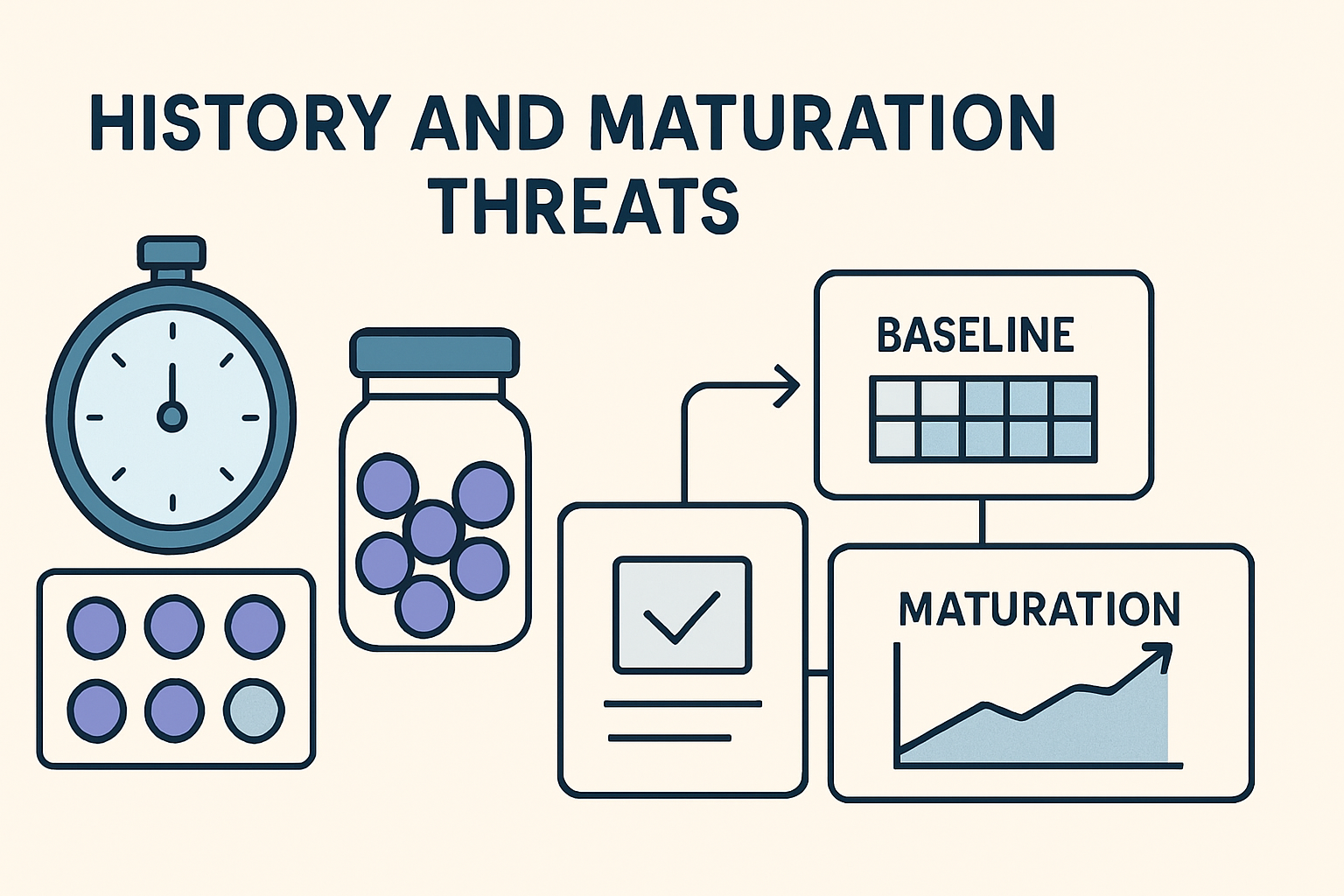
History Threat: When Outside Events Interfere
A history threat occurs when an external, specific event happens between measurements that could explain the observed behavior change. This is not part of your intervention but rather something happening in the environment that coincides with your data collection.
Imagine conducting a study on classroom engagement when a fire drill unexpectedly occurs mid-session. Any changes in student behavior following the drill might be due to that external event rather than your teaching strategy. In ABA terms, history threats are environmental events that occur during the study period and could influence the dependent variable.
Maturation Threat: The Natural Passage of Time
A maturation threat involves changes in the participant due to the passage of time itself. These are internal processes like growing older, getting tired, becoming bored, or experiencing hunger—changes that would happen regardless of your intervention.
For example, if you’re working with a toddler on language skills over six months, their natural developmental progression might account for some improvement, not just your teaching methods. Maturation threats are particularly relevant in studies with young children or over extended time periods where natural growth and development occur.
Seeing the Threats in Action: ABA Examples and Analysis
Let’s translate these definitions into practical understanding using realistic single-subject design scenarios. Each example models the kind of thinking you’ll need for the BCBA exam.
Example 1: The School Assembly (History Threat)
A BCBA implements a differential reinforcement procedure (DRA) for hand-raising versus calling out in a third-grade classroom. Baseline data shows high rates of calling out. During the intervention phase, the school unexpectedly holds a special assembly with a motivational speaker about classroom behavior.
The data show a dramatic decrease in calling out immediately after the assembly. Is this due to the DRA procedure or the assembly? This represents a clear history threat—an external, specific event (the assembly) that could explain the behavior change.
Example 2: Skill Acquisition with a Young Child (Maturation Threat)
A BCBA tracks mand frequency for a 2-year-old child with autism over a six-month intervention using functional communication training. The data show a gradual increase in mands from 2-3 per hour to 10-12 per hour.
The question arises: Is this improvement due to the intervention or natural language development? Since 2-year-olds typically experience rapid language growth, this presents a potential maturation threat. The child’s biological and cognitive development might account for some of the progress.
Example 3: The Confounding Case (When Both Could Apply)
A teenager in an after-school social skills group shows reduced problem behavior over three months. Coincidentally, they started a new medication for anxiety (history threat) and are also getting older and more emotionally regulated (maturation threat).
This complex scenario demonstrates why experimental control is crucial. A well-designed study would need to account for both potential threats through appropriate research design choices and careful data analysis.
Exam Relevance and Common Candidate Traps
Understanding these threats is essential for the BCBA exam’s experimental design section. Questions often present vignettes where you must identify the most likely threat to internal validity or select the research design that best controls for specific threats.
How the BCBA Exam Tests These Concepts
The exam typically assesses your ability to:
- Identify whether a described scenario represents a history or maturation threat
- Select appropriate single-subject designs that control for these threats
- Distinguish between threats to internal validity versus other validity concerns
- Apply these concepts to data interpretation in research scenarios
These questions align with the BACB Task List’s focus on being a critical consumer of research and designing studies with strong experimental control.
The #1 Trap: Confusing History and Maturation
The most common mistake candidates make is mixing up these two threats. Here’s a simple decision rule:
- History threat: Is there a specific, identifiable EVENT that occurred?
- Maturation threat: Is the change due to the general passage of TIME or biological processes?
Practice applying this rule: A child getting tired during a long session (maturation), versus a fire alarm going off during data collection (history).
Beyond Identification: Controlling for the Threats
Different experimental designs offer varying levels of protection against these threats:
- Reversal designs (ABAB) help control for maturation by demonstrating that behavior changes when and only when the intervention is applied
- Multiple baseline designs across settings, behaviors, or participants help control for history threats by staggering intervention implementation
- Changing criterion designs can help rule out maturation when gradual changes are expected
Understanding these design strengths is crucial for both the exam and real-world research planning. For more on experimental designs, see our guide to single-subject experimental designs.

Quick-Reference Checklist for Your Study Notes
Copy this checklist into your study materials for quick review:
- History threat = External EVENT between measurements
- Maturation threat = Internal PROCESS due to time passage
- Ask: “Specific event or general time passage?”
- Remember: Young children = watch for maturation threats
- Long studies = increased risk of both threats
- ABAB designs help control maturation
- Multiple baselines help control history
- Always consider alternative explanations for behavior change
This checklist will help you quickly identify threats in exam scenarios and design stronger studies in practice.
Summary: Mastering Validity for the Exam and Beyond
Mastering the distinction between history and maturation threats is essential for BCBA candidates. These concepts represent more than just exam content—they’re fundamental to designing valid research and interpreting data accurately in practice.
Remember that internal validity concerns whether we can confidently attribute behavior changes to our intervention. History threats introduce external events that could explain changes, while maturation threats involve natural processes that occur with time. The ability to identify and control for these threats makes you both a better researcher and a more effective practitioner.
For further study on related concepts, explore our resources on independent and dependent variables and experimental design. To deepen your understanding of research methodology, consult authoritative sources like the BACB Task List and peer-reviewed journals in behavior analysis.
By mastering these threats to internal validity, you’ll not only perform better on the BCBA exam but also contribute to the scientific foundation of our field through methodologically sound research and practice.


