

In applied behavior analysis, prompts are essential tools for teaching new skills, and among these, gestural prompts offer a unique balance of support and independence. This guide provides a comprehensive look at gestural prompts in ABA, from their precise definition to practical implementation strategies that matter for both clinical practice and BCBA exam preparation.
Table of Contents
- gestural prompt ABA: What is a Gestural Prompt? A Clear Definition for BCBA Candidates
- Gestural Prompts in Action: Worked ABA Examples
- Gestural Prompts on the BCBA Exam: Relevance and Common Traps
- Implementing Gestural Prompts Ethically and Effectively
- Final Summary and Key Takeaways
gestural prompt ABA: What is a Gestural Prompt? A Clear Definition for BCBA Candidates
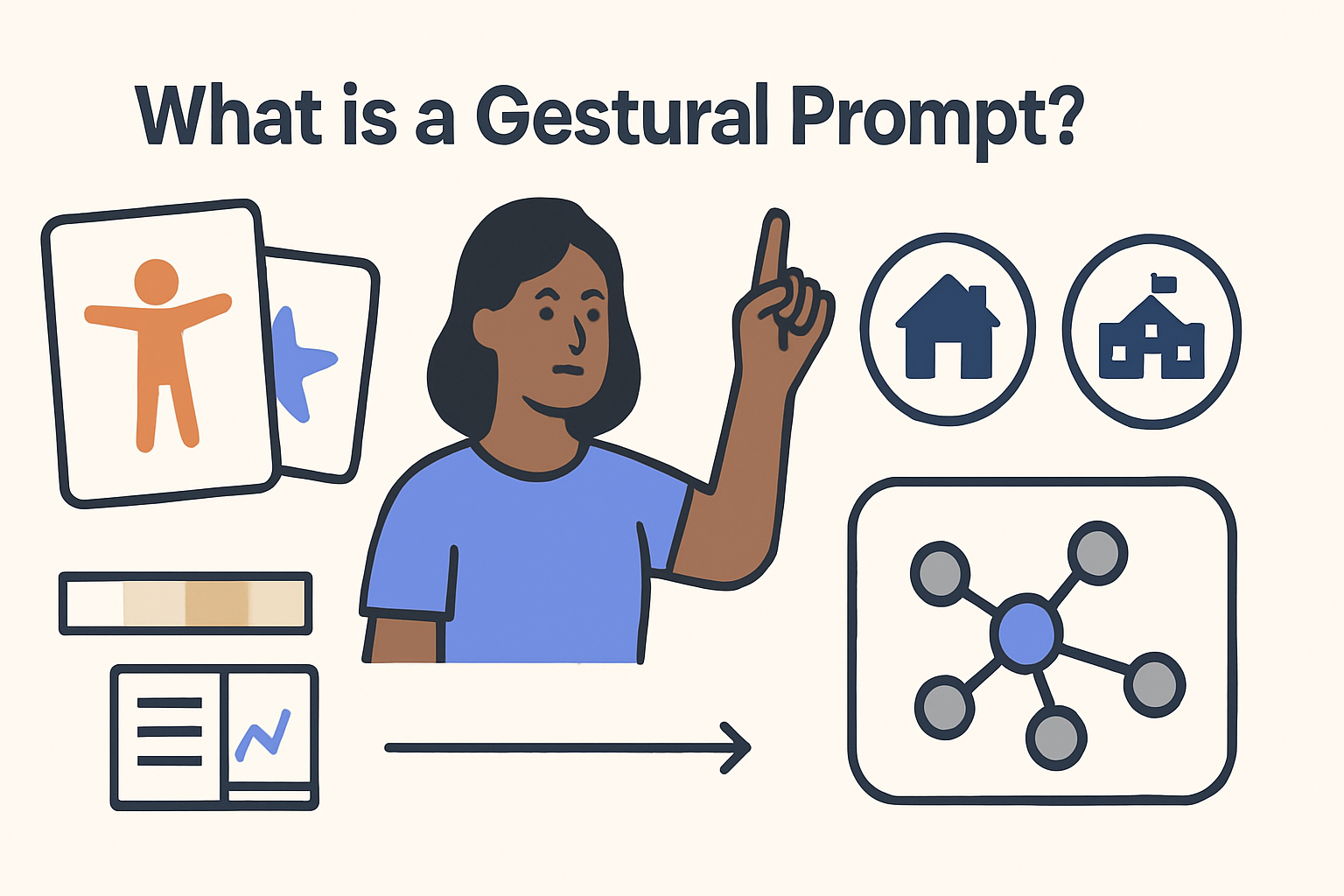
A gestural prompt is a non-verbal, non-physical cue that guides a learner toward the correct response. Unlike more intrusive prompts, it respects the learner’s autonomy while providing necessary support.
These prompts occupy a specific position in the prompt hierarchy, typically being less intrusive than physical guidance but more supportive than independent responding.
Key Characteristics and Distinctions
Gestural prompts are defined by several core features that distinguish them from other prompt types:
- Non-verbal nature: They use visual cues rather than spoken words
- Non-physical contact: No touching or physical guidance is involved
- Response prompt category: They directly prompt the target behavior
- Minimal intrusiveness: Less controlling than physical or full verbal prompts
Common examples include pointing, nodding, glancing toward the correct item, or using hand gestures to indicate direction. These differ fundamentally from model prompts (demonstrating the entire behavior) and physical prompts (hand-over-hand guidance).
Gestural Prompts in Action: Worked ABA Examples
Understanding gestural prompts requires seeing them in practical contexts. These examples demonstrate how they function within ABC data collection frameworks.
Example 1: Teaching a Child to Hang a Backpack
This scenario illustrates gestural prompting for a skill acquisition task with escape-maintained behavior.
- Antecedent: Instruction “Hang up your backpack” presented near coat hook
- Behavior: Client looks at hook but doesn’t initiate movement
- Consequence: Therapist points to hook (gestural prompt), then provides praise + token when client completes task
- Hypothesized function: Escape from task demand due to skill deficit
The gestural prompt here provides minimal support to initiate the behavior chain without removing the learner’s autonomy. This approach aligns with errorless learning principles while respecting client dignity.
Example 2: Prompting an Adult to Select a Break Activity
This example shows gestural prompting in choice-making scenarios with tangible-maintained behavior.
- Antecedent: Choice board presented with 4 activity options
- Behavior: Client scans board silently for 10 seconds without selection
- Consequence: Therapist glances toward preferred puzzle, client selects it, gains access to activity
- Hypothesized function: Tangible access, with discrimination difficulty
The subtle glance serves as a discriminative stimulus that helps the client make a choice while maintaining the naturalness of the interaction. This contrasts with more intrusive verbal prompts like “pick the puzzle.”
Gestural Prompts on the BCBA Exam: Relevance and Common Traps
Gestural prompts frequently appear on the BCBA exam, testing candidates’ understanding of prompt hierarchy and ethical implementation. Recognizing common exam patterns is crucial for success.
Frequent Exam Scenarios and Distractors
Exam questions typically test several key areas related to gestural prompts:
- Least intrusive prompt identification from a list of options
- Prompt fading sequence planning (e.g., moving from physical to gestural)
- Ethical prompt selection based on client characteristics and dignity
- Stimulus control transfer procedures involving gestural prompts
Common distractor answers include confusing gestural prompts with modeling, partial physical guidance, or positional prompts. Remember that gestural prompts specifically involve non-verbal, non-physical cues that guide but don’t demonstrate the entire behavior.
Implementing Gestural Prompts Ethically and Effectively
Successful implementation requires careful planning and attention to ethical considerations. Gestural prompts should always align with the client’s best interests and cultural context.
Quick-Reference Implementation Checklist
Use this checklist when planning gestural prompt implementation:
- Skill assessment: Is the target skill within the client’s repertoire but not under correct stimulus control?
- Prompt fading history: Have more intrusive prompts been successfully faded in previous steps?
- Gesture clarity: Is the specific gesture unambiguous and culturally appropriate for the client?
- Fading plan: Is there a documented plan for fading this prompt to independence or more natural cues?
- Client preference: Does using this prompt align with client dignity and cultural considerations?
- Data collection: Are systems in place to track prompt effectiveness and fading progress?
Effective implementation also requires understanding when gestural prompts are appropriate. They work best when the client has some component skills but needs help with initiation or discrimination. For more on related concepts, see our guide on prompt dependency in ABA.
Final Summary and Key Takeaways
Gestural prompts represent a valuable middle ground in the prompt hierarchy, offering support while respecting learner autonomy. Their effective use requires understanding both technical implementation and ethical considerations.
Key points to remember include:
- Gestural prompts are non-verbal, non-physical cues like pointing or glancing
- They occupy a specific position in the prompt hierarchy, less intrusive than physical prompts
- Implementation requires careful assessment and planning with clear fading procedures
- Ethical use considers client dignity and cultural appropriateness
- BCBA exam questions often test identification and application of gestural prompts
For further study on related behavioral principles, explore our resources on stimulus control and errorless learning procedures. The BACB Ethics Code provides essential guidance on ethical prompt implementation.
Mastering gestural prompts enhances both clinical effectiveness and exam performance, making them a crucial component of any behavior analyst’s skill set.


