

Generative instruction ABA: What is Generative Instruction in ABA?
Generative instruction is a teaching strategy designed to produce a variety of untrained responses after teaching only a limited set of specific skills. This approach connects directly to the BACB Task List item B-11, which addresses using generalization and maintenance procedures.
Table of Contents
- generative instruction ABA: What is Generative Instruction in ABA?
- Generative Instruction in Practice: ABA Examples
- Generative Instruction on the BCBA Exam
- Quick-Reference Checklist for Study and Practice
- Summary and Key Takeaways
Core Definition and Key Features
Unlike rote learning where each response must be taught individually, generative instruction creates response generalization. The learner demonstrates novel behaviors that are functionally similar to taught skills. This concept relates to recombinative generalization and derived relational responding in more advanced applications.
Why It Matters for Effective Programming
Generative instruction offers clinical efficiency by teaching less to get more. When practitioners design programs that promote generative outcomes, they help learners become more independent. Skills become useful across natural environments without requiring direct teaching in every context.
From an ethical perspective, generative instruction supports meaningful outcomes that extend beyond the therapy room. It aligns with the seven dimensions of ABA, particularly generality, by ensuring skills maintain and generalize to relevant situations.
Generative Instruction in Practice: ABA Examples
Understanding generative instruction becomes clearer with concrete examples. These scenarios illustrate how targeted teaching leads to spontaneous, untrained responses.
Example 1: Generative Language with Mand Training
A child learns to mand for ‘cookie’ and ‘juice’ using picture cards during structured sessions. After mastering these two requests, the child spontaneously points to a cracker and says ‘cracker’ during snack time.
The original training involved discriminative stimuli (picture cards) and reinforcement (access to requested items). The novel mand for cracker demonstrates response generalization within the manding function. The hypothesized function remains access to edible reinforcers, but the specific item and response topography are untrained.
Example 2: Generative Play Skills
A learner is taught to assemble three-piece train tracks during discrete trial training. After achieving mastery, the child independently assembles four-piece airplane tracks during free play.
The taught skill involved visual-motor coordination and sequential assembly. The novel application to different materials shows generative performance in play. The function likely involves automatic reinforcement from the play activity itself.
Example 3: Generative Problem-Solving
A client learns to use a visual schedule to transition from play to work activities. Later, when an unexpected fire drill occurs, the client independently grabs a ‘first-then’ board to cope with the routine change.
The original teaching focused on routine transitions using visual supports. The novel use for unexpected changes demonstrates generative application of self-management strategies. The function involves escape or avoidance of distress through learned coping mechanisms.
Generative Instruction on the BCBA Exam
Exam questions about generative instruction test your ability to distinguish it from related concepts. Understanding these distinctions is crucial for selecting correct answers.
Common Exam Traps and How to Avoid Them
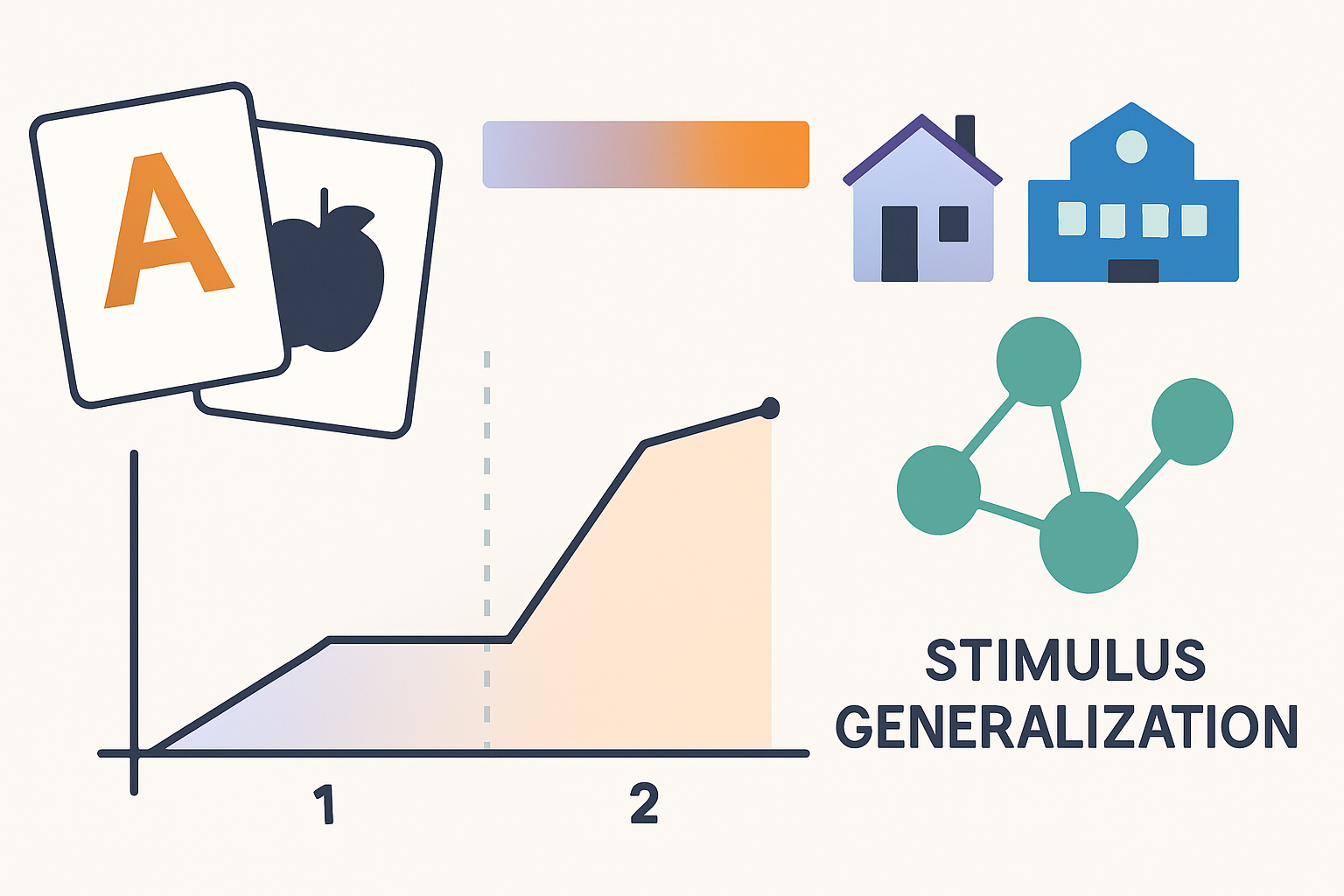
The most frequent mistake involves confusing generative instruction with stimulus generalization. Look for keywords in the vignette: if the question describes performing the same behavior in new settings or with new people, it’s stimulus generalization. If it describes performing novel behaviors that serve the same function, it’s generative instruction.
Other traps include selecting ‘prompting’ or ‘discrete trial training’ when the question clearly describes untrained responses emerging. Always check whether the response was directly taught or emerged spontaneously.
Related Concepts You Must Differentiate
- Generative Instruction: Produces untrained, functionally similar responses
- Stimulus Generalization: Same response occurs with novel stimuli or settings
- Maintenance: Skill persists over time without continued intervention
- Fluency: Skill performed quickly and accurately with minimal errors
- Response Generalization: Similar responses emerge without direct training (often used interchangeably with generative instruction)
Quick-Reference Checklist for Study and Practice
Use this checklist to evaluate your understanding and application of generative instruction principles.
- Identify whether a program aims for rote learning or generative outcomes
- Design teaching procedures that promote response variation and novel applications
- Monitor for untrained responses that serve similar functions as taught skills
- Distinguish generative instruction from stimulus generalization in data analysis
- Incorporate multiple exemplars and varied teaching contexts to support generative outcomes
- Document generative outcomes as evidence of meaningful skill acquisition
- Review the generalization and maintenance guide for related concepts
Summary and Key Takeaways
Generative instruction represents a sophisticated approach to teaching in ABA. By designing programs that produce untrained responses, practitioners achieve greater efficiency and more meaningful outcomes.
The core principle involves teaching a limited set of skills that lead to novel applications without direct instruction. This differs fundamentally from stimulus generalization, which involves the same response occurring in new contexts.
For BCBA exam preparation, focus on identifying keywords like ‘untrained,’ ‘novel,’ and ‘spontaneously’ in question stems. Remember that generative instruction produces functionally similar behaviors rather than the exact same behavior in new settings.
In clinical practice, generative instruction supports the ethical imperative for meaningful change that extends beyond therapy sessions. It helps learners apply skills flexibly in natural environments, promoting greater independence and quality of life.
For further study on related concepts, explore our guide on stimulus and response generalization and review the official BACB Task List for complete coverage of generalization procedures.


