
generalization of skills: What is Generalization in ABA? A Foundational Definition
In applied behavior analysis, generalization refers to the transfer of learned skills to new situations, people, or settings beyond the original teaching context. This critical concept ensures that skills are not just mastered in the therapy room but become functional in real-world environments. Without effective generalization, clients may demonstrate skills only under specific conditions, limiting the social significance of intervention outcomes.
Table of Contents
- generalization of skills: What is Generalization in ABA? A Foundational Definition
- Generalization in Practice: Worked ABA Examples
- Generalization and the BCBA Exam: Relevance and Common Traps
- A BCBA’s Quick Checklist for Promoting Generalization
- Summary and Key Takeaways
Generalization is distinct from maintenance, which refers to the persistence of a behavior over time after teaching has ended. While maintenance focuses on durability, generalization emphasizes breadth of application across different contexts.
Stimulus Generalization vs. Response Generalization
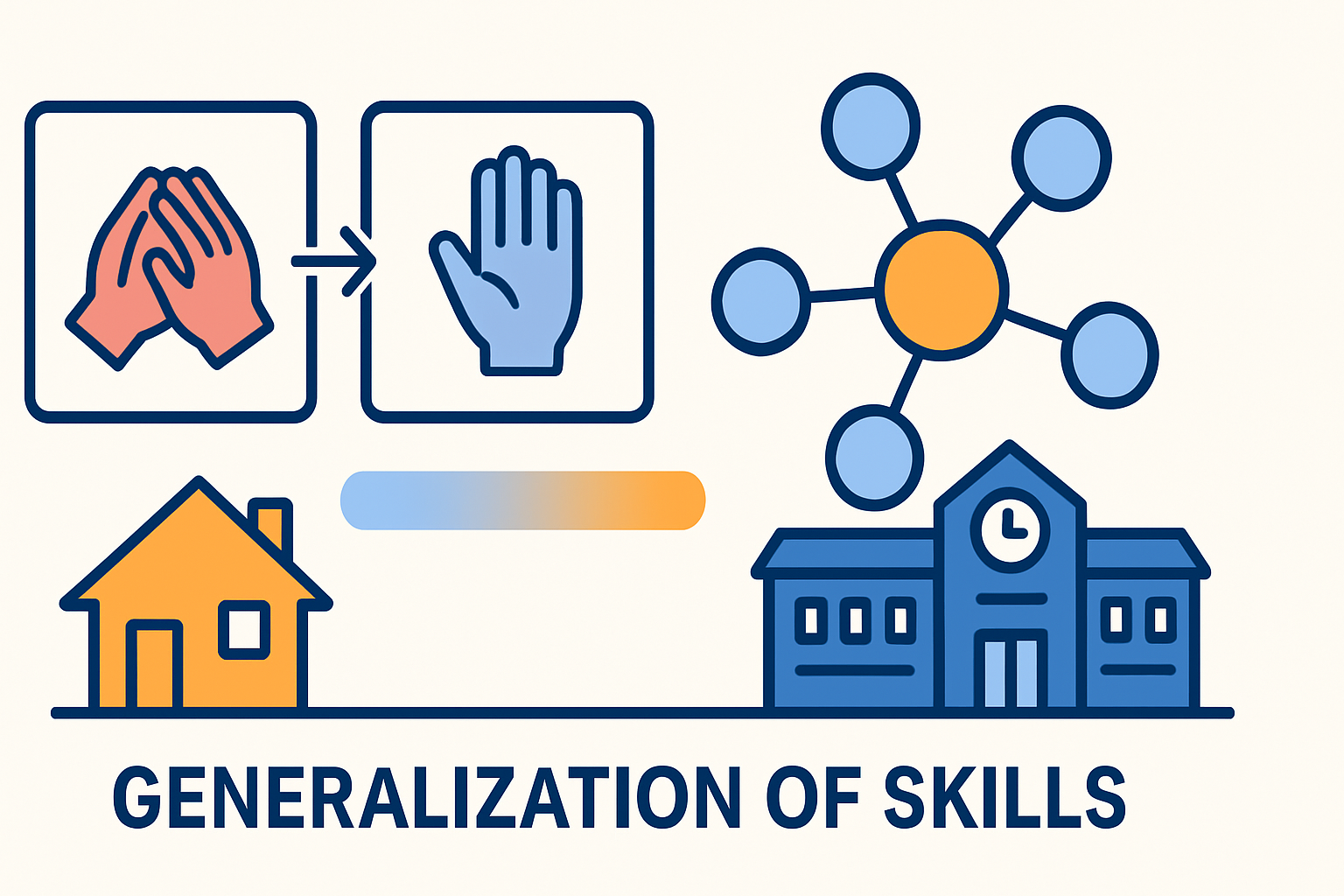
Understanding these two primary types is essential for both practice and exam success. Stimulus generalization occurs when a behavior occurs in the presence of stimuli that are similar to the original discriminative stimulus. For example, if a child learns to say ‘hello’ to their therapist, stimulus generalization would be demonstrated when they greet other adults.
Response generalization involves the emergence of variations of a target behavior that serve the same function. When a client learns to request a break using a card and later uses different but functionally equivalent responses like signing ‘break’ or saying ‘I need space,’ this demonstrates response generalization.
Generalization in Practice: Worked ABA Examples
Let’s examine concrete scenarios that illustrate how generalization occurs in real interventions. Each example follows the ABC framework and considers behavioral function to model clinical thinking.
Example 1: Greeting Skills Across People (Stimulus Generalization)
A client learns to say ‘Hi’ when their therapist enters the room. The initial teaching involves specific antecedent conditions (therapist presence), target behavior (verbal greeting), and consequence (social praise). To program for generalization, the BCBA systematically introduces novel people.
- Initial learning: Antecedent – Therapist says ‘Good morning,’ Behavior – Client says ‘Hi,’ Consequence – Therapist provides enthusiastic praise
- Generalization trial: Antecedent – Receptionist says ‘Hello,’ Behavior – Client says ‘Hi,’ Consequence – Receptionist smiles and responds
- Function: Social reinforcement maintains this greeting behavior across different people
Example 2: Tying Shoes in Different Settings
A client masters shoe-tying at the therapy table with specific materials. The BCBA plans for setting generalization by systematically varying the environment while maintaining the skill.
- Original setting: Therapy room table with practice shoes
- First transfer: Hallway bench with same practice shoes
- Second transfer: Home entryway with personal shoes
- Key strategy: Programming common stimuli (similar shoes initially) then fading to natural materials
Example 3: Requesting a Break (Response Generalization)
A client is taught to use a break card when overwhelmed. Over time, they begin using alternative responses that serve the same escape function.
- Taught response: Handing break card to staff member
- Generalized response 1: Signing ‘break’ with hands
- Generalized response 2: Saying ‘I need a minute’
- Critical element: All responses produce the same consequence (brief break from task)
Generalization and the BCBA Exam: Relevance and Common Traps
Generalization concepts appear throughout the BCBA examination, particularly in sections addressing intervention planning and implementation. Understanding these principles is essential for selecting appropriate strategies and interpreting client progress data.
Key Related Terms You Must Know
Several concepts frequently appear alongside generalization questions. Master these to avoid confusion:
- Maintenance: Persistence of behavior over time after intervention ends
- Stimulus control: Degree to which a behavior occurs in the presence of specific antecedents
- Programming common stimuli: Including elements from natural environment in teaching
- Multiple exemplar training: Teaching with varied examples to promote generalization
- General case analysis: Systematic approach to selecting teaching examples
- Natural maintaining contingencies: Reinforcement that occurs naturally in the environment
Frequent Exam Pitfalls to Avoid
Many candidates struggle with specific aspects of generalization on the exam. Be aware of these common errors:
- Confusing generalization with maintenance: Remember that generalization is about breadth across contexts, while maintenance is about durability over time
- Misidentifying generalization type: Carefully analyze whether a scenario describes stimulus or response generalization
- Overlooking programming strategies: Selecting interventions that promote rote learning rather than generalization
- Ignoring natural contingencies: Failing to consider how skills will be reinforced in everyday settings
For more on related concepts, see our guide on stimulus and response generalization.
A BCBA’s Quick Checklist for Promoting Generalization
Use this practical checklist when planning interventions to ensure skills transfer effectively. These strategies align with evidence-based practices in ABA programming.
- Teach loosely: Vary instructions, materials, and settings during acquisition
- Use multiple exemplars: Include diverse examples that represent the range of real-world situations
- Program common stimuli: Incorporate elements from natural environments into teaching
- Train sufficient exemplars: Continue teaching until generalization occurs across multiple untrained examples
- Mediate generalization: Teach self-management strategies clients can use in new situations
- Train to generalize: Explicitly program generalization trials rather than hoping it occurs naturally
- Use indiscriminable contingencies: Vary reinforcement schedules to mimic natural environments
- Program natural maintaining contingencies: Ensure skills contact reinforcement in everyday settings
For additional programming strategies, explore our article on the seven dimensions of ABA.
Summary and Key Takeaways
Generalization of skills represents a fundamental goal in applied behavior analysis. Effective practitioners systematically plan for skill transfer rather than assuming it will occur naturally. Remember these essential points:
- Generalization involves skill transfer across people, settings, or materials
- Distinguish between stimulus generalization (different antecedents) and response generalization (different behaviors)
- Program generalization explicitly using evidence-based strategies
- Monitor both acquisition and generalization data to evaluate intervention effectiveness
- Consider natural maintaining contingencies when selecting target behaviors
For authoritative information on behavior analysis standards, consult the Behavior Analyst Certification Board resources. Additional research on generalization strategies can be found in peer-reviewed journals like the Journal of Applied Behavior Analysis.


