

A Functional Behavior Assessment (FBA) represents the cornerstone of effective behavior analysis practice. This systematic process moves beyond surface-level descriptions to uncover the underlying functions of challenging behaviors. For BCBA candidates, mastering these functional behavior assessment steps is essential for both exam success and ethical practice.
Table of Contents
- functional behavior assessment steps: What is a Functional Behavior Assessment?
- The 7 Systematic Steps of an FBA
- FBA in Practice: Worked Examples for the BCBA Exam
- Common FBA Pitfalls and Exam Traps
- Your FBA Process Checklist
- Key Takeaways for Your BCBA Studies
functional behavior assessment steps: What is a Functional Behavior Assessment?
An FBA is a comprehensive process that identifies the environmental variables maintaining problem behavior. Unlike simple behavior descriptions, it seeks to answer the critical question: “Why does this behavior occur?” This approach aligns with the BACB’s emphasis on function-based interventions rather than topography-based strategies.
The Core Goal: Identifying Function
The primary objective of any FBA is to determine the behavioral function. Most behaviors serve one of four primary functions, often remembered by the acronym SEAT: Sensory (automatic reinforcement), Escape (negative reinforcement), Attention (positive reinforcement), or Tangible (positive reinforcement). This process directly corresponds to Section F of the BCBA Task List, which covers behavior assessment procedures.
The 7 Systematic Steps of an FBA
Following a structured approach ensures thorough assessment and valid conclusions. These seven steps provide a reliable framework for conducting comprehensive FBAs.
Step 1: Define the Target Behavior
Begin with a clear, operational definition that is observable, measurable, and repeatable. Avoid vague labels like “aggression” in favor of specific descriptions such as “hits others with open palm with force sufficient to leave a red mark.” This precision enables reliable data collection and consistent measurement across observers.
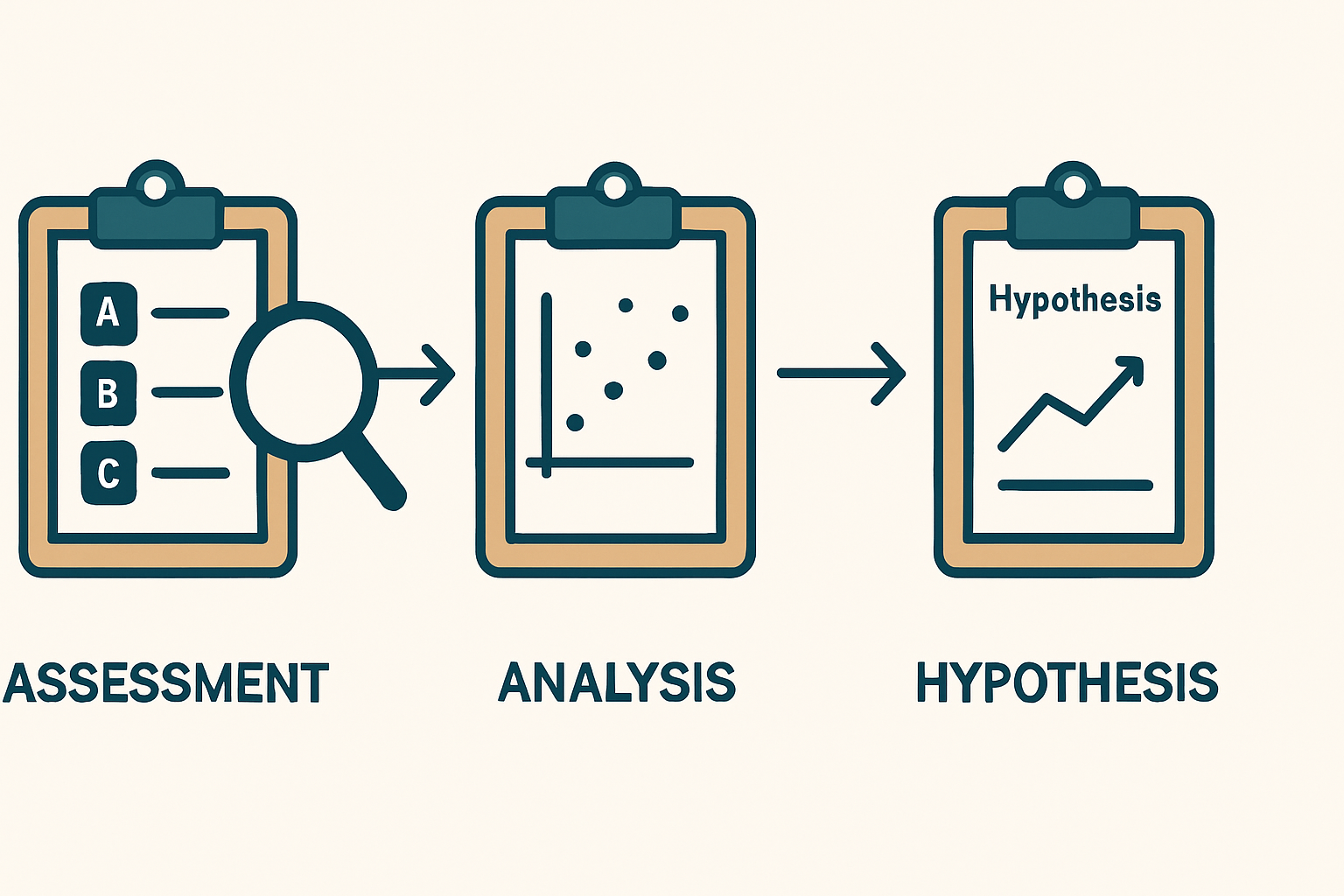
Step 2: Gather Indirect Information
Collect preliminary data through interviews and rating scales. Common tools include the Functional Assessment Interview (FAI), Functional Analysis Screening Tool (FAST), and Motivation Assessment Scale (MAS). These methods help form initial hypotheses about potential behavioral functions but should never stand alone as conclusive evidence.
Step 3: Conduct Direct Descriptive Assessments
Move beyond reports to direct observation using ABC data collection (Antecedent-Behavior-Consequence). Record what happens immediately before and after the target behavior. Scatterplots can identify temporal patterns, while conditional probability analyses help identify correlations between environmental events and behavior.

Step 4: Analyze Data and Form a Hypothesis
Synthesize information from indirect and direct assessments to develop a testable hypothesis statement. A well-formed hypothesis specifies the maintaining variable, such as “The behavior is maintained by escape from difficult academic tasks.” This hypothesis guides subsequent experimental analysis.
Step 5: Test the Hypothesis (Functional Analysis)
The gold standard for confirming behavioral function involves systematically manipulating environmental variables. Standard conditions include alone (automatic reinforcement), attention, demand (escape), tangible, and play (control). While not always feasible in natural settings, functional analysis provides the strongest evidence for behavioral function.
Step 6: Develop a Function-Based Intervention
Design interventions that directly address the identified function. For escape-maintained behaviors, consider functional communication training (teaching appropriate escape requests) or demand fading. For attention-maintained behaviors, implement differential reinforcement of alternative behaviors. Learn more about functional communication training strategies for comprehensive intervention planning.
Step 7: Monitor and Adjust
Implement ongoing data collection to evaluate intervention effectiveness. Use single-subject designs to demonstrate experimental control and make data-based decisions about intervention modifications. This step ensures interventions remain effective over time and across settings.
FBA in Practice: Worked Examples for the BCBA Exam
Applying FBA steps to realistic scenarios solidifies understanding and prepares you for exam questions that require practical application.
Example 1: Escape-Maintained Behavior in a Classroom
Consider a student who engages in task refusal during math worksheets. ABC data shows the behavior consistently occurs when presented with multi-step problems and results in worksheet removal. The hypothesis: “Behavior is maintained by escape from challenging academic demands.” A function-based intervention might include task modification, choice-making opportunities, and teaching a break request system.
Example 2: Attention-Maintained Behavior at Home
A child engages in property destruction when parents are occupied with phone calls. Interval recording data shows higher rates during parental distraction. The hypothesis: “Behavior is maintained by access to parental attention.” Intervention components could include planned ignoring of destructive behavior, differential reinforcement of appropriate attention-seeking, and scheduled quality time intervals.
Common FBA Pitfalls and Exam Traps
Several common mistakes can undermine assessment validity and lead to ineffective interventions. Recognizing these pitfalls is crucial for both practice and exam success.
- Confusing correlation with causation: Just because behavior follows an event doesn’t mean that event maintains the behavior. Experimental manipulation through functional analysis is needed to establish causation.
- Relying solely on indirect assessments: Interviews and rating scales provide hypotheses, not conclusions. Direct observation and experimental analysis are essential for confident function identification.
- Mismatching intervention to function: A classic exam trap involves using time-out (removing attention) for escape-maintained behavior, which may actually reinforce rather than reduce the behavior.
- Insufficient data collection: Making decisions based on limited observation periods can lead to inaccurate conclusions about behavioral patterns and functions.
Your FBA Process Checklist
Use this quick-reference guide to ensure you’ve covered all essential FBA components:
- ✓ Develop clear operational definitions for target behaviors
- ✓ Conduct comprehensive indirect assessments (interviews, rating scales)
- ✓ Collect sufficient ABC data across relevant contexts
- ✓ Analyze patterns to form testable hypotheses
- ✓ Consider functional analysis when feasible and appropriate
- ✓ Design function-based interventions matching identified function
- ✓ Implement ongoing data collection and progress monitoring
- ✓ Adjust interventions based on data-driven decisions
Key Takeaways for Your BCBA Studies
Mastering FBA procedures requires understanding both the sequential steps and their underlying principles. Remember that FBA is not a single method but a comprehensive process that integrates multiple assessment approaches. The ethical imperative to conduct thorough assessments before intervention cannot be overstated—effective treatment depends on accurate function identification.
For further study, explore the BCBA Test Content Outline and consider how FBA aligns with broader assessment competencies. Additionally, understanding the four functions of behavior provides essential context for interpreting assessment data and designing effective interventions.


