
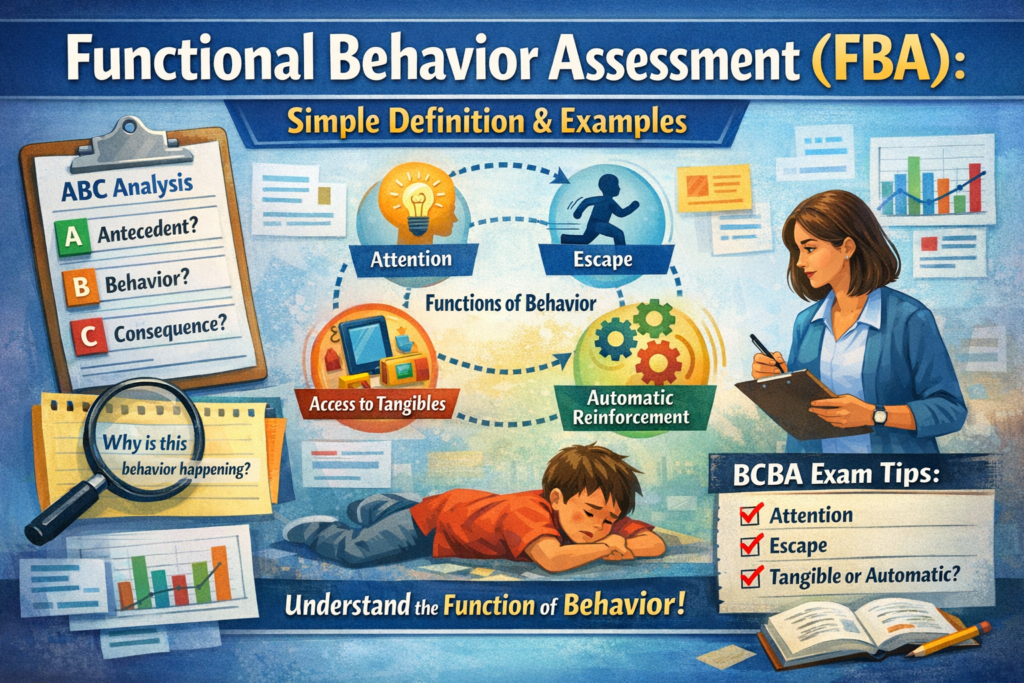
Functional Behavior Assessment (FBA): Simple Definition & Examples
Functional Behavior Assessment (FBA) is a core process in Applied Behavior Analysis (ABA) and a high-frequency topic on the BCBA® exam.
Many BCBA candidates know that FBA is “used to find the function of behavior,” but still miss exam questions because they confuse assessment with intervention, or mix up FBA steps. In ABA, FBA has a specific, structured meaning.
This guide explains Functional Behavior Assessment (FBA) using simple language, real-world examples, and BCBA exam tips. You can use it to study for the exam, design behavior plans, and clearly explain behavior functions to caregivers and staff.
What Is Functional Behavior Assessment (FBA)?
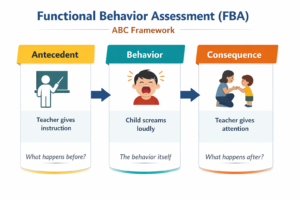
FBA Definition: Key Components Explained
A Functional Behavior Assessment (FBA) is a systematic process used to identify the function of a behavior by analyzing antecedents, behaviors, and consequences.
In simple terms, FBA answers the question:
Why is this behavior happening?
If the assessment does not lead to identifying a likely function, then it is not a complete FBA.
Breaking Down the Definition
For BCBA exam questions, every part of the definition matters.
Function of behavior
The outcome that maintains the behavior (e.g., attention, escape, access to tangibles, automatic reinforcement).
Systematic process
FBA is not guessing. It involves structured data collection and analysis.
Antecedents, behaviors, and consequences
Often referred to as the ABC framework, which helps identify patterns in behavior.
📌 Exam reminder:
An FBA identifies why behavior occurs. It does not directly change behavior.
Functional Behavior Assessment (FBA) Definition: Key Components
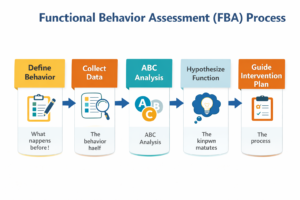
In ABA practice, an FBA generally follows this sequence:
-
Define the target behavior clearly
-
Collect indirect data (interviews, rating scales)
-
Collect direct observation data (ABC data)
-
Analyze patterns to identify the function
-
Use the results to guide intervention
ABA focuses on predicting and understanding behavior, not labeling it as “good” or “bad.”
Common Functions Identified in Functional Behavior Assessment (FBA)
Most FBA exam questions involve one or more of these functions:
-
Social attention
-
Escape or avoidance
-
Access to tangibles or activities
-
Automatic (sensory) reinforcement
📌 BCBA exam tip:
Always ask, “What happens right after the behavior that could be reinforcing it?”
Everyday Examples of Functional Behavior Assessment
1. Attention-maintained behavior
Behavior:
Child screams during group instruction.
Observation:
Teacher looks at the child and talks to them each time the screaming occurs.
Likely function:
Attention.
The behavior continues because it reliably produces adult attention.
2. Escape-maintained behavior
Behavior:
Student tears worksheets during math tasks.
Observation:
The task is removed after the behavior occurs.
Likely function:
Escape from demands.
Removing the task increases the likelihood the behavior will happen again in similar situations.
3. Access to tangibles
Behavior:
Child grabs toys from peers.
Observation:
Child gains access to the toy immediately after grabbing.
Likely function:
Access to tangibles.
4. BCBA-style exam example
A learner frequently drops to the floor when presented with writing tasks. Data show that staff remove the task and allow a break after the behavior.
Target behavior:
Dropping to the floor during writing tasks.
Consequence:
Task removal and break.
Likely function:
Escape.
→ This conclusion is based on observable patterns, not assumptions about motivation.
Types of FBA: Indirect, Direct, and Functional Analysis
In practice, FBAs can vary in intensity.
Indirect assessment
-
Interviews
-
Questionnaires
-
Rating scales
Useful for gathering background information, but not sufficient alone.
Direct observation
-
ABC data
-
Scatterplots
-
Frequency or duration measures
These methods provide objective evidence of behavior patterns.
Functional analysis (FA)
A systematic manipulation of antecedents and consequences to confirm function.
📌 Exam note:
A functional analysis is one type of FBA, but not all FBAs include a functional analysis.
How to Use FBA Results for Behavior Intervention Planning
A well-conducted FBA guides intervention decisions.
-
Interventions should match the identified function
-
Reinforce appropriate alternative behaviors
-
Reduce reinforcement for problem behavior
If the intervention does not address the function, behavior change is unlikely to last.
How Functional Behavior Assessment (FBA) Appears on the BCBA Exam
Look for these patterns in exam questions:
-
The stem describes repeated ABC patterns
-
The question asks for the most likely function
-
Answer choices include attention, escape, tangible, or automatic
-
Trick answers focus on topography instead of function
When in doubt, ask:
“What consequence is consistently maintaining this behavior?”
Quick Study Checklist for Functional Behavior Assessment (FBA):
Before the exam, make sure you can:
-
Define Functional Behavior Assessment using task-list language
-
Identify common behavior functions
-
Distinguish FBA from intervention
-
Interpret simple ABC data patterns
-
Select interventions that match function
Final Thoughts
Functional Behavior Assessment (FBA) is the foundation of effective behavior intervention in ABA.
By identifying why a behavior occurs, BCBAs can design interventions that are ethical, effective, and durable. Without an FBA, treatment decisions are often guesswork.
Once you understand how FBA works, you can analyze behavior more clearly, explain your reasoning to others, and answer BCBA® exam questions with greater confidence.


