
What Are Functional Analysis Conditions?
A functional analysis is an experimental procedure used to identify the specific environmental variables maintaining problem behavior. The functional analysis conditions represent systematically manipulated test situations designed to isolate potential reinforcement contingencies. This method provides the most definitive evidence about behavioral function, making it a cornerstone of evidence-based practice in applied behavior analysis.
Table of Contents
- What Are Functional Analysis Conditions?
- Breaking Down the Four Functional Analysis Conditions
- Functional Analysis in Practice: Worked Examples
- FA Conditions on the BCBA Exam: What to Know
- Quick-Study Checklist for Functional Analysis
- Summary and Next Steps for Mastery
- References
Unlike descriptive assessments that merely observe behavior in natural settings, functional analysis actively tests hypotheses through controlled manipulation. This approach allows practitioners to establish clear functional relationships between environmental variables and behavior, which is essential for developing effective interventions.
The Purpose of Experimental Analysis
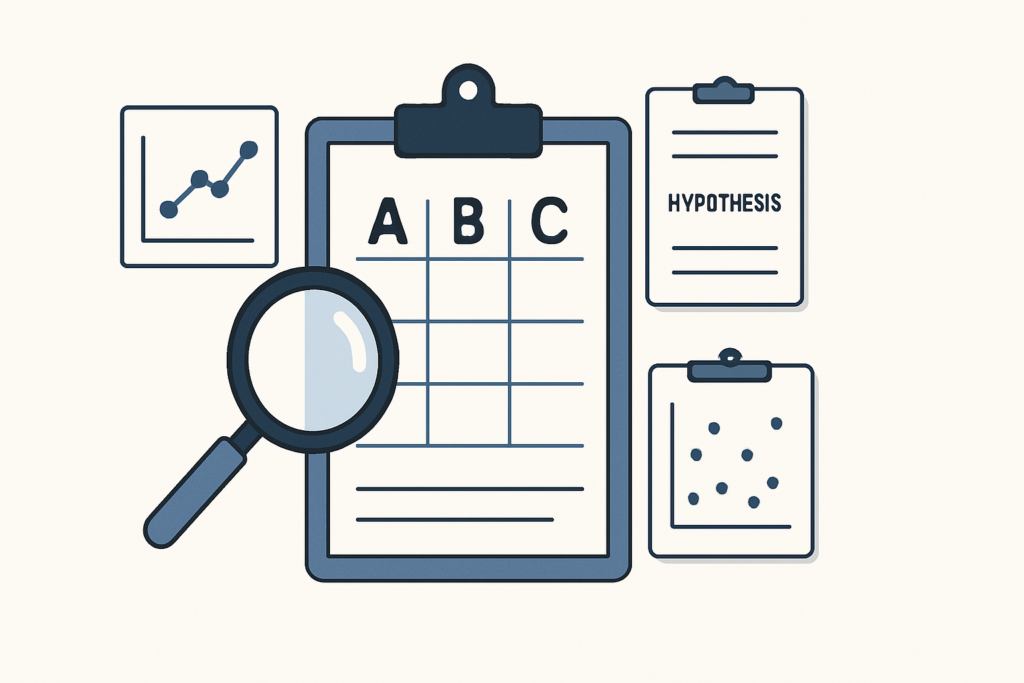
Functional analysis conditions serve as hypothesis-testing tools that systematically evaluate whether specific consequences maintain problem behavior. Each condition presents a different potential reinforcement contingency to determine which one produces the highest rates of target behavior. This experimental approach contrasts with descriptive assessments like ABC recording, which can identify correlations but cannot establish causation.
Overview of the Four Key Conditions
The standard functional analysis includes four primary conditions, though some protocols may include additional variations:
- Alone/Ignore Condition: Tests for automatic reinforcement
- Attention Condition: Tests for social positive reinforcement
- Demand/Escape Condition: Tests for social negative reinforcement
- Play/Control Condition: Serves as a comparison baseline
Some protocols include a tangible condition as a fifth test when access to preferred items is suspected as a maintaining variable.

Breaking Down the Four Functional Analysis Conditions
Each functional analysis condition has a specific setup and purpose. Understanding these details is crucial for both clinical practice and exam success.
Alone (or Ignore) Condition
The alone condition involves placing the individual in a room with no social interaction and no access to toys or activities. The therapist remains present but provides no attention or interaction. This condition tests for automatic reinforcement – behavior maintained by sensory consequences rather than social consequences.
If problem behavior occurs at high rates in this condition but low rates in other conditions, it suggests the behavior is self-stimulatory or maintained by internal sensory consequences. This condition is particularly important for behaviors like hand-flapping, body rocking, or other stereotypies.
Attention Condition
In the attention condition, the therapist provides attention contingent on problem behavior. This might include statements like “Don’t do that” or “That’s not safe.” The condition tests for social positive reinforcement in the form of attention.
High rates of behavior in this condition indicate that attention functions as a reinforcing consequence. This is common for behaviors like aggression, property destruction, or inappropriate vocalizations when they reliably produce attention from caregivers.
Demand (or Escape) Condition
The demand condition involves presenting instructional demands, with problem behavior resulting in a brief break from demands. This tests for social negative reinforcement through escape or avoidance of aversive stimuli.
When behavior occurs primarily during this condition, it suggests the individual is using problem behavior to escape demands or difficult tasks. This function is common in academic or work settings where challenging tasks are presented.
Play (or Control) Condition
The play condition serves as a control or comparison condition. The individual has free access to preferred toys and continuous attention from the therapist, with no demands presented. This creates a low-demand environment where problem behavior is least likely to occur.
This condition provides a baseline comparison against which to evaluate behavior in test conditions. Low rates across all conditions, including play, might indicate the behavior is not maintained by social consequences. For more on assessment approaches, see our guide on assessment in ABA.
Functional Analysis in Practice: Worked Examples
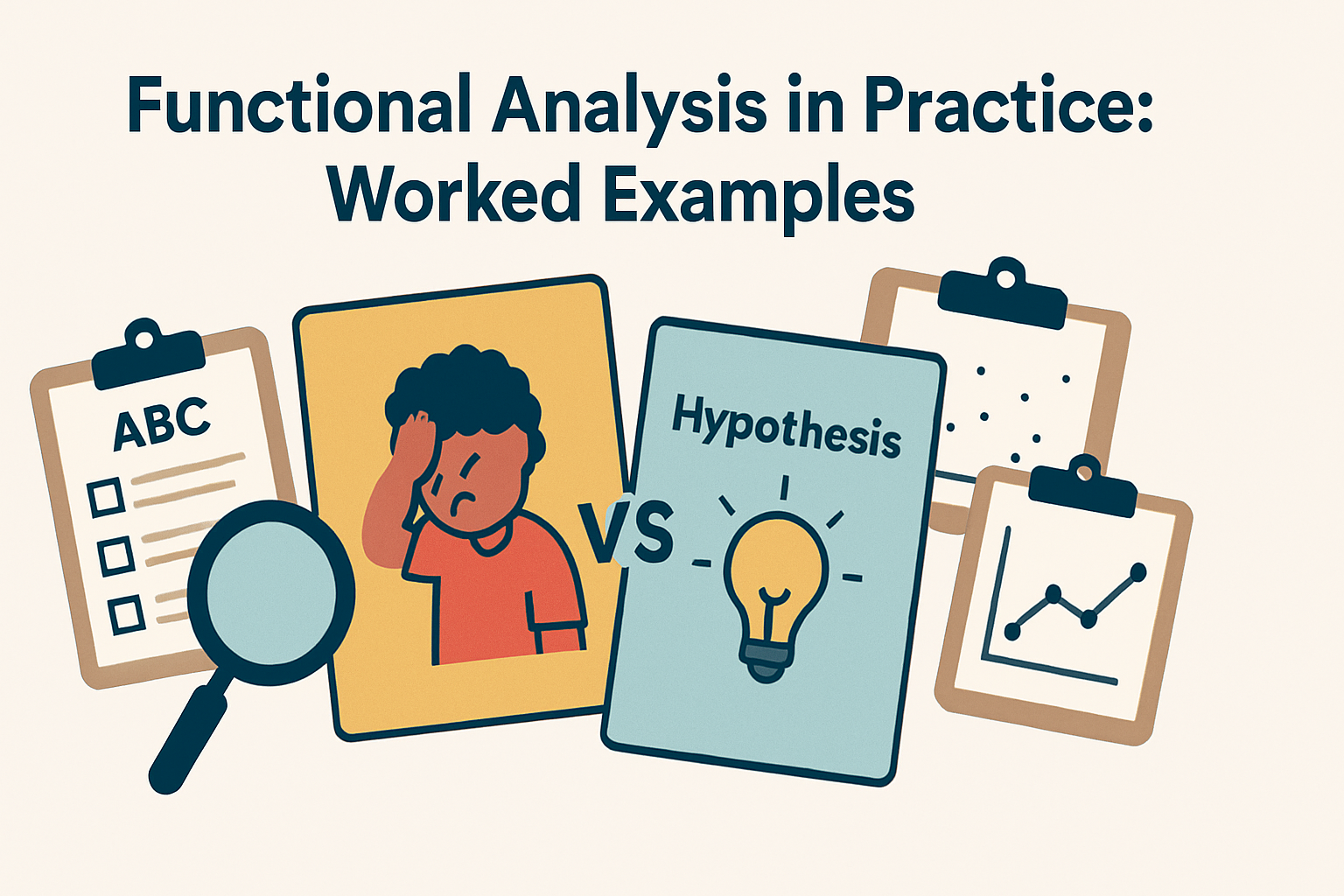
Applying functional analysis conditions to real scenarios helps build the critical thinking skills needed for both clinical work and exam questions.
Example 1: Identifying an Escape Function
Consider a child who engages in head-slapping during academic tasks. In a functional analysis:
- Alone condition: Low rates of head-slapping
- Attention condition: Moderate rates when attention is given
- Demand condition: High rates during task presentation, with behavior resulting in task removal
- Play condition: Very low rates throughout
This pattern clearly indicates an escape function. The behavior is maintained by negative reinforcement – removing academic demands. This understanding directly informs intervention planning, such as implementing functional communication training to teach appropriate escape requests.
Example 2: Differentiating Attention from Automatic Reinforcement
An adult in a group home engages in hand mouthing. The functional analysis shows:
- Alone condition: Consistently high rates of hand mouthing
- Attention condition: Similar high rates when attention is provided
- Demand condition: Moderate rates during tasks
- Play condition: High rates even with free access to toys and attention
This pattern suggests automatic reinforcement as the primary function, with possible secondary social functions. The behavior occurs across all conditions but is highest when alone, indicating it’s maintained by sensory consequences. This distinction is crucial for selecting appropriate interventions.
FA Conditions on the BCBA Exam: What to Know
Functional analysis questions appear frequently on the BCBA exam. Understanding how these questions are structured can significantly improve your performance.
Common Exam Question Formats
Exam questions typically test your ability to:
- Interpret FA graphs showing data across conditions
- Select the correct condition based on a scenario description
- Identify behavioral function from data patterns
- Match conditions to their purposes and setups
- Differentiate FA from descriptive assessment methods
These questions require both memorization of condition characteristics and analytical skills for data interpretation.
Frequent Pitfalls and Misconceptions
Several common mistakes can trip up exam candidates:
- Confusing Alone with Ignore: Some protocols use slightly different procedures
- Mistaking Play for a test condition: Remember it’s a control/comparison
- Forgetting multiple functions: Behavior can be maintained by multiple contingencies
- Overlooking automatic reinforcement: This function requires different intervention approaches
- Misinterpreting low rates: Low behavior doesn’t always mean no function
Understanding these common traps can help you avoid them on exam day. For more on experimental methods, see our guide to single-subject experimental designs.
Quick-Study Checklist for Functional Analysis
Use this checklist to review key concepts before your exam:
- Memorize the four conditions: Alone, Attention, Demand, Play
- Know what each tests: Automatic, social positive, social negative reinforcement
- Recognize data patterns: High rates in a condition indicate that function
- Understand control conditions: Play serves as comparison baseline
- Identify common mistakes: Review frequent exam traps
- Practice graph interpretation: Work with sample FA data
- Differentiate FA from FBA: Know when each is appropriate
- Review ethical considerations: Safety and dignity in FA implementation
This checklist covers the essential knowledge needed for both clinical application and exam success.
Summary and Next Steps for Mastery
Mastering functional analysis conditions is essential for both effective clinical practice and BCBA exam success. These experimental procedures provide the most definitive evidence about behavioral function, allowing for precisely targeted interventions.
To build your skills, practice interpreting functional analysis graphs and work through scenario-based questions. The BACB’s resources on functional analysis provide additional guidance on implementation standards. Remember that while functional analysis provides powerful data, it must always be conducted with consideration for client safety and ethical standards.
Continue your preparation by reviewing related concepts like the four functions of behavior and practicing with mock exam questions that test your analytical skills. With thorough understanding and practice, you’ll be well-prepared to apply functional analysis principles in both clinical settings and on your certification exam.


