

Defining the Full Physical Prompt in ABA
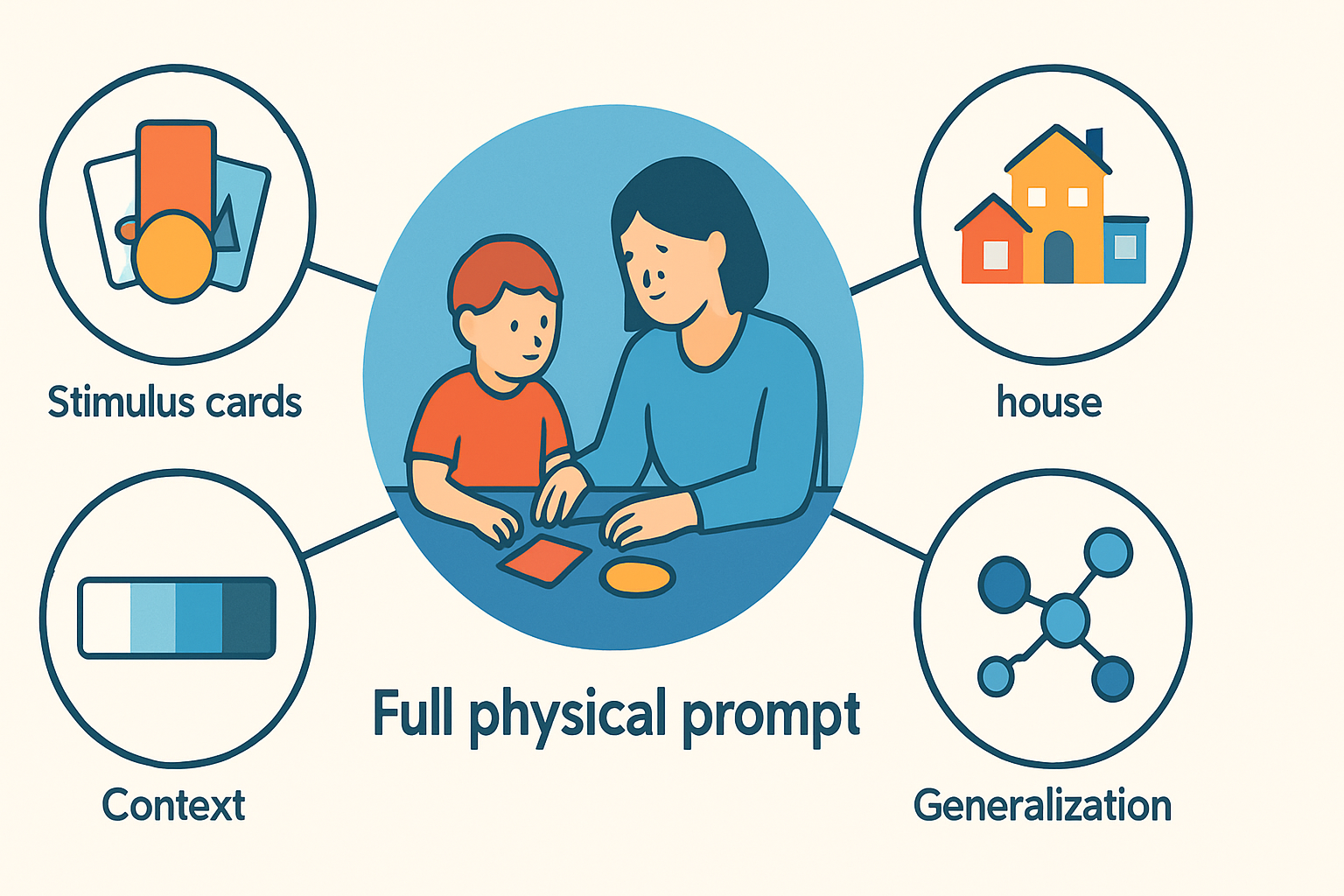
A full physical prompt represents the most intrusive level of assistance within the prompting hierarchy used in Applied Behavior Analysis. This type of response prompt involves complete physical guidance where the practitioner physically moves the learner’s body through the entire target behavior sequence.
Table of Contents
- Defining the Full Physical Prompt in ABA
- Applied Examples and Functional Analysis
- Exam Relevance, Ethical Considerations, and Common Traps
- Summary and Key Takeaways for BCBA Candidates
- References
Understanding this prompt type is essential for effective skill acquisition while maintaining ethical standards.
Core Definition and Key Characteristics
The defining characteristic of a full physical prompt is that it provides complete physical assistance throughout the entire behavioral chain. Unlike partial physical prompts that offer limited guidance, or model prompts that demonstrate the behavior, this approach involves hand-over-hand or full-body guidance.
Key distinctions include:
- Complete physical guidance throughout the entire response
- Positioned as the most intrusive prompt in least-to-most prompting hierarchies
- Often used for initial skill acquisition or safety-critical behaviors
- Requires immediate prompt fading to prevent dependency
Place in the Prompting Hierarchy and Fading
Within prompting strategies, full physical prompts occupy the highest level of intrusiveness. In least-to-most prompting, practitioners begin with less intrusive prompts and escalate only when necessary. Conversely, most-to-least prompting starts with full physical guidance and systematically reduces support.
The critical component following any physical prompt is prompt fading – the systematic reduction of assistance to promote independent responding. Without proper fading, learners may develop prompt dependency, where they wait for physical guidance rather than attempting the behavior independently.
Applied Examples and Functional Analysis
Examining concrete scenarios through an ABC framework (Antecedent-Behavior-Consequence) clarifies how full physical prompts function in practice. These examples demonstrate both the procedural application and potential behavioral functions.
Example 1: Teaching a Handwashing Chain
Consider teaching handwashing to a young learner with limited fine motor skills. The antecedent is the verbal instruction ‘Wash your hands’ paired with access to the sink. When the learner doesn’t initiate the behavior, the practitioner implements a full physical prompt.
The practitioner guides the learner’s hands through each step: turning on water, applying soap, scrubbing palms and fingers, rinsing thoroughly, and drying hands. The consequence is successful completion of the task, potentially avoiding escape from task demands through compliance.
This example highlights how full physical prompts can establish behavioral chains while considering the learner’s current skill level.
Example 2: Prompting a Fine Motor Skill
In a shape-sorting activity, the antecedent includes presenting the shape sorter and saying ‘Put the circle in.’ When the learner reaches incorrectly or doesn’t attempt placement, the practitioner provides hand-over-hand guidance.
The practitioner physically guides the learner’s hand to pick up the circle shape, align it with the correct opening, and push it through. The consequence is access to the tangible reinforcement of seeing the shape drop through, with the hypothesized function being access to preferred items or play activities.
This scenario demonstrates how full physical prompts can facilitate skill acquisition in fine motor tasks while maintaining engagement through reinforcement.
Exam Relevance, Ethical Considerations, and Common Traps
Understanding full physical prompts extends beyond clinical application to BCBA exam preparation and ethical practice. This knowledge area connects directly to the BACB Task List and requires careful consideration of client dignity and autonomy.
Linking to the Task List and Common Question Formats
Full physical prompts fall under Task List Section G-13: Use prompt and prompt fading procedures. Exam questions frequently test this content through several formats:
- Identifying prompt types within a hierarchy
- Selecting appropriate fading techniques
- Determining when to use most-to-least versus least-to-most prompting
- Recognizing ethical considerations in physical guidance
For comprehensive exam preparation, consider reviewing related concepts like prompt dependency and errorless learning procedures.
Prioritizing Dignity and Autonomy in Physical Guidance
Ethical implementation of full physical prompts requires careful consideration of several factors. First, practitioners must determine if this level of intrusiveness is necessary for skill acquisition or safety. Less intrusive alternatives should always be considered first.
Informed consent is crucial, particularly when working with clients who may have trauma histories or sensory sensitivities. Practitioners should monitor client comfort throughout physical guidance and be responsive to any signs of distress or discomfort.
Cultural considerations also play a significant role, as physical touch norms vary across communities. Pairing physical prompts with positive reinforcement helps maintain the therapeutic relationship while promoting skill development.
Quick-Reference Checklist for Implementation
Before implementing a full physical prompt, practitioners should complete this brief checklist:
- Assess necessity: Is this the least intrusive effective option?
- Obtain consent: Have stakeholders provided informed agreement?
- Plan fading: Is there a systematic prompt fading strategy?
- Pair with reinforcement: Will successful responses be reinforced?
- Monitor comfort: Are you observing and responding to client reactions?
- Document rationale: Is the decision and procedure properly recorded?

Summary and Key Takeaways for BCBA Candidates
Full physical prompts represent a powerful but intrusive tool in the ABA practitioner’s toolkit. When used appropriately and ethically, they can facilitate skill acquisition for behaviors that might otherwise remain unlearned.
The most critical consideration is that full physical prompts should always be part of a larger plan that includes systematic prompt fading to promote independence. Without this component, the procedure risks creating dependency rather than building skills.
Ethical implementation requires balancing effectiveness with respect for client autonomy and dignity. Practitioners must consider cultural factors, obtain proper consent, and remain responsive to client comfort throughout the process.
For exam preparation, focus on identifying prompt types within hierarchies, selecting appropriate fading techniques, and recognizing ethical considerations in physical guidance procedures. Remember that the BACB Ethics Code provides essential guidance for all prompting procedures, emphasizing client dignity and the least restrictive effective interventions.
Additional resources on ethical practice can be found in the ethics guide for ABA practitioners, which covers essential considerations for all behavioral procedures.


