
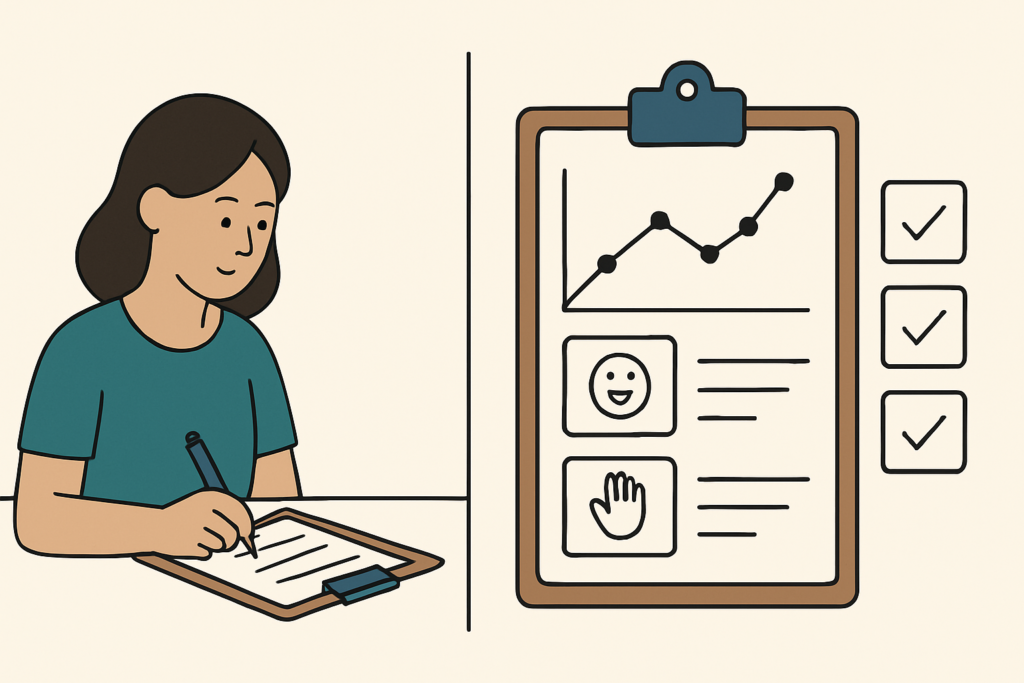
frequency recording ABA: What is Frequency Recording in Applied Behavior Analysis?
Frequency recording is a direct measurement procedure that involves counting the number of times a behavior occurs during an observation period. This fundamental technique provides a simple count of behavior occurrences without considering time dimensions unless specifically calculated as rate.
Table of Contents
- frequency recording ABA: What is Frequency Recording in Applied Behavior Analysis?
- Applying Frequency Recording: Worked Examples from Practice
- Frequency Recording on the BCBA Exam: What to Watch For
- Quick-Reference Implementation Checklist
- Summary and Key Takeaways
The basic formula is straightforward: Frequency = Number of occurrences. When you need to convert this to rate, you divide the frequency by the observation time (Rate = Frequency/Time).
The Core Definition and Formula
In applied behavior analysis, frequency recording serves as one of the most basic yet essential measurement tools. It’s sometimes called event recording because it tracks discrete behavioral events. The key distinction from rate recording is that frequency alone doesn’t account for time unless explicitly calculated.
For example, if a student raises their hand 15 times during a 30-minute class, the frequency is 15. The rate would be 0.5 responses per minute (15/30).
When to Choose Frequency Over Other Measures
Frequency recording works best for behaviors that have a clear beginning and end and occur at a moderate, countable rate. Consider these guidelines:
- Discrete behaviors with obvious onset and offset points
- Behaviors that don’t occur too rapidly to count accurately
- When you need a simple count rather than duration or latency data
- For skill acquisition tracking where each occurrence represents a learning opportunity
It’s less suitable for continuous behaviors or those with very high rates where interval recording or duration measurement would be more appropriate.
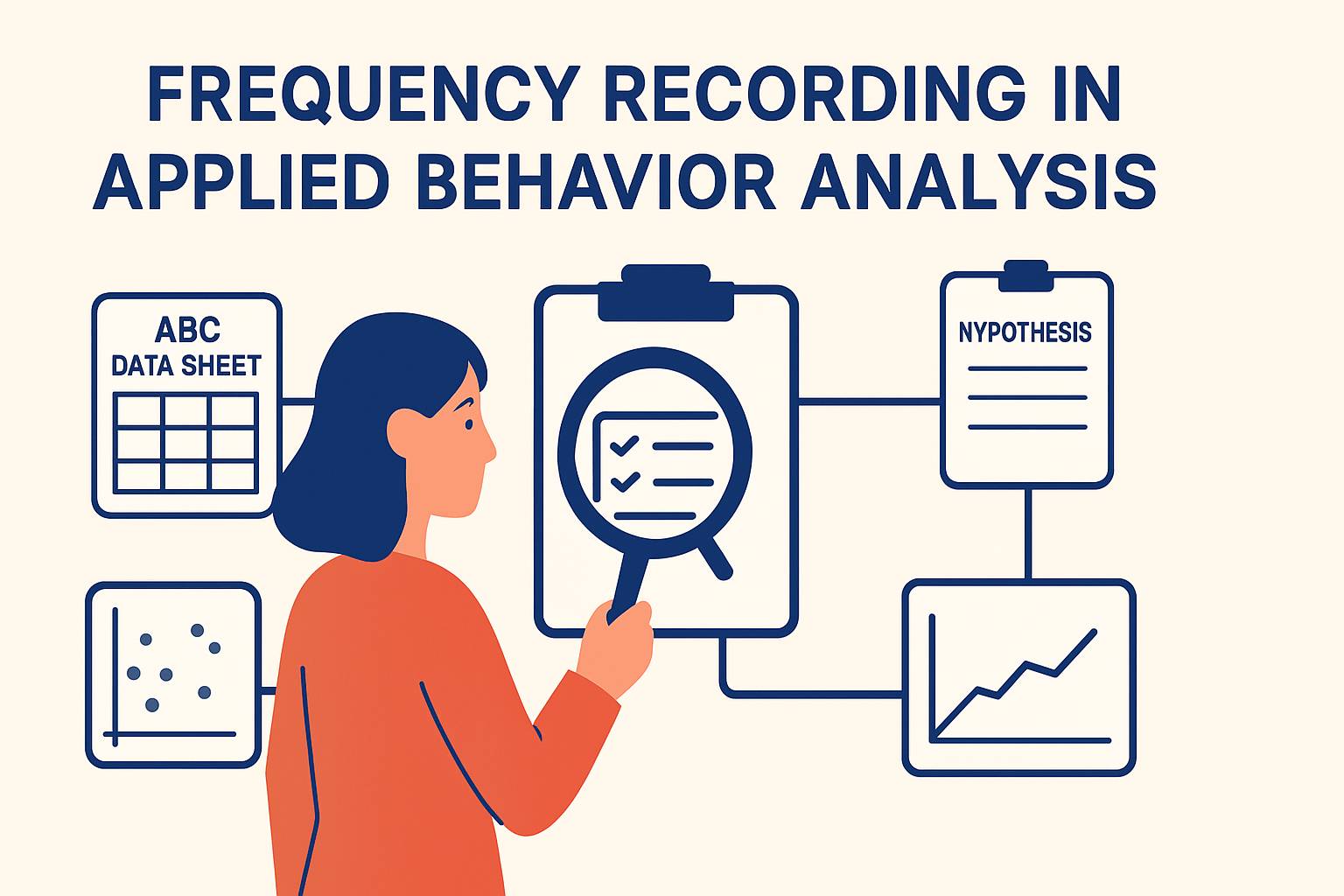
Applying Frequency Recording: Worked Examples from Practice
Let’s examine three realistic scenarios where frequency recording provides valuable data for assessment and intervention planning.
Example 1: Hand Raising in a Classroom Setting
Scenario: During a 45-minute math lesson, a teacher wants to increase appropriate participation. The target behavior is defined as: ‘Student raises hand with elbow bent at 90 degrees, waits quietly until called on.’
- Antecedent: Teacher asks a question to the class
- Behavior: Student raises hand appropriately
- Consequence: Teacher calls on student, provides praise
Data collection shows 8 occurrences during the session. The function appears to be attention/access to answering opportunities. This frequency data helps track intervention effectiveness for increasing appropriate classroom participation.
Example 2: Vocal Stereotypy During Independent Work
Scenario: A client engages in non-contextual vocalizations during independent work time. The operational definition specifies: ‘Any vocal sound not related to the task, lasting 2 seconds or longer, excluding coughs or sneezes.’
- Antecedent: Presented with math worksheet
- Behavior: Non-contextual vocalizations (humming, repeating phrases)
- Consequence: Ignored by staff (extinction procedure)
Frequency recording reveals 12 occurrences during a 20-minute session. The data suggests an automatic reinforcement function, and tracking frequency helps evaluate the effectiveness of the extinction procedure over time.
Example 3: Manding for a Break
Scenario: A client learning functional communication mands for breaks during difficult tasks. The behavior is defined as: ‘Client says ‘break please’ or exchanges break card without aggression.’
- Antecedent: Difficult academic task presented
- Behavior: Client says ‘break please’ appropriately
- Consequence: Brief 2-minute break provided immediately
Frequency data shows the client manded for breaks 5 times during a 60-minute session. This measurement tracks skill acquisition progress and ensures the communication response is strengthening appropriately. For more on communication training, see our guide to functional communication training.
Frequency Recording on the BCBA Exam: What to Watch For
The BCBA exam frequently tests your understanding of when and how to use different measurement procedures. Here’s what you need to know about frequency recording specifically.
Common Exam Traps and Terminology Mix-Ups
Several pitfalls regularly appear on the exam:
- Confusing frequency with rate (rate includes time, frequency does not)
- Selecting frequency recording for behaviors without clear onset/offset
- Applying it to continuous or extremely high-rate behaviors
- Mistaking ‘event recording’ as a different procedure (it’s synonymous)
- Forgetting that tally marking is just a method of frequency recording
Remember that frequency recording is ideal for discrete, countable behaviors at moderate rates. For continuous behaviors, consider duration recording or interval methods instead.
Alignment with the BCBA Task List
Frequency recording aligns with several key Task List items:
- C-1: Establish operational definitions of behavior
- C-2: Identify measurement procedures to obtain representative data
- C-3: Select a measurement system to obtain representative data
- C-8: Evaluate the validity and reliability of measurement procedures
Understanding when to choose frequency recording demonstrates your mastery of measurement systems and data collection methodology. For comprehensive exam preparation, explore our BCBA exam prep guide.
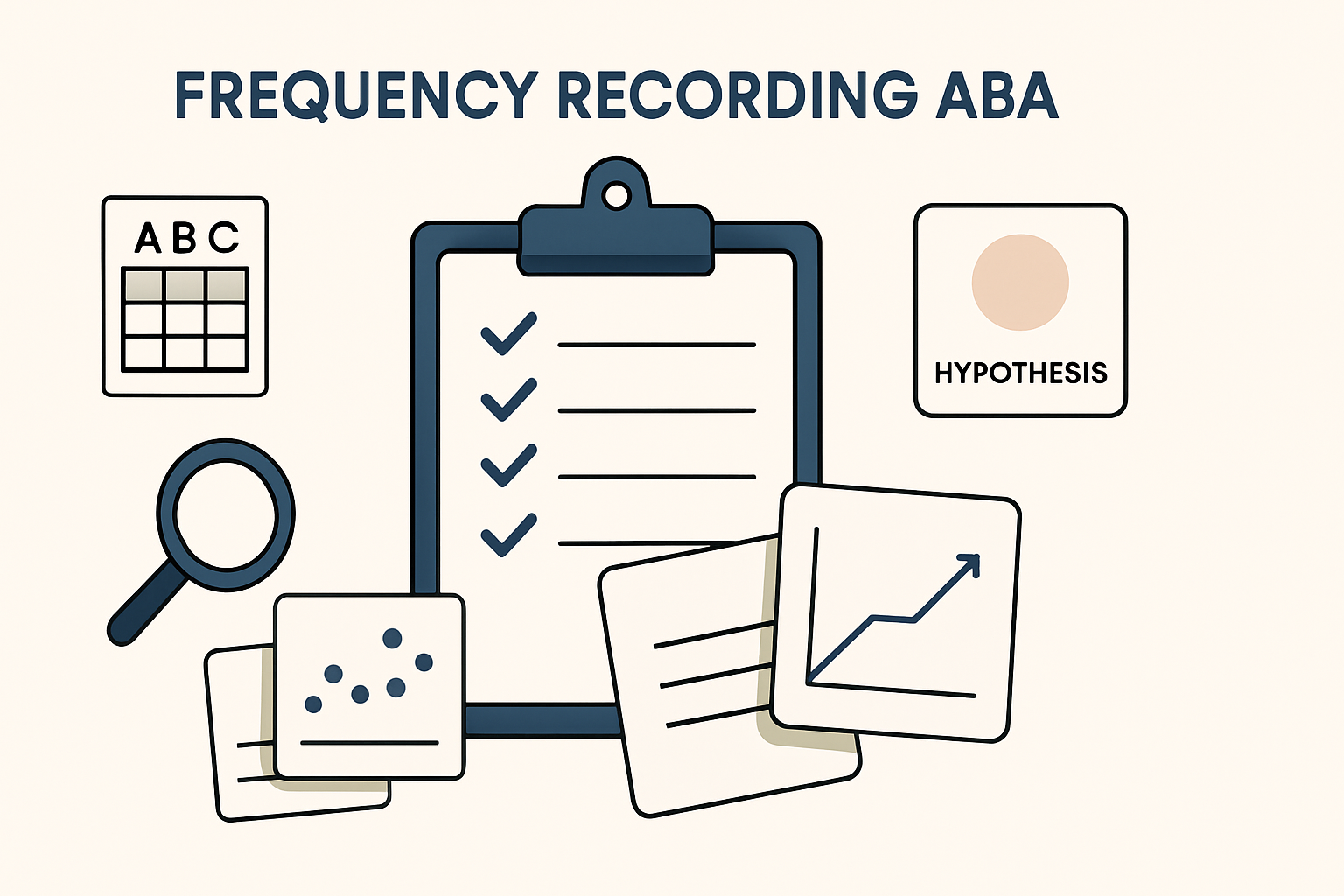
Quick-Reference Implementation Checklist
Use this checklist to ensure proper implementation of frequency recording in practice and to prepare for exam questions:
- Define the behavior with clear operational criteria
- Ensure the behavior has discrete beginning and ending points
- Verify the behavior occurs at a countable rate (not too rapid)
- Prepare a simple data sheet with date, time, and tally columns
- Train observers on the operational definition and recording procedure
- Calculate interobserver agreement periodically to ensure reliability
- Convert to rate when comparing across different observation periods
- Graph the data to visualize trends and evaluate intervention effects
For additional measurement guidance, the BCBA Test Content Outline provides comprehensive standards for measurement procedures.
Summary and Key Takeaways
Frequency recording remains one of the most fundamental and practical measurement procedures in applied behavior analysis. Its simplicity makes it accessible for practitioners while providing valuable data for decision-making.
Key points to remember:
- Frequency recording counts behavior occurrences without time consideration
- It’s ideal for discrete behaviors with clear onset/offset at moderate rates
- Always pair it with a clear operational definition
- On the BCBA exam, distinguish carefully between frequency and rate
- Use the implementation checklist to ensure proper application
- Convert to rate when comparing data across different time periods
Mastering frequency recording strengthens your overall measurement skills and prepares you for both clinical practice and certification examinations. For more on behavior measurement fundamentals, see our article on data collection methods in ABA.


