
What is an FR1 Schedule of Reinforcement?
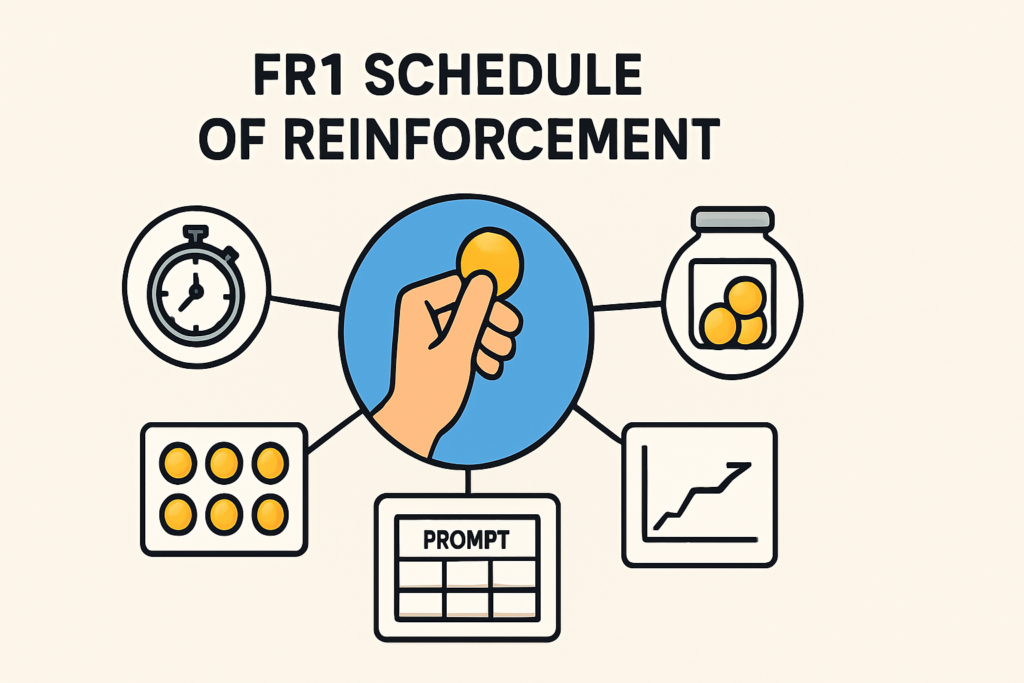
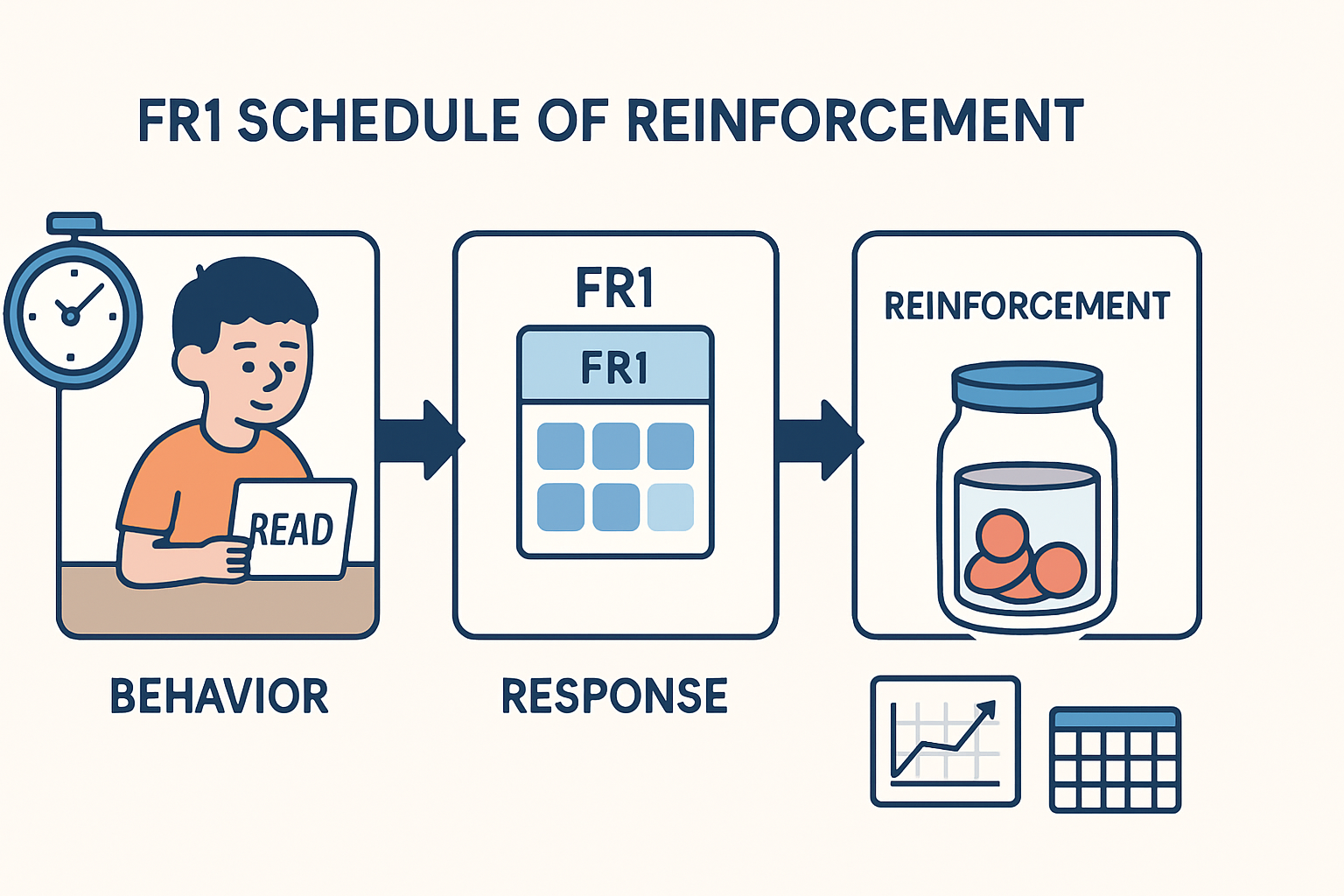
The FR1 schedule of reinforcement represents one of the most fundamental concepts in applied behavior analysis. This schedule delivers reinforcement after every single occurrence of a target behavior, making it essential for skill acquisition and initial learning phases.
Table of Contents
- What is an FR1 Schedule of Reinforcement?
- FR1 Schedule Examples in ABA Practice
- FR1 on the BCBA Exam: Relevance and Common Traps
- Quick-Study Checklist and Summary
Understanding this schedule is crucial for BCBA candidates, as it forms the foundation for more complex reinforcement strategies.
The Core Definition and Key Characteristics
An FR1 schedule is defined by two key components: the fixed ratio requirement and the specific number of responses needed. The ‘fixed’ aspect means the requirement remains constant, while ‘ratio 1’ indicates reinforcement follows exactly one response.
This schedule is synonymous with continuous reinforcement (CRF), where every correct response receives immediate reinforcement. The predictable nature of FR1 creates a distinctive response pattern characterized by high, steady rates of behavior with brief pauses following reinforcement delivery.
FR1 in the Context of Other Simple Schedules
To fully grasp FR1, it helps to contrast it with other basic reinforcement schedules:
- VR1 (Variable Ratio 1): Reinforcement occurs on average after one response, but the actual number varies unpredictably
- FI1 (Fixed Interval 1): Reinforcement becomes available after a fixed time period has elapsed since the last reinforcement
- VI1 (Variable Interval 1): Reinforcement becomes available after variable time intervals
Unlike interval schedules that focus on time, ratio schedules like FR1 emphasize response count. This distinction significantly impacts response patterns and practical applications in ABA programming.
FR1 Schedule Examples in ABA Practice
Real-world applications demonstrate how FR1 functions across different settings and target behaviors. These examples illustrate the schedule’s versatility in teaching new skills and establishing behavioral patterns.
Example 1: Teaching a Mand with an Echoic Prompt
In this common teaching scenario, a therapist works with a child to develop verbal communication skills. The therapist presents a preferred item (cookie) and models the word ‘cookie’ as an echoic prompt.
- Antecedent: Therapist holds cookie and says ‘cookie’
- Behavior: Child says ‘cookie’ (echoic response)
- Consequence: Immediate delivery of cookie
The hypothesized function is access to tangibles. This represents FR1 because reinforcement follows every correct verbal response, establishing the manding repertoire through consistent reinforcement.
Example 2: Token Economy for Task Completion
Token systems often incorporate FR1 schedules during initial teaching phases. Consider a classroom where students earn tokens for completing academic tasks.
- Antecedent: Teacher gives instruction to complete worksheet
- Behavior: Student completes worksheet independently
- Consequence: Immediate token delivery
The token delivery operates on FR1, while the exchange schedule for backup reinforcers follows a separate contingency. This layered approach helps bridge immediate and delayed reinforcement, teaching valuable delay tolerance skills.
Example 3: DRA for Hand Raising vs. Calling Out
Differential reinforcement of alternative behavior (DRA) frequently employs FR1 schedules to establish appropriate classroom behaviors. When teaching hand-raising as an alternative to calling out:
- Antecedent: Teacher asks question to class
- Behavior: Student raises hand quietly
- Consequence: Teacher provides verbal praise and calls on student
The hypothesized function is access to adult attention. FR1 proves ideal here because consistent reinforcement strengthens the new behavior pattern quickly, making it more likely to compete with the established calling-out behavior.
FR1 on the BCBA Exam: Relevance and Common Traps
Mastering FR1 concepts is essential for BCBA exam success. Questions testing this knowledge often appear in scenarios requiring schedule identification, response pattern prediction, or intervention planning.
How the BCBA Exam Tests FR1 Knowledge
Exam questions typically follow several formats that require different analytical approaches:
- Scenario identification: Recognizing FR1 from descriptive passages about reinforcement delivery
- Response pattern prediction: Anticipating the behavioral outcomes of implementing FR1 schedules
- Intervention selection: Choosing FR1 as the appropriate schedule for skill acquisition phases
- Schedule comparison: Differentiating FR1 from other simple and compound schedules
Understanding these question types helps candidates approach exam items systematically and avoid common misinterpretations.
Frequent Exam Mistakes and How to Avoid Them
Several predictable errors trap unprepared candidates on FR1-related questions:
- Confusing FR1 with VR1: Remember that FR1 means reinforcement after EVERY response, not ‘on average’ after one response
- Missing response specificity: FR1 applies to a precisely defined target behavior, not any behavior that occurs
- Overlooking schedule transitions: Forgetting that FR1 is optimal for acquisition but requires thinning for maintenance
- Ignoring the fixed aspect: Failing to recognize that variable delivery patterns indicate different schedules
- Misapplying to maintenance: Using FR1 when intermittent schedules would be more appropriate for established behaviors
To avoid these traps, practice identifying the reinforcement contingency in exam scenarios and verify whether the schedule description matches FR1 criteria exactly.
Quick-Study Checklist and Summary
Use this checklist to verify your understanding of FR1 schedule concepts before the exam:
- Define FR1 precisely: Reinforcement follows every occurrence of a specific behavior
- Recognize synonyms: FR1 equals continuous reinforcement (CRF)
- Identify applications: Best for skill acquisition and establishing new behaviors
- Predict response patterns: High steady rates with brief post-reinforcement pauses
- Differentiate from VR1: Fixed vs. variable ratio requirements
- Plan schedule thinning: Transition from FR1 to intermittent schedules for maintenance
- Apply to DRA procedures: Use FR1 to strengthen alternative behaviors
- Recognize exam traps: Avoid common misinterpretations of schedule descriptions
FR1 represents a cornerstone concept in ABA practice and BCBA exam preparation. Its predictable reinforcement pattern makes it ideal for establishing new behaviors, though practitioners must plan for schedule thinning to promote maintenance and generalization. Understanding when and how to apply FR1, while avoiding common misinterpretations, will serve you well both on the exam and in clinical practice.
For more information on related concepts, explore our guides on compound vs. simple schedules and differential reinforcement procedures. The BACB Handbook provides additional guidance on ethical implementation of reinforcement schedules.


