
Understanding reinforcement schedules is essential for any behavior analyst preparing for the BCBA exam. Among these, the fixed interval schedule presents unique patterns and applications that frequently appear on certification tests. This guide breaks down everything you need to know about this time-based reinforcement schedule.
Table of Contents
- Understanding Fixed Interval Schedules
- Fixed Interval Schedules in Practice: ABA Examples
- Fixed Interval on the BCBA Exam: What to Watch For
- Study Checklist and Key Takeaways
Understanding Fixed Interval Schedules
A fixed interval schedule delivers reinforcement for the first response after a specific, unchanging time period has elapsed. This creates predictable patterns that differ significantly from ratio-based schedules.
The Official Definition and Key Characteristics
In technical terms, a fixed interval (FI) schedule provides reinforcement contingent upon the first instance of a target behavior occurring after a fixed duration of time. The interval resets immediately after reinforcement delivery.
Key characteristics include:
- Time-based requirement: Reinforcement depends on time passage, not response count
- Fixed duration: The interval length remains constant (e.g., FI 5-min, FI 1-hour)
- Post-reinforcement pause: A period of little to no responding immediately after reinforcement
- Accelerating responding: Response rate increases as the interval end approaches
Visualizing the Pattern: The Fixed Interval Scallop
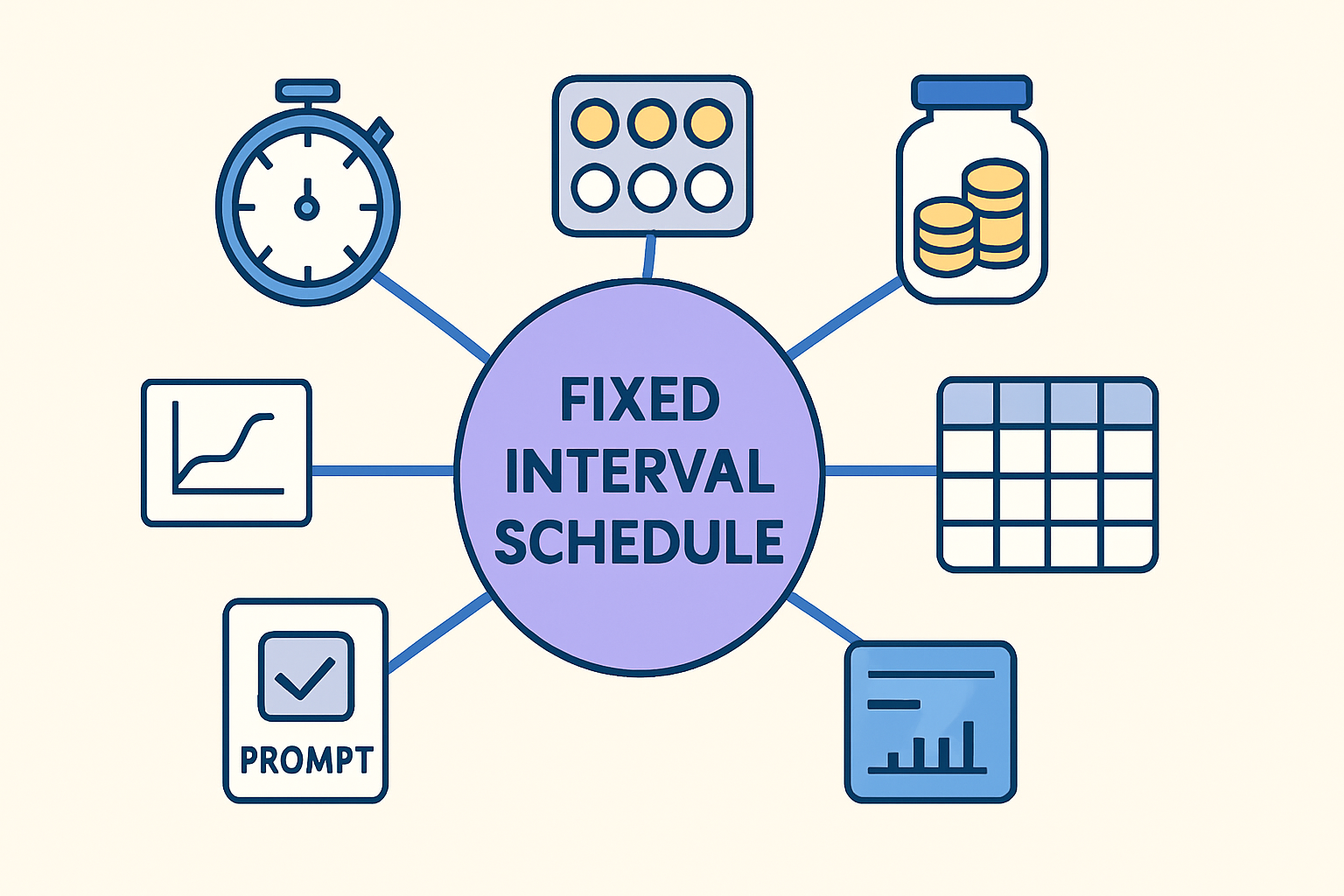
The cumulative record of a fixed interval schedule shows a distinctive scalloped pattern. This visual representation demonstrates how responding changes throughout the interval.
Immediately after reinforcement, there’s typically a pause in responding (post-reinforcement pause). As time progresses toward the interval’s end, responding gradually accelerates, creating the curved appearance that gives the pattern its name.
Fixed Interval Schedules in Practice: ABA Examples
Real-world applications help solidify understanding of fixed interval schedules. These examples demonstrate how time-based reinforcement operates in clinical and everyday settings.
Example 1: The Weekly Check-In
A client receives access to a preferred activity every Friday after completing their weekly work session. The ABC analysis reveals:
- Antecedent: Time since last Friday’s reinforcement (approximately 7 days)
- Behavior: Completion of work session tasks
- Consequence: Access to preferred activity (reinforcer)
This represents an FI 7-day schedule where the function is access to tangibles/activities. The client’s work behavior is reinforced on a predictable weekly basis.
Example 2: Salary Paycheck
While often cited as an example, it’s important to analyze this carefully. An employee receives a paycheck every two weeks for their work behavior.
- Antecedent: Completion of the 2-week work period
- Behavior: Working during the pay period
- Consequence: Receipt of paycheck (reinforcer)
This constitutes an FI schedule for the employee’s work behavior. The reinforcement is time-based rather than response-based, which distinguishes it from piece-rate pay systems.
Example 3: Medication Delivery
In a clinical scenario, an individual engages in low-rate head-turning behavior only during the 10-minute window before a scheduled pain medication dose.
- Antecedent: Approximately 50 minutes since last medication (for a 60-minute FI schedule)
- Behavior: Head-turning or other pain-indicating behaviors
- Consequence: Medication delivery providing pain relief
The function is pain reduction on an FI schedule. This pattern demonstrates how biological needs can create fixed interval responding patterns.
Fixed Interval on the BCBA Exam: What to Watch For
Exam questions about fixed interval schedules often include common distractors designed to test your understanding of schedule distinctions. Being aware of these traps can improve your accuracy.
Common Exam Traps and Misconceptions
Several misconceptions regularly appear on BCBA exams. Watch for these specific traps:
- Confusing FI with FR: Remember that FI is time-based while FR is response-based
- Misidentifying variable schedules: FI has fixed time requirements; VI has variable time requirements
- Overlooking ‘first response’ criterion: Only the first response after the interval ends receives reinforcement
- Forgetting the post-reinforcement pause: This characteristic pattern distinguishes FI from other schedules
- Mistaking interval for ratio: Time vs. response count is the fundamental difference
Practice Identifying Schedule Types
Use this systematic approach to identify reinforcement schedules on exam questions:
- Determine if reinforcement depends on responses or time
- Identify whether the requirement is fixed or variable
- Apply the classification: FI (time, fixed), VI (time, variable), FR (response, fixed), VR (response, variable)
For more on reinforcement schedules, see our guide on compound schedules of reinforcement.
Study Checklist and Key Takeaways
Use this checklist to ensure you’ve mastered fixed interval schedule concepts for your BCBA exam preparation.
Essential Knowledge Points
Before your exam, verify you can:
- Define fixed interval schedule using precise behavioral terminology
- Describe the characteristic scalloped pattern on cumulative records
- Explain why post-reinforcement pauses occur in FI schedules
- Differentiate FI from fixed ratio, variable interval, and variable ratio schedules
- Identify real-world examples of FI schedules in ABA practice
- Recognize common exam distractors related to reinforcement schedules
- Apply the systematic approach to schedule identification on exam questions
Final Summary and Resources
Fixed interval schedules represent a fundamental concept in behavior analysis with distinct patterns and applications. Mastery requires understanding both the theoretical framework and practical implementations.
Remember that FI schedules produce predictable patterns of responding characterized by pauses after reinforcement and acceleration as the interval ends. This differs from ratio schedules where responding typically occurs at higher, more consistent rates.
For additional study resources, explore our comprehensive BCBA exam prep guide and review the official BCBA Test Course Outline for reinforcement schedule requirements. Understanding these concepts within the broader context of the seven dimensions of ABA will strengthen your overall exam preparation.


