
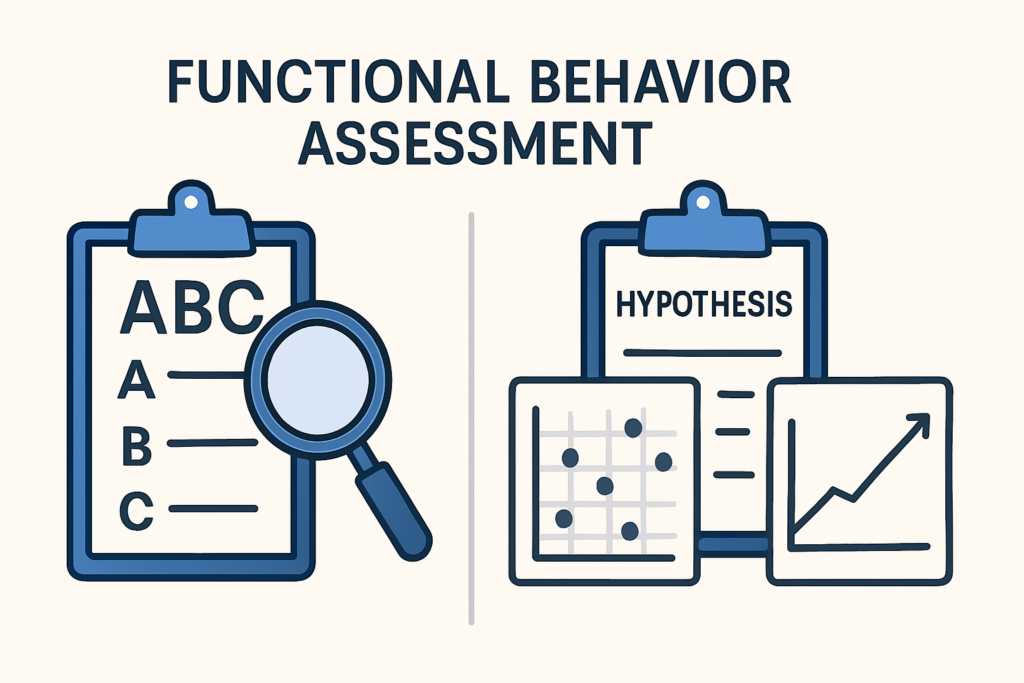
In special education settings, the Functional Behavior Assessment (FBA) serves as a critical tool for understanding challenging behaviors and developing effective interventions. This systematic process goes beyond simple observation to identify the underlying functions of behavior, making it essential for creating meaningful Behavior Intervention Plans (BIPs) that support student success.
Table of Contents
- Functional Behavior Assessment FBA: What is Functional Behavior Assessment (FBA) in Specia
- Conducting an FBA: From Data to Hypothesis
- FBA for the BCBA Exam: Key Concepts and Common Traps
- From Assessment to Intervention: The FBA Checklist
- Summary and Next Steps for Mastery
Functional Behavior Assessment FBA: What is Functional Behavior Assessment (FBA) in Specia
An FBA represents a data-driven approach to understanding why behaviors occur in educational settings. Unlike general behavioral assessments, it specifically examines the environmental variables maintaining problem behaviors.
The Legal Mandate: FBA, IDEA, and the IEP
The Individuals with Disabilities Education Act (IDEA) requires schools to consider conducting an FBA when a student’s behavior impedes their learning or that of others. This legal mandate connects directly to the Individualized Education Program (IEP) process, ensuring that interventions are based on functional understanding rather than assumptions.
When behavior interferes with educational progress, the multidisciplinary team must determine if an FBA is needed to inform the development of an appropriate Behavior Intervention Plan. This requirement emphasizes the importance of evidence-based practices in special education.
Core Components of a School-Based FBA
Every comprehensive FBA in educational settings includes several essential components:
- Indirect assessment through records review and stakeholder interviews
- Direct observation using ABC data collection methods
- Hypothesis development identifying potential behavioral functions
- Hypothesis testing through systematic analysis and validation
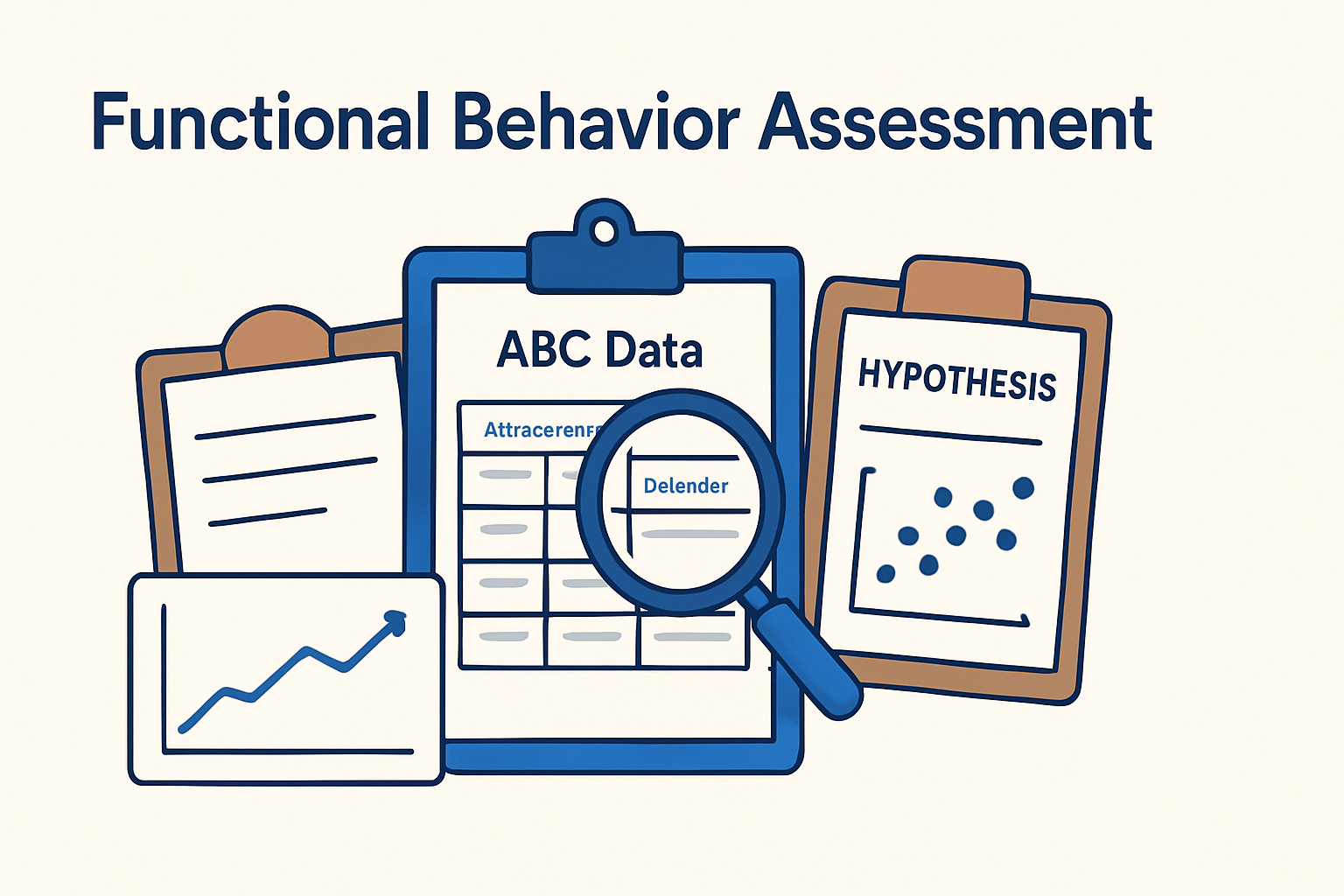
Conducting an FBA: From Data to Hypothesis
The FBA process transforms raw behavioral data into actionable insights through systematic analysis. This practical approach ensures interventions target the true maintaining variables rather than surface-level symptoms.
Example 1: Escape-Maintained Behavior in the Classroom
Consider a student who consistently elopes from the classroom during independent math work. ABC data collection reveals a clear pattern: antecedent is difficult academic demands, behavior is elopement, and consequence is removal from the work area.
The formulated hypothesis becomes: “Behavior is maintained by escape from challenging academic tasks.” This understanding directs intervention toward modifying task difficulty or providing appropriate escape alternatives rather than simply addressing the elopement behavior itself.
Example 2: Attention-Seeking Behavior During Transitions
Another common scenario involves a student who makes loud disruptive noises during hallway transitions. Data analysis shows the behavior consistently occurs when peer and staff attention is available, with the consequence being immediate social attention from multiple sources.
The working hypothesis: “Behavior is maintained by access to social attention during low-structure transition periods.” This insight guides the development of proactive strategies for providing attention before the behavior occurs.
The Multidisciplinary Team Approach
Effective FBA implementation requires collaboration among various professionals:
- BCBA provides behavioral expertise and analysis leadership
- Special education teacher offers classroom context and implementation support
- General education teacher provides mainstream environment insights
- School psychologist contributes assessment and mental health perspectives
- Parents offer home environment information and cultural context
FBA for the BCBA Exam: Key Concepts and Common Traps
Understanding FBA concepts is essential for BCBA exam success, particularly in distinguishing between assessment types and avoiding common analytical errors.
Essential Terminology and Definitions
Several key distinctions appear frequently on the BCBA exam:
- Functional Assessment vs. Functional Analysis: The former includes indirect and descriptive methods, while the latter involves experimental manipulation
- Descriptive Assessment vs. Indirect Assessment: Descriptive methods involve direct observation, while indirect methods rely on interviews and records
- Setting Event vs. Antecedent: Setting events establish conditions for behavior, while antecedents immediately precede it
- The four common functions (SEAT): Sensory, Escape, Attention, Tangible
Frequent Exam Pitfalls and Misinterpretations
BCBA candidates commonly encounter these challenges:
- Confusing correlation with causation in ABC data patterns
- Failing to consider multiple maintaining functions for complex behaviors
- Overlooking medical or biological variables that influence behavior
- Misapplying FBA results when designing Behavior Intervention Plans
- Neglecting to validate hypotheses through systematic testing
From Assessment to Intervention: The FBA Checklist
Use this practical checklist to ensure comprehensive FBA implementation:
- Review all available educational records and previous assessments
- Conduct structured interviews with key stakeholders (teachers, parents, student)
- Collect direct observation data using ABC recording methods
- Analyze patterns to develop testable hypotheses about function
- Validate hypotheses through systematic manipulation or additional data collection
- Document findings in clear, educator-friendly language
- Connect assessment results directly to intervention strategies
- Establish data collection systems for ongoing progress monitoring
Summary and Next Steps for Mastery
Mastering Functional Behavior Assessment in special education requires both conceptual understanding and practical application skills. The process serves as the foundation for developing effective, ethical interventions that address the true functions of behavior rather than merely suppressing symptoms.
For BCBA candidates, focusing on the systematic nature of FBA, the legal requirements under IDEA, and common analytical errors will strengthen exam performance. Remember that successful FBA implementation always leads directly to function-based interventions that support student learning and development.
To deepen your understanding of behavioral assessment, explore our guide on Functional Behavior Assessment FBA and learn about developing effective interventions through our Behavior Intervention Plan BIP resource. For comprehensive exam preparation, consider our BCBA exam prep guide that covers all essential domains.
Additional authoritative information about FBA requirements can be found through the Behavior Analyst Certification Board and the U.S. Department of Education IDEA website.


