

An FBA questionnaire serves as a critical starting point in functional behavior assessment, providing valuable preliminary data about challenging behaviors. This indirect assessment method helps behavior analysts gather information from caregivers, teachers, and other stakeholders to develop initial hypotheses about behavior function.
Table of Contents
- What is an FBA Questionnaire? Defining the Tool
- From Questions to Function: Worked Examples
- Exam Relevance and Common Traps
- FBA Questionnaire Implementation Checklist
- Summary and Next Steps in Assessment
- References
Understanding how to properly administer, analyze, and interpret these questionnaires is essential for effective assessment and treatment planning. This guide walks through the practical application of FBA questionnaires with real-world examples and exam-focused insights.
What is an FBA Questionnaire? Defining the Tool
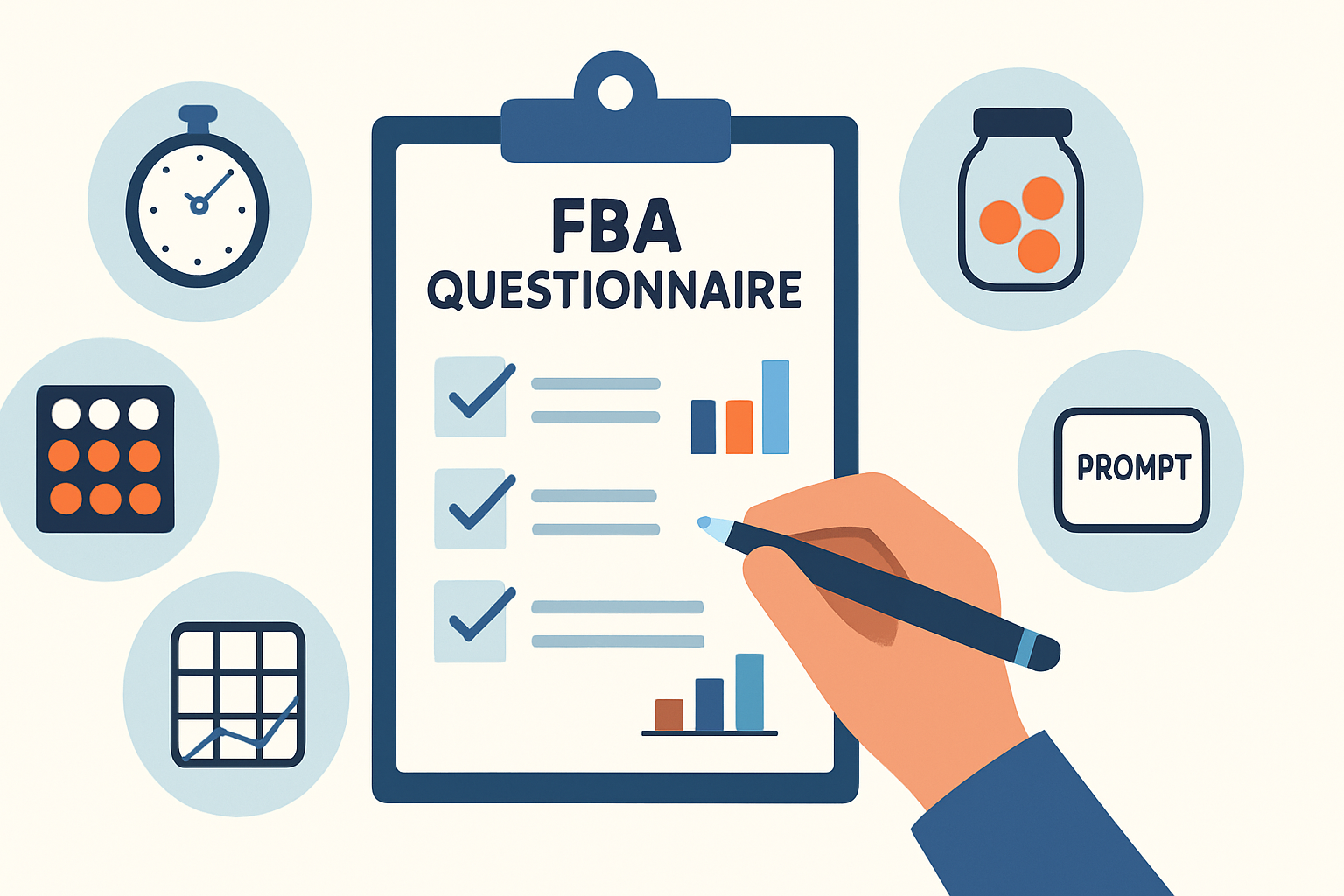
An FBA questionnaire is a structured interview tool designed to collect information about target behaviors and their environmental contexts. Unlike direct observation methods, it relies on reports from individuals familiar with the client’s behavior patterns across settings and time periods.
These questionnaires systematically gather data about antecedents, behaviors, and consequences to identify potential maintaining variables. They represent the first phase of comprehensive functional assessment, guiding subsequent direct observation and analysis.
Role in the FBA Process
Within the broader functional behavior assessment framework, questionnaires serve as indirect assessment tools. They complement direct methods like ABC recording and experimental analyses by providing historical context and multiple perspectives.
Questionnaires help identify patterns that might not be immediately observable during limited assessment sessions. They’re particularly valuable for understanding behaviors that occur infrequently or across multiple environments where direct observation isn’t feasible.
Key Components of a Quality Questionnaire
Effective FBA questionnaires share several essential characteristics that ensure reliable data collection and meaningful analysis.
- Clear operational definitions of target behaviors to ensure consistent understanding across respondents
- Specific questions about antecedent conditions that precede challenging behaviors
- Detailed inquiries about consequences that follow behaviors, including both natural and programmed responses
- Sections addressing setting events and establishing operations that might influence behavior patterns
- Open-ended questions allowing for qualitative data about behavior patterns and environmental contexts
- Rating scales or frequency estimates to quantify behavior occurrence and intensity
From Questions to Function: Worked Examples
Translating questionnaire responses into meaningful hypotheses requires systematic analysis of reported patterns. These examples demonstrate how raw data becomes actionable assessment information.
Example 1: Elopement in the Classroom
A teacher completes an FBA questionnaire describing a student’s elopement behavior during academic activities. The responses indicate the behavior occurs most frequently during independent math work and results in the student being escorted to a quiet area.
Analysis reveals a clear pattern: Antecedent (difficult math task) → Behavior (leaves instructional area) → Consequence (task removal and quiet time). This suggests an escape function, where elopement serves to avoid or terminate aversive academic demands.
Example 2: Vocal Stereotypy During Play
Parent questionnaire data describes a child’s vocal stereotypy that occurs consistently during independent play. Responses indicate the behavior persists regardless of social attention or environmental changes.
Key findings include: behavior occurs across all settings, continues when alone, and isn’t affected by social consequences. This pattern points toward automatic reinforcement, where the behavior itself produces sensory stimulation that maintains its occurrence.
Exam Relevance and Common Traps
BCBA exam questions frequently test understanding of FBA questionnaire limitations and proper application. Recognizing common pitfalls helps avoid errors in both clinical practice and examination scenarios.
Trap 1: Confusing Correlation with Causation
Questionnaire data reveals correlations between environmental events and behaviors, but cannot establish functional relationships. Exam questions often test whether candidates recognize that direct observation is necessary to confirm hypothesized functions.
A common error involves treating questionnaire findings as conclusive evidence rather than preliminary hypotheses. Remember that questionnaires suggest possible relationships that require experimental verification through functional analysis or descriptive assessment.
Trap 2: Overlooking Setting Events
Exam questions frequently include setting event information within questionnaire data that candidates must identify as relevant contextual variables. These establishing operations alter the value of potential reinforcers and influence behavior patterns.
Common setting events in exam scenarios include missed medication, poor sleep, changes in routine, or recent conflicts. Recognizing these variables as part of the assessment picture is crucial for comprehensive understanding.
Trap 3: Selecting an Intervention Before Confirming the Function
The FBA questionnaire represents only the assessment phase of behavior analysis. Exam questions may present questionnaire data and ask for the next appropriate step, which should typically involve further assessment rather than immediate intervention.
Candidates must remember that questionnaire findings guide subsequent direct observation and experimental analysis. Premature intervention selection based solely on questionnaire data violates best practice assessment sequences.
FBA Questionnaire Implementation Checklist
This practical checklist ensures systematic and effective use of FBA questionnaires in assessment practice. Follow these steps to maximize data quality and utility.
- Select or develop a questionnaire with clear operational definitions of target behaviors
- Identify appropriate respondents with sufficient observation opportunities across relevant contexts
- Provide clear instructions about completing the questionnaire, emphasizing specific examples over general impressions
- Review completed questionnaires for consistency and completeness before analysis
- Analyze patterns across multiple respondents to identify convergent and divergent perspectives
- Develop specific, testable hypotheses about potential behavior functions based on identified patterns
- Plan subsequent assessment activities to verify or refine initial hypotheses through direct methods
- Document limitations of questionnaire data and their implications for assessment conclusions
Summary and Next Steps in Assessment
The FBA questionnaire serves as a valuable hypothesis-generating tool within comprehensive functional assessment. Its strength lies in gathering historical and contextual information that informs subsequent direct observation and experimental analysis.
Properly used, questionnaires provide essential preliminary data about behavior patterns, environmental contexts, and potential maintaining variables. However, their limitations require careful consideration, particularly regarding indirect assessment methods and respondent biases.
Following questionnaire administration, behavior analysts should progress to descriptive assessments like ABC recording and, when appropriate, experimental functional analysis. This sequential approach ensures assessment conclusions rest on multiple data sources and methodological approaches, aligning with best practices in behavior analysis.
For further study of assessment methods, explore resources on functional behavior assessment and related topics to strengthen your understanding of comprehensive assessment approaches.


