

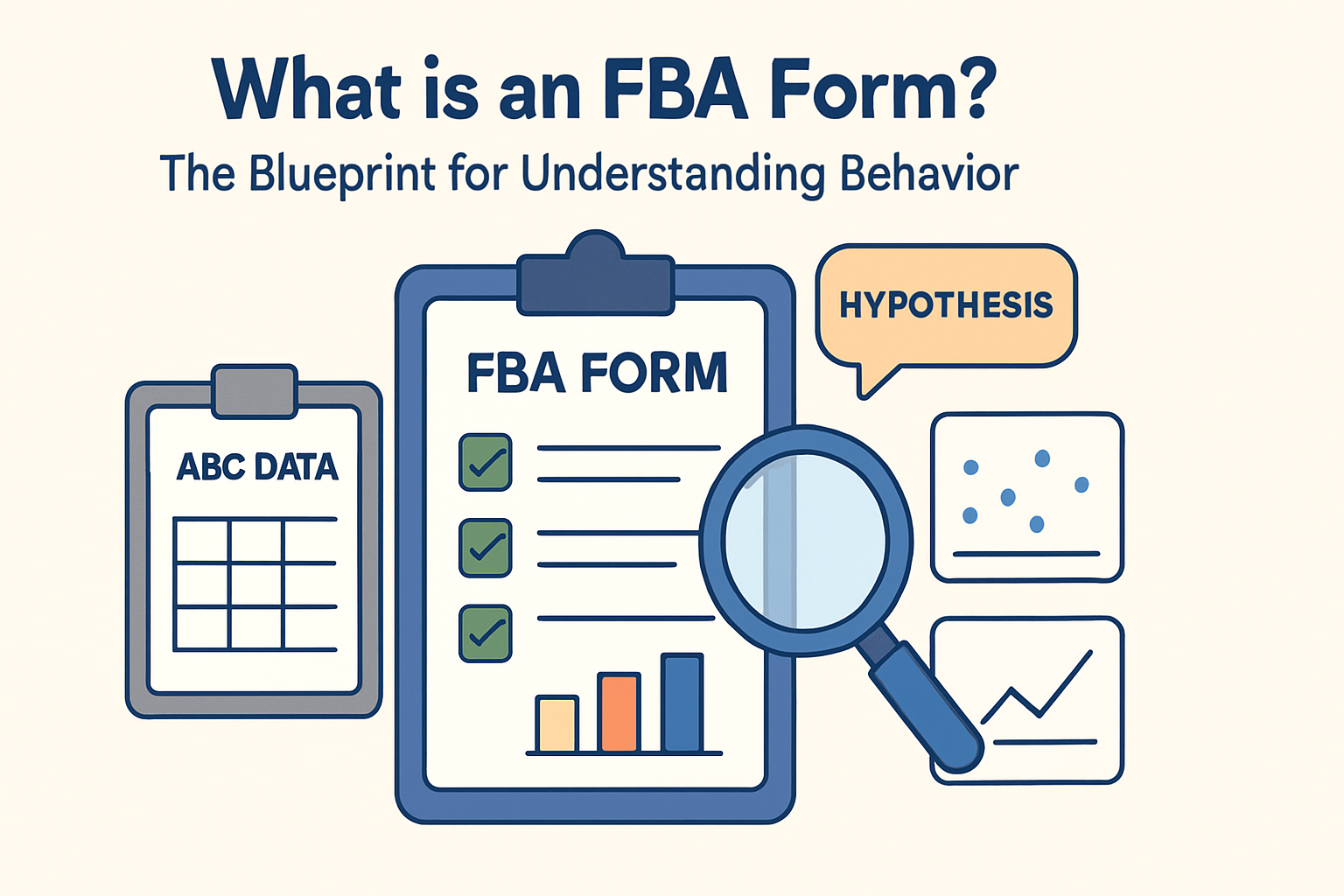
What is an FBA Form? The Blueprint for Understanding Behavior
A Functional Behavior Assessment (FBA) form serves as the central organizing document that structures your assessment process. It’s not the assessment itself but rather the systematic framework that guides data collection and analysis. This standardized template ensures you gather all necessary information to develop an accurate behavioral hypothesis.
Table of Contents
- What is an FBA Form? The Blueprint for Understanding Behavior
- Completing an FBA Form: From Raw Data to Behavioral Hypothesis
- FBA Forms and the BCBA Exam: What You Need to Know
- FBA Form Quick-Reference Checklist
- Summary and Key Takeaways
- References
Think of the FBA form as a roadmap that leads from initial observations to evidence-based conclusions about why behavior occurs.
Core Components of a Standard FBA Form
Every comprehensive FBA form includes several essential sections that work together to create a complete picture of the behavior in context.
- Client and Setting Information: Basic demographic data and environmental context details
- Target Behavior Definition: Operational definitions that are observable and measurable
- Data Collection Summary: Both indirect assessment (interviews, rating scales) and direct assessment (ABC recording, scatter plots)
- Antecedent-Behavior-Consequence Analysis: The core three-term contingency pattern analysis
- Identified Function(s): The hypothesized maintaining variables (escape, attention, tangible, automatic)
- Hypothesis Statement: A testable prediction about the behavior’s function
FBA Form vs. FBA Process: Understanding the Distinction
Many students confuse the form with the process. The FBA process encompasses all assessment activities, while the FBA form documents these activities systematically. The process involves actual data collection, observation, and analysis, while the form organizes and presents this information coherently.
This distinction is crucial for both clinical practice and exam success, as questions often test your understanding of what belongs in each category.
Completing an FBA Form: From Raw Data to Behavioral Hypothesis
The real skill lies in transforming raw observational data into meaningful patterns that reveal behavioral function. This systematic approach follows a logical progression from data collection to hypothesis development.
Worked Example 1: Escape-Maintained Behavior in a Classroom
Consider a student who engages in task refusal during math instruction. Your ABC data shows consistent patterns: when presented with difficult math worksheets (antecedent), the student pushes materials away (behavior), and is sent to the calm-down corner (consequence).
On the FBA form, you would summarize this pattern as escape from academic demands. The hypothesis statement might read: “When presented with challenging math tasks, the student engages in material refusal to escape the demand, as evidenced by removal from the instructional setting.”
Worked Example 2: Attention-Seeking Behavior in a Social Setting
Imagine a child who interrupts conversations during family dinner. Your observations reveal that when parents are talking to each other (antecedent), the child makes loud noises (behavior), resulting in parental attention (consequence).
The FBA form would document this as access to social attention. The completed hypothesis would state: “During periods of limited adult attention, the child engages in disruptive vocalizations to access parental attention, as demonstrated by immediate caregiver response.”
The Critical Link: From Function to Intervention Planning
A properly completed FBA form directly informs your function-based intervention. The identified function determines whether you’ll teach alternative behaviors, modify antecedents, or adjust consequences. For escape-maintained behavior, you might implement demand fading or teach a functional communication response like “I need a break.”
This connection between assessment and intervention is fundamental to ethical, effective practice and is heavily emphasized on the BCBA exam.
FBA Forms and the BCBA Exam: What You Need to Know
Understanding FBA forms is essential for exam success, as this content appears across multiple domains of the BCBA Task List. Questions often test your ability to identify missing components, evaluate hypothesis statements, or select appropriate data collection methods.
Alignment with the BCBA Task List (Section G)
FBA form components directly correspond to several Task List items in Section G (Behavior Assessment). Key alignments include:
- G-1: Review records and available data at the outset of the case
- G-2: Identify and prioritize socially significant behavior-change goals
- G-3: Conduct assessments of relevant skill strengths and deficits
- G-4: Conduct preference assessments to identify potential reinforcers
- G-5: Describe and explain behavior from the perspective of radical behaviorism
- G-6: Conduct descriptive assessments to identify probable maintaining variables
- G-7: Interpret functional assessment data to develop hypothesis statements
Common Exam Traps and Misconceptions
Several predictable errors appear regularly on FBA-related exam questions. Being aware of these traps can significantly improve your performance.
- Confusing topography with function: Remember that what a behavior looks like doesn’t reveal why it occurs
- Prioritizing indirect over direct assessment: Direct observation data should carry more weight than interview data
- Failing to write measurable hypothesis statements: Vague hypotheses cannot guide effective intervention
- Over-relying on single data sources: Triangulation across multiple sources increases validity
- Ignoring setting events: Distant antecedents can influence behavioral patterns
FBA Form Quick-Reference Checklist
Use this practical checklist to ensure you’re completing FBA forms comprehensively and accurately. This tool serves both clinical practice and exam preparation needs.
- Define target behaviors using observable, measurable terms
- Collect multiple data types (indirect, descriptive, functional analysis when appropriate)
- Analyze ABC patterns across different settings and times
- Identify consistent antecedents that reliably precede the behavior
- Document immediate consequences that follow the behavior
- Formulate testable hypotheses about behavioral function
- Connect findings to intervention planning for function-based treatment
- Review for completeness before finalizing the assessment
Summary and Key Takeaways
The FBA form represents a critical tool in behavior analytic practice, serving as both an organizational framework and a decision-making guide. Mastering its components and completion process is essential for developing effective interventions and succeeding on the BCBA exam.
Remember that the form documents the assessment process systematically, leading from data collection to hypothesis development. Each section builds upon the previous one, creating a logical progression toward understanding behavioral function. The hypothesis statement serves as the bridge between assessment and intervention, guiding all subsequent treatment decisions.
For comprehensive exam preparation, integrate your understanding of FBA forms with other assessment concepts covered in the BCBA Test Content Outline. Practice analyzing sample data and completing mock FBA forms to build fluency with this essential skill. Additional resources on functional assessment methods can further strengthen your understanding of when to use different assessment approaches.
By mastering FBA forms, you’re not just preparing for an exam—you’re developing a fundamental skill that will serve you throughout your career as a behavior analyst. The systematic approach documented in these forms represents the scientific foundation of our field, ensuring that interventions are based on evidence rather than assumption.


