
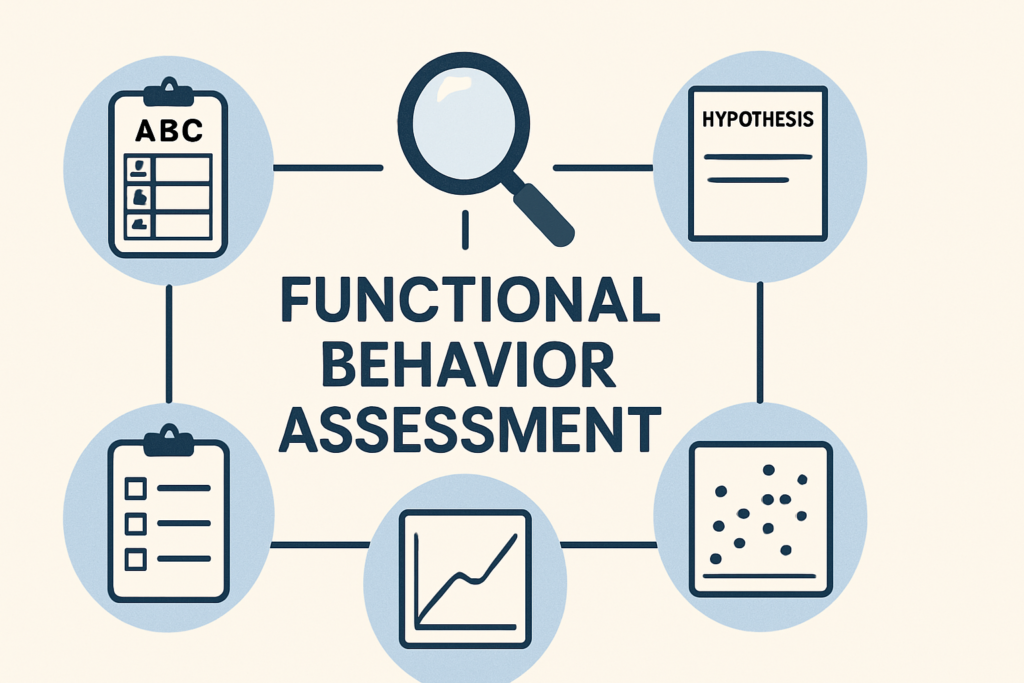
Understanding Functional Behavior Assessment is essential for any BCBA candidate preparing for certification. This systematic approach goes beyond simply describing problem behaviors to identifying their underlying maintaining variables and environmental functions. Mastering FBA principles ensures you can develop effective, ethical interventions that address the root causes of challenging behaviors rather than just their surface appearances.
Table of Contents
- What is Functional Behavior Assessment (FBA)? A Foundational Definition
- The FBA Process in Action: Worked Examples for BCBA Candidates
- FBA on the BCBA Exam: Common Traps and How to Avoid Them
- Your FBA Competency Checklist
- Summary: Integrating FBA Education into Your Practice
What is Functional Behavior Assessment (FBA)? A Foundational Definition
Functional Behavior Assessment is a systematic process for identifying the environmental variables that maintain problem behavior. Unlike assessments that merely describe what behaviors look like, FBA reveals why behaviors occur by examining their functional relationships with antecedents and consequences.
FBA vs. Descriptive Assessment: Knowing the Difference
Many exam questions test your ability to distinguish between these assessment types. Descriptive assessments identify correlations between behaviors and environmental events through observation. In contrast, functional assessments identify causal relationships through systematic manipulation of variables.
- Descriptive methods include ABC recording, scatterplots, and narrative recordings
- Functional analysis involves experimental manipulation to test hypotheses
- Descriptive data shows correlation; functional analysis demonstrates causation
The Core Purpose: From Identifying Function to Informing Intervention
The ultimate goal of FBA is to develop function-based interventions that address the maintaining variables of problem behavior. Without understanding function, interventions may be ineffective or even exacerbate the problem. A well-conducted FBA leads directly to a Behavior Intervention Plan (BIP) that targets the specific environmental contingencies maintaining the behavior.
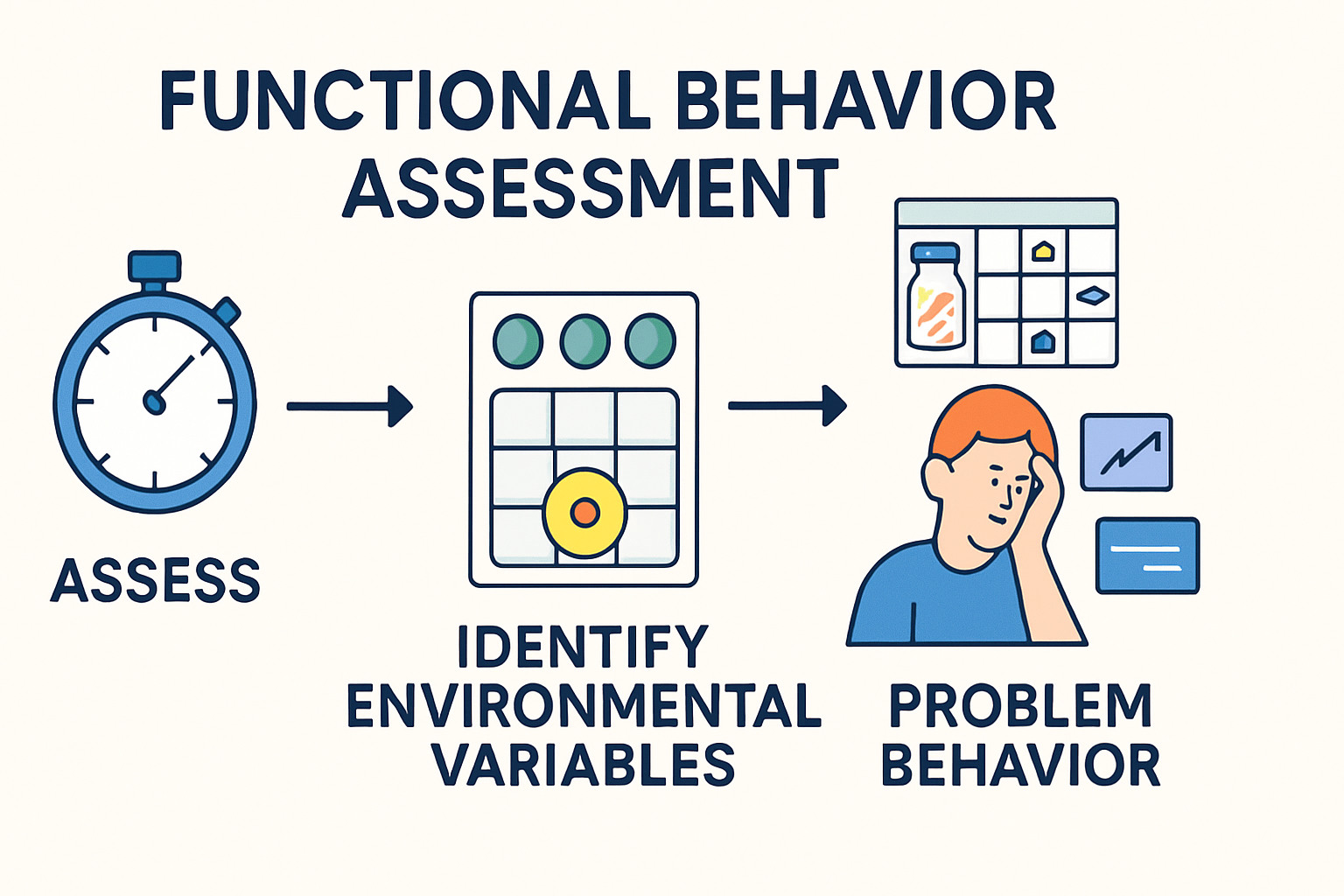
The FBA Process in Action: Worked Examples for BCBA Candidates
Let’s examine three common scenarios that frequently appear on the BCBA exam. Each example demonstrates how to apply FBA principles to real-world situations.
Example 1: Escape-Maintained Behavior in a Classroom Setting
Scenario: A student engages in disruptive behavior during independent math work. The ABC data reveals: Antecedent – difficult math worksheet presented; Behavior – student throws materials and yells; Consequence – teacher removes worksheet and sends student to time-out.
- Hypothesized function: Escape from academic demands
- Key indicator: Behavior consistently occurs during difficult tasks
- BIP strategy: Modify task difficulty, provide breaks, teach alternative escape responses
Example 2: Attention-Seeking Behavior During Social Play
Scenario: A child hits peers when they are playing with others. The ABC pattern shows: Antecedent – peers engaged in play without the child; Behavior – hitting; Consequence – peers stop playing and attend to the child.
- Hypothesized function: Access to peer/adult attention
- Key indicator: Behavior occurs when attention is diverted elsewhere
- BIP strategy: Teach initiation skills, provide attention for appropriate play, use differential reinforcement
Example 3: Tangible-Maintained Behavior with a Potential Sensory Component
Scenario: A client engages in property destruction when a preferred tablet is removed. The ABC analysis indicates: Antecedent – tablet removal; Behavior – throwing objects; Consequence – tablet is returned.
- Hypothesized function: Access to tangible items
- Critical distinction: Must rule out automatic reinforcement through careful assessment
- Assessment approach: Use preference assessments and functional analysis to differentiate functions
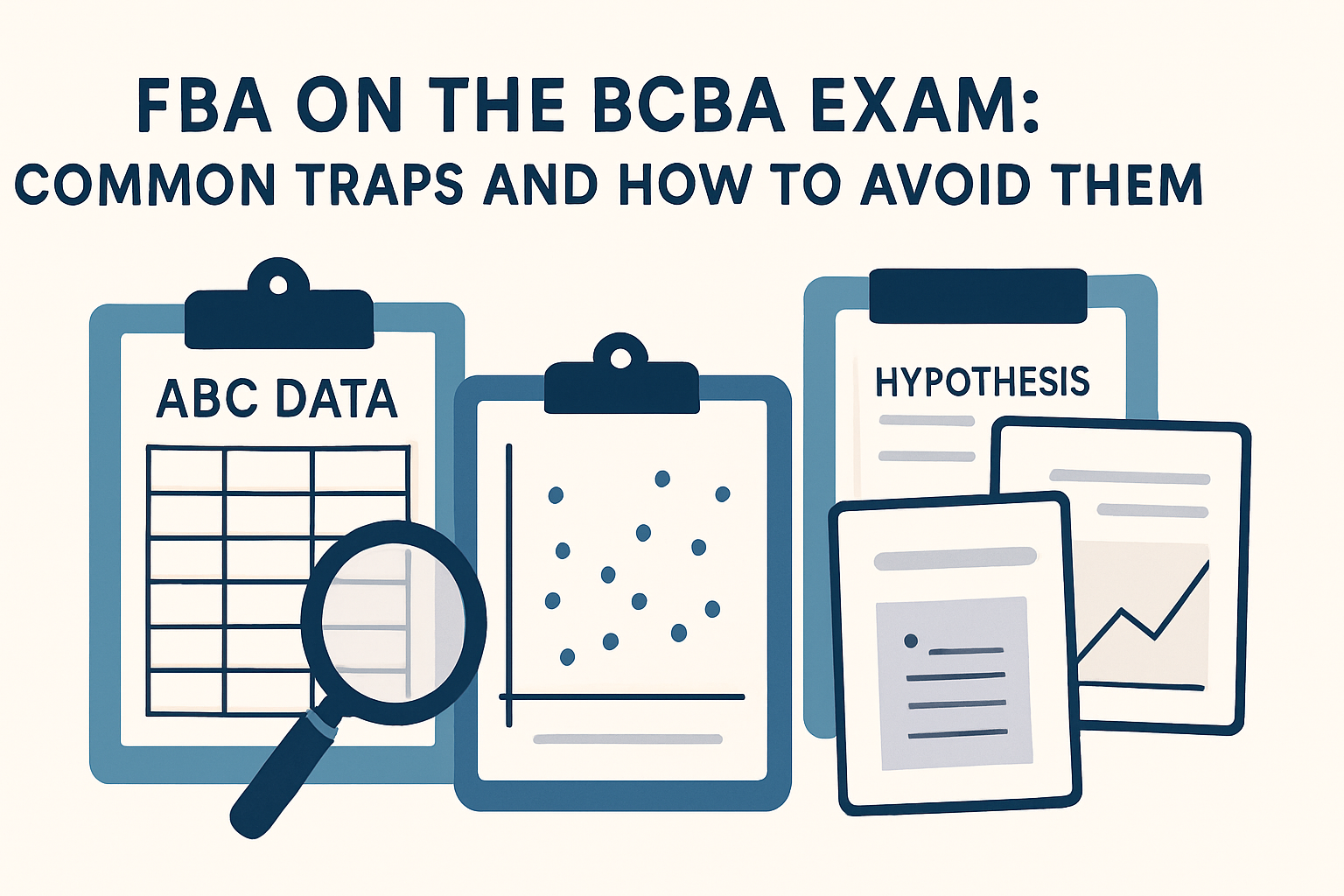
FBA on the BCBA Exam: Common Traps and How to Avoid Them
The BCBA exam frequently tests your ability to apply FBA concepts correctly. Understanding these common pitfalls can significantly improve your exam performance.
Trap 1: Confusing Topography with Function
Many candidates mistakenly assume that behaviors with similar topographies serve the same function. The exam often presents scenarios where identical behaviors (like hitting) serve different functions for different individuals or in different contexts.
- Remember: Function determines intervention, not topography
- Key principle: Two behaviors that look different can serve the same function
- Exam strategy: Always analyze the ABC pattern, not just the behavior description
Trap 2: Misidentifying the ‘Best’ Assessment Method
Exam questions often ask which assessment method is most appropriate for a given scenario. Understanding the strengths and limitations of each approach is crucial.
- Indirect methods (interviews, questionnaires): Quick but subjective
- Descriptive methods (ABC recording): Observational but correlational
- Functional analysis: Experimental and conclusive but requires expertise
- Ethical consideration: Always start with least intrusive methods first
Trap 3: Overlooking Ecological and Setting Events
Many exam questions include setting events that influence behavior but aren’t immediate antecedents. Missing these can lead to incorrect function identification.
- Common setting events: Lack of sleep, missed medication, illness
- Exam tip: Look for information about the client’s broader context
- Key distinction: Setting events alter the value of reinforcers, not directly trigger behavior
Your FBA Competency Checklist
Use this checklist to assess your FBA knowledge and identify areas needing further study. Each item represents a core competency tested on the BCBA exam.
- I can define Functional Behavior Assessment and distinguish it from descriptive assessment
- I understand the four primary functions of behavior (attention, escape, tangible, automatic)
- I can analyze ABC data to hypothesize behavioral function
- I know when to use indirect, descriptive, and experimental assessment methods
- I can differentiate between topography and function in behavior analysis
- I understand how setting events influence behavioral function
- I can explain how FBA results inform function-based interventions
- I recognize common exam traps related to FBA questions
Summary: Integrating FBA Education into Your Practice
Mastering Functional Behavior Assessment is essential for both BCBA exam success and ethical practice. This systematic approach ensures interventions address the root causes of behavior rather than just symptoms. Remember that FBA is not merely an assessment tool but a problem-solving framework that guides effective intervention development.
As you prepare for the BCBA exam, focus on understanding the functional relationships between behavior and environment. Practice analyzing ABC data, distinguishing assessment methods, and applying FBA principles to diverse scenarios. For additional study resources, explore our guide on functional analysis vs. descriptive assessment and the comprehensive four functions of behavior analysis.
For authoritative information on assessment standards, refer to the BACB Ethics Code and research on functional assessment methodologies. Consistent practice with FBA concepts will build the analytical skills needed for both exam success and effective clinical practice.


