

extinction behavior modification: What is Extinction in Applied Behavior Analysis?
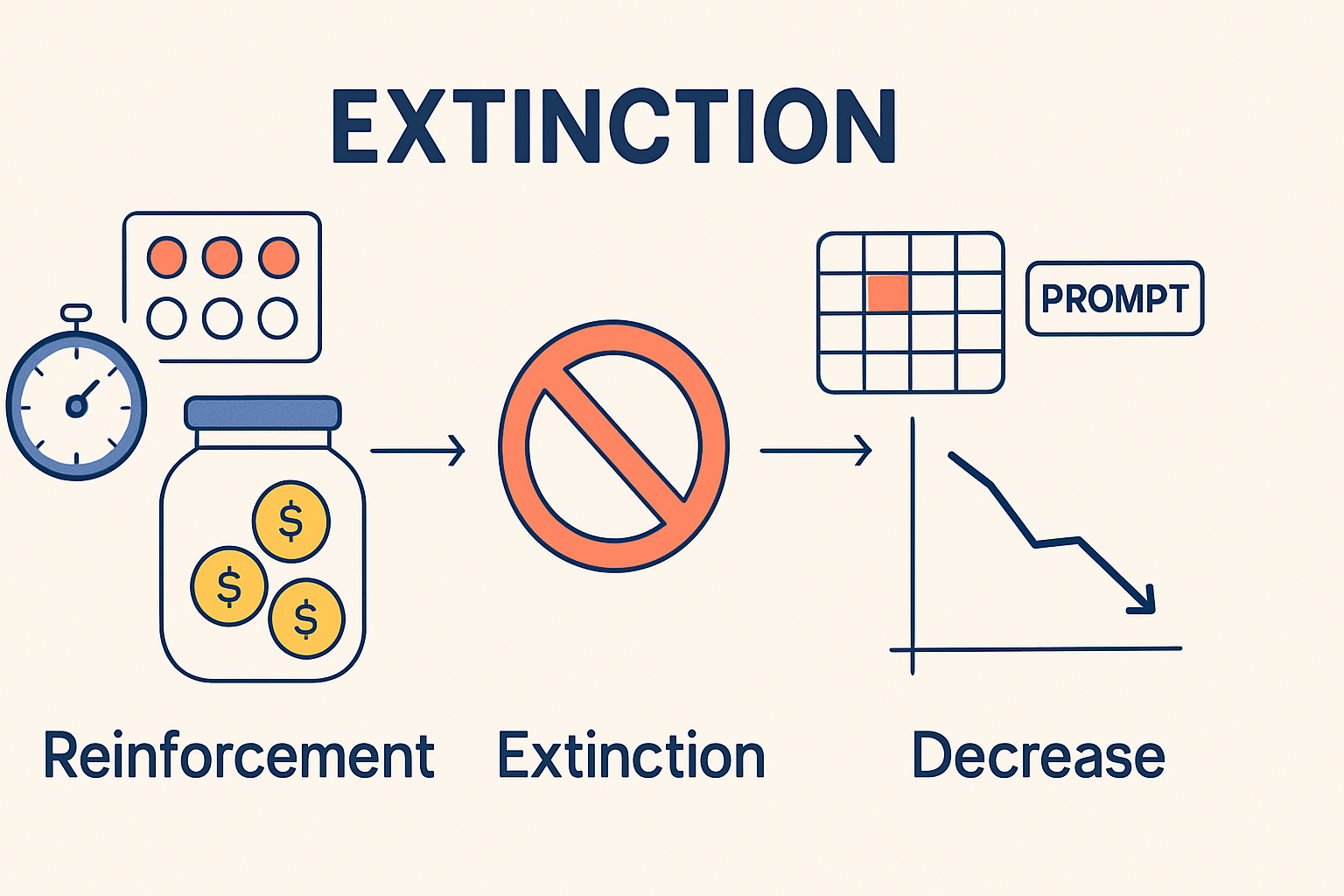
Extinction is a fundamental behavior modification procedure in applied behavior analysis that involves discontinuing reinforcement for a previously reinforced behavior. This process leads to a gradual decrease in the behavior’s frequency or intensity over time. Unlike punishment, which adds or removes stimuli, extinction works by withholding the maintaining consequence.
Table of Contents
- extinction behavior modification: What is Extinction in Applied Behavior Analysis?
- Applying Extinction: Worked Examples for BCBA Candidates
- Extinction on the BCBA Exam: Common Traps and How to Avoid Them
- Ethical Implementation and Your Quick-Action Checklist
- Summary and Key Takeaways
The core principle is simple: when reinforcement stops, the behavior that once produced that reinforcement will eventually stop too. However, effective implementation requires precise understanding of behavioral function and careful planning.
The Core Principle: Discontinuing Reinforcement
Operationally, extinction means withholding reinforcement that previously maintained a behavior. This differs fundamentally from punishment procedures. While punishment involves adding an aversive stimulus or removing a preferred one, extinction simply removes the reinforcing consequence.
Three critical phenomena often accompany extinction procedures:
- Extinction burst: An initial increase in behavior frequency, duration, or intensity when reinforcement is first withheld
- Spontaneous recovery: The temporary reappearance of the extinguished behavior after a period of absence
- Resurgence: The reappearance of previously extinguished behaviors when a current behavior is placed on extinction
Function-Based Extinction: A Critical Distinction
Extinction is always defined by the behavioral function being targeted. The procedure varies depending on which of the four common functions maintains the behavior. You must correctly identify the function through functional behavior assessment before implementing extinction.
The four primary functions and their corresponding extinction procedures include:
- Attention extinction: Withholding attention for attention-maintained behaviors
- Escape extinction: Preventing escape from demands for escape-maintained behaviors
- Tangible extinction: Withholding access to preferred items for tangible-maintained behaviors
- Sensory extinction: Blocking or altering sensory consequences for automatically reinforced behaviors
Applying Extinction: Worked Examples for BCBA Candidates
Understanding extinction requires seeing it in action. These practical examples demonstrate how to apply extinction procedures based on behavioral function, complete with ABC data analysis and clear intervention steps.
Example 1: Extinction of Attention-Maintained Behavior
Scenario: A child whines when wanting a toy on a high shelf. The parent typically responds by giving the toy while saying “stop whining.”
ABC Analysis:
- Antecedent: Toy visible on high shelf
- Behavior: Whining and pointing
- Consequence: Parent gives toy with verbal attention
Hypothesized Function: Socially-mediated positive reinforcement (attention/tangible access)
Extinction Procedure: Implement planned ignoring of whining while not providing the toy. Teach and reinforce appropriate requesting through functional communication training.
Example 2: Extinction of Escape-Maintained Behavior
Scenario: A student tears worksheets during math instruction. The teacher typically removes the worksheet and allows a break.
ABC Analysis:
- Antecedent: Math worksheet presented
- Behavior: Tearing paper
- Consequence: Worksheet removed, break provided
Hypothesized Function: Socially-mediated negative reinforcement (escape from demands)
Extinction Procedure: Implement escape extinction by continuing to present the demand using least-to-most prompting. Prevent escape by not removing the worksheet contingent on tearing behavior.
Example 3: Extinction of Automatically Reinforced Behavior
Scenario: An individual engages in hand-flapping that appears to produce sensory stimulation. This example highlights the complexity of extinction for automatically reinforced behaviors.
Important Considerations: Sensory extinction procedures (like wearing gloves to block stimulation) are highly intrusive and rarely appropriate as first-line interventions. The BACB Ethics Code requires considering less restrictive alternatives first.
Recommended Approach: Focus on reinforcement-based alternatives like teaching functionally equivalent behaviors or providing competing sensory stimulation through appropriate activities.
Extinction on the BCBA Exam: Common Traps and How to Avoid Them
BCBA exam questions about extinction often contain subtle traps. Understanding these common pitfalls will help you select the correct answers and demonstrate your mastery of this critical procedure.
Trap 1: Confusing Extinction with Punishment or Time-Out
Many exam items present scenarios where you must distinguish between extinction and punishment procedures. Remember: extinction weakens behavior by withholding reinforcement, while punishment involves adding or removing stimuli.
Practice distinguishing these scenarios:
- Ignoring a child’s whining (extinction) vs. sending the child to time-out (punishment)
- Not allowing escape from a demand (escape extinction) vs. adding extra work (punishment)
- Withholding attention (extinction) vs. giving a verbal reprimand (punishment)
Trap 2: Overlooking the Extinction Burst and Ethical Planning
Exam questions often test your understanding of the extinction burst and its ethical implications. You must recognize that an initial increase in behavior is expected and plan accordingly.
Key ethical considerations include:
- Obtaining informed consent about potential behavior escalation
- Developing safety plans for aggressive side effects
- Ensuring staff are trained to implement procedures consistently
- Monitoring for emotional responding and adjusting as needed
Trap 3: Failing to Identify the Correct Function to Withhold
The most critical exam trap involves applying extinction to the wrong behavioral function. If you withhold attention for an escape-maintained behavior, you’re not implementing extinction—you’re potentially making the behavior worse.
Always follow this sequence:
- First, identify the maintaining function through FBA
- Second, determine which consequence to withhold
- Third, implement extinction for that specific function
- Fourth, reinforce alternative appropriate behaviors
Ethical Implementation and Your Quick-Action Checklist
Ethical implementation of extinction requires careful planning and ongoing monitoring. This checklist synthesizes key considerations from the BACB Ethics Code and best practices for responsible behavior modification.
Pre-Implementation Ethical Review
Before implementing any extinction procedure, complete this essential review:
- Confirm behavioral function through reliable functional assessment
- Obtain informed consent detailing extinction burst risks and procedures
- Ensure reinforcement-based alternatives are established and functional
- Develop comprehensive safety plans for potential side effects
- Train all implementers on consistent procedure application
- Consider less restrictive alternatives as required by ethics codes
Monitoring and Maintaining Client Dignity
During implementation, maintain these monitoring practices to ensure ethical treatment:
- Pair extinction with robust differential reinforcement of alternative behaviors
- Monitor closely for emotional responding and adjust procedures as needed
- Ensure all team members implement procedures with 100% consistency
- Regularly review data and client welfare indicators
- Maintain client dignity through respectful implementation
- Document all procedures, data, and adjustments systematically
Summary and Key Takeaways
Extinction is a powerful behavior modification tool when applied correctly and ethically. Remember these essential points for BCBA mastery:
- Extinction works by withholding the specific reinforcement maintaining a behavior
- Always base extinction procedures on accurate functional assessment
- Plan for extinction bursts and other predictable side effects
- Pair extinction with reinforcement of appropriate alternative behaviors
- Follow ethical guidelines and maintain client dignity throughout implementation
- Monitor data consistently and adjust procedures based on client response
For comprehensive information on behavior analytic procedures, refer to the BACB Ethics Code and peer-reviewed literature on extinction procedures. Mastery of extinction requires both technical understanding and ethical application in real-world settings.


