
Extinction behavior in ABA represents one of the most fundamental yet frequently misunderstood procedures in behavior analysis. This behavior reduction technique involves systematically discontinuing reinforcement for a previously reinforced behavior, leading to its eventual decrease. Understanding extinction is essential not only for clinical practice but also for success on the BCBA exam, where questions often test subtle distinctions between procedures.
Table of Contents
- extinction behavior ABA: What is Extinction in Applied Behavior Analysis?
- Implementing Extinction: A Function-Based Approach
- Extinction on the BCBA Exam: Common Traps and Tips
- Quick Checklist for Ethical Extinction Procedures
- Summary and Key Takeaways
extinction behavior ABA: What is Extinction in Applied Behavior Analysis?
In technical terms, extinction refers to a procedure where the reinforcement maintaining a behavior is discontinued, resulting in a decrease in that behavior’s future frequency. The core principle involves breaking the contingency between the behavior and its maintaining consequence.
The Core Principle: Discontinuing Reinforcement
Extinction is defined by its effect on behavior—specifically, a decrease in responding—and its process of withholding reinforcement. The procedure requires identifying and then systematically withholding the specific reinforcer that has been maintaining the target behavior. This differs from simply ignoring behavior, as extinction must be based on a documented reinforcement history.
Extinction vs. Forgetting vs. Punishment
These distinctions are critical for exam success. Extinction requires a known reinforcement history that is then discontinued. Forgetting involves a decrease in behavior due to lack of practice or passage of time without any reinforcement history being manipulated. Punishment involves adding an aversive consequence or removing a positive one, while extinction involves removing reinforcement without adding new consequences.
Implementing Extinction: A Function-Based Approach
Extinction is not a one-size-fits-all procedure. Its implementation varies depending on the behavioral function identified through assessment. A function-based approach ensures the procedure targets the specific maintaining variable.
Example 1: Extinction for Attention-Maintained Behavior
Consider a student who calls out during class. Baseline data shows that each time the student calls out, the teacher responds with verbal attention (“Please raise your hand”). The attention-maintained behavior is reinforced by teacher responses. For extinction, the teacher implements planned ignoring—systematically withholding attention when the student calls out while continuing to respond to appropriate hand-raising.
During implementation, expect an extinction burst—a temporary increase in frequency, intensity, or duration of the behavior. The student might call out louder or more frequently initially. This is followed by spontaneous recovery, where the behavior may briefly reappear after apparent elimination.
Example 2: Extinction for Escape-Maintained Behavior
For a child who engages in tantrums during academic demands to escape work, baseline shows tantrums lead to task removal. Here, extinction involves escape extinction—continuing to present the demand despite the tantrum. This requires careful implementation with prompting procedures to ensure the child completes the task while the escape contingency is broken.
Ethical considerations are paramount with escape extinction. Always pair extinction with positive reinforcement for task completion and consider the learner’s skill level to ensure demands are appropriate.
The Critical Role of Reinforcement
Extinction is rarely used alone. Effective implementation requires reinforcing an alternative appropriate behavior through Differential Reinforcement of Alternative Behavior (DRA). This makes the intervention both effective and ethical by teaching what to do instead of just what not to do.
For more on reinforcement strategies, see our guide on differential reinforcement procedures.
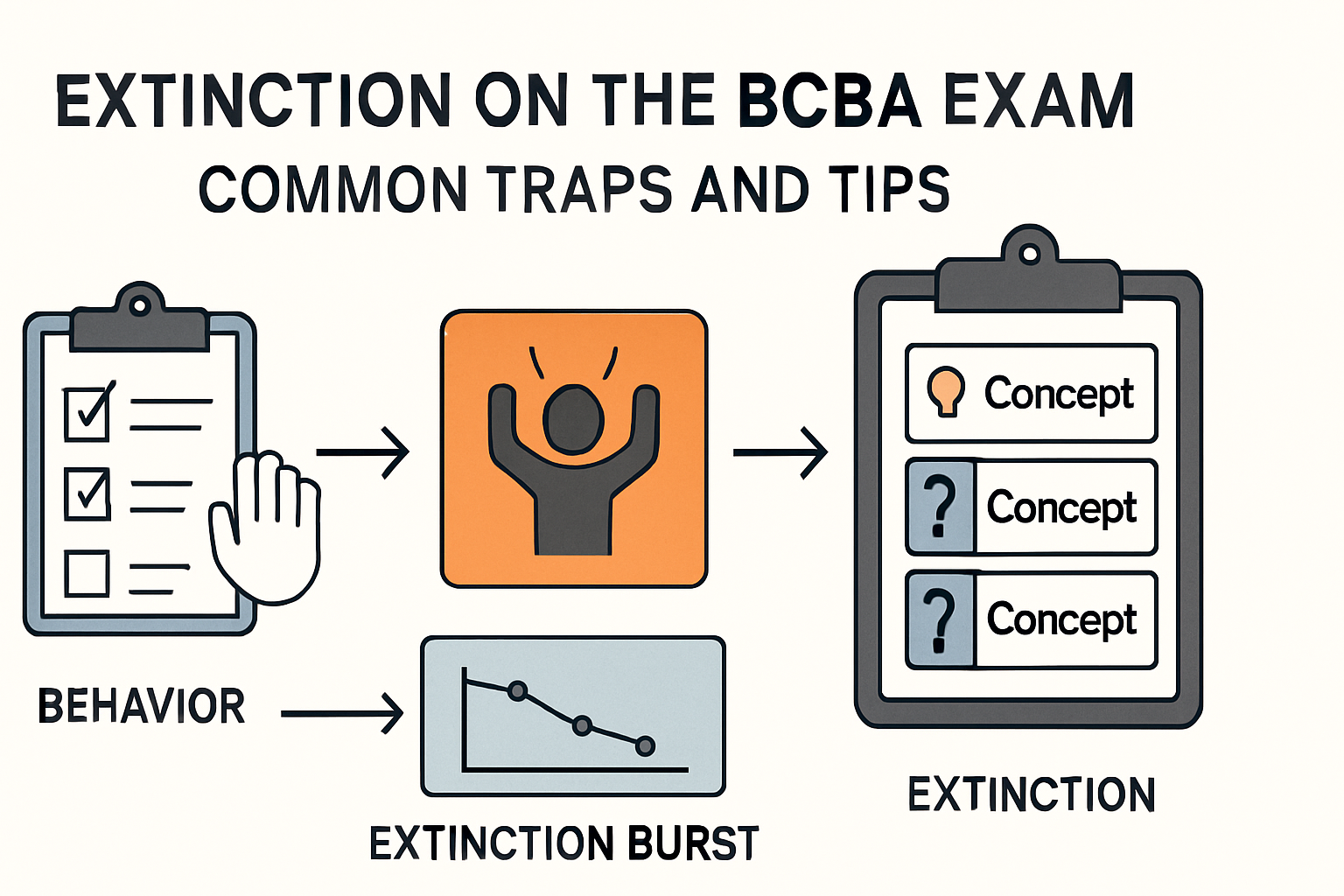
Extinction on the BCBA Exam: Common Traps and Tips
Exam questions often test your ability to distinguish extinction from similar concepts and apply it appropriately. Understanding these common traps can significantly improve your exam performance.
Trap 1: Confusing Procedure with Side Effect
Questions may describe “an extinction burst” and ask what procedure is being used. Remember: extinction is the procedure; the burst is a potential side effect. Other side effects include spontaneous recovery, emotional responding, and aggression. The exam tests whether you can distinguish the intervention from its possible outcomes.
Trap 2: Overlooking the Reinforcement History
For extinction to be the correct answer, the question must imply or state that the behavior was previously reinforced. If no reinforcement history is mentioned, it’s likely a trick question testing whether you’ll incorrectly select extinction when another procedure (like forgetting or satiation) is more appropriate.
Trap 3: Selecting Extinction When Safety is a Concern
Extinction is contraindicated for dangerous behaviors like severe self-injury or aggression. Exam questions may present a dangerous behavior scenario to test whether you recognize that extinction alone is inappropriate. In such cases, consider functional communication training or other reinforcement-based approaches first.
For ethical guidance on behavior reduction, review our article on ethics in ABA practice.
Quick Checklist for Ethical Extinction Procedures
Use this checklist to ensure proper implementation and avoid common mistakes:
- Conduct functional assessment to identify the maintaining variable
- Define extinction procedure specifically for that function
- Plan for extinction burst and prepare stakeholders
- Implement DRA concurrently to teach replacement behavior
- Monitor safety concerns and have crisis plan ready
- Collect baseline and intervention data to measure effectiveness
- Ensure treatment integrity across all implementers
- Consider social validity of procedures and outcomes
Summary and Key Takeaways
Extinction remains a cornerstone procedure in ABA, but its proper application requires careful consideration. Remember these essential points:
- Extinction involves discontinuing reinforcement for a previously reinforced behavior
- The procedure must be function-based—different for attention, escape, tangible, or automatic reinforcement
- Always pair extinction with reinforcement of alternative behavior (DRA)
- Expect and plan for extinction bursts and spontaneous recovery
- Extinction is contraindicated for dangerous behaviors without additional safeguards
- On the BCBA exam, distinguish extinction from forgetting, punishment, and satiation
For further study on related concepts, explore the four functions of behavior and how they inform intervention selection. The BACB’s Ethics Code provides essential guidance on implementing behavior reduction procedures ethically.


