
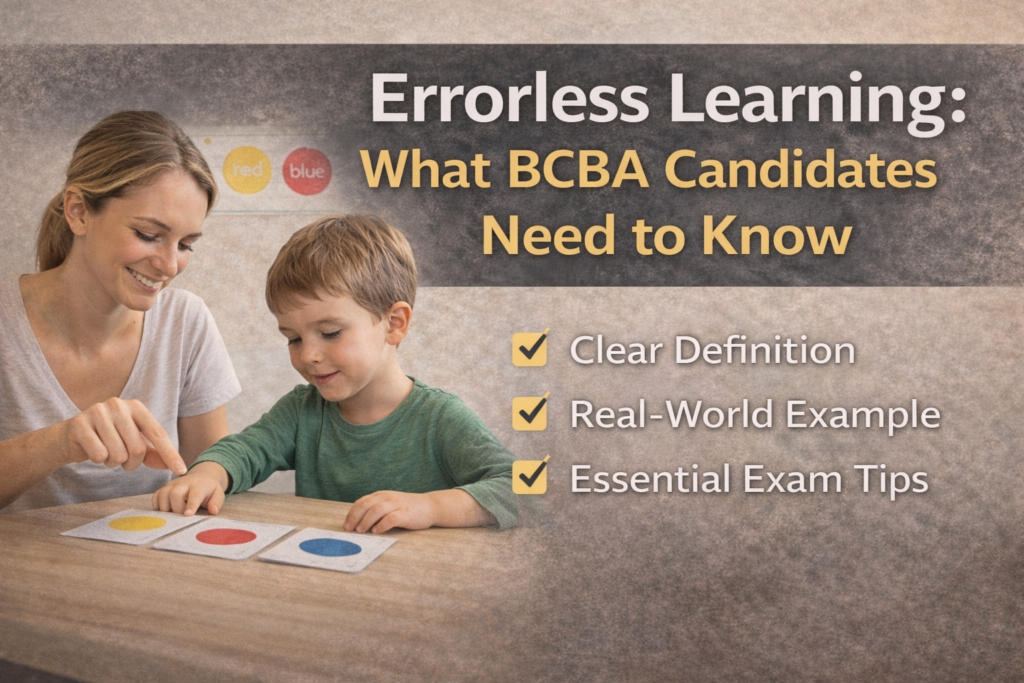
Errorless Learning: What BCBA Candidates Need to Know
Errorless learning is a common teaching strategy in applied behavior analysis (ABA), and it appears regularly on the BCBA® exam.
Many candidates understand the general idea but struggle to explain how error-free learning works, when to use it, or how it differs from trial-and-error learning. On the exam, these details matter.
This article explains error-free learning in clear, practical terms. You will learn the definition, see real-world examples, understand common procedures, and review BCBA exam tips so you can answer related questions with confidence.
What Is Errorless Learning in ABA?
Definition (BCBA task-list style)
Errorless learning is a teaching approach in which prompts are arranged so that the learner makes few or no errors while acquiring a new skill.
The key idea is simple:
-
The instructor prevents errors
-
Correct responses contact reinforcement
-
Errors are minimized from the start
Error-free learning Learning is often used when teaching new skills, especially to learners who may become frustrated or engage in problem behavior when they make repeated mistakes.
Why Errorless Learning Is Used in ABA
Error-free learning is not about “making things too easy.” It is about efficient and humane skill acquisition.
This approach helps:
-
Reduce learner frustration
-
Prevent practicing incorrect responses
-
Increase contact with reinforcement
-
Build strong stimulus control early
From an ethical perspective, minimizing errors can reduce escape-maintained problem behavior and support a more positive learning environment.
Errorless Learning vs Trial-and-Error Learning
This comparison is common on the BCBA exam.
Errorless learning
-
Prompts are provided before the learner can respond incorrectly
-
Correct responses occur almost immediately
-
Reinforcement is frequent early in teaching
Trial-and-error learning
-
Learner is allowed to respond independently right away
-
Errors are corrected after they occur
-
Can result in repeated mistakes before mastery
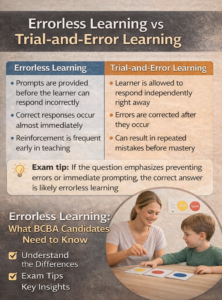
Exam tip:
If the question emphasizes preventing errors or immediate prompting, the correct answer is likely error-free learning
Common Errorless Learning Procedures
Errorless learning is not one single procedure. It is a teaching strategy that can be implemented in different ways.
Most-to-Least Prompting
The instructor starts with the most intrusive prompt needed to ensure a correct response, then gradually fades prompts.
Example:
A teacher physically guides a learner to point to the correct picture, then moves to modeling, then to a verbal prompt, and finally to independence.
Why this is errorless:
-
Errors are prevented at the start
-
Prompt fading transfers control to the natural stimulus
Time Delay Procedures
The instructor controls when prompts are delivered.
0-second time delay
The prompt is delivered immediately after the instruction.
Progressive time delay
A brief delay is added before the prompt, allowing the learner a chance to respond independently.
Why this is errorless:
-
Prompts still prevent most errors
-
Independence increases gradually
Stimulus Fading
The instructor alters stimulus features to guide correct responding.
Example:
Teaching letter discrimination by starting with a very large, bold target letter and gradually reducing its size.
Why this is errorless:
-
The correct stimulus stands out
-
Discrimination errors are minimized
Everyday Example of Errorless Learning
A child is learning to identify colors.
The instructor says, “Touch red,” while immediately pointing to the red card (prompt). The child touches the correct card and receives praise.
Over time, the instructor fades the pointing prompt until the child responds independently.
Result:
-
The child rarely practices incorrect color names
-
Correct responses are reinforced from the start
This is a classic example of error-free learning.
Errorless Learning in Treatment Planning
When designing ABA programs, error-free learning is especially helpful when:
-
Teaching new or complex skills
-
Working with learners who have low tolerance for errors
-
Introducing academic or communication tasks
-
Preventing problem behavior linked to task difficulty
Important considerations:
-
Prompts must be systematically faded
-
Reinforcement should be immediate and meaningful
-
Data should show increasing independence over time
If prompts are not faded, error-free learning can lead to prompt dependence, which is a common implementation mistake.
How Errorless Learning Appears on the BCBA Exam
BCBA exam questions often describe error-free learning without using the label.
Look for these clues:
-
Prompts are delivered immediately
-
Errors rarely occur
-
The learner contacts reinforcement quickly
-
Prompts are faded gradually
Trick answers may include:
-
“Providing corrective feedback after errors”
-
“Allowing the learner to try independently until correct”
If errors are allowed to happen repeatedly, the procedure is not error-free learning
Common Mistakes BCBA Candidates Make
-
Thinking errorless learning means “never fading prompts”
-
Confusing error-free learning with overprompting
-
Assuming it prevents independence
-
Forgetting that it is a strategy, not a single procedure
Remember:
Errorless learning supports independence when implemented correctly.
Quick Study Checklist
Before the exam, make sure you can:
-
Define errorless learning in your own words
-
Explain why minimizing errors can be beneficial
-
Identify most-to-least prompting and time delay procedures
-
Distinguish error-free learning from trial-and-error learning
-
Recognize exam questions describing how to learn with minimal errors
Final Thoughts
Errorless learning is a powerful teaching strategy in ABA when used intentionally and systematically.
By preventing repeated errors, learners experience more success, more reinforcement, and less frustration. For BCBA candidates, learning with minimal errors means you can design better programs and answer exam questions with clarity.
When you focus on how prompts are arranged and faded, error-free learning becomes easy to recognize—both in practice and on the BCBA® exam.


