
What is Differential Reinforcement of Other Behavior (DRO)?
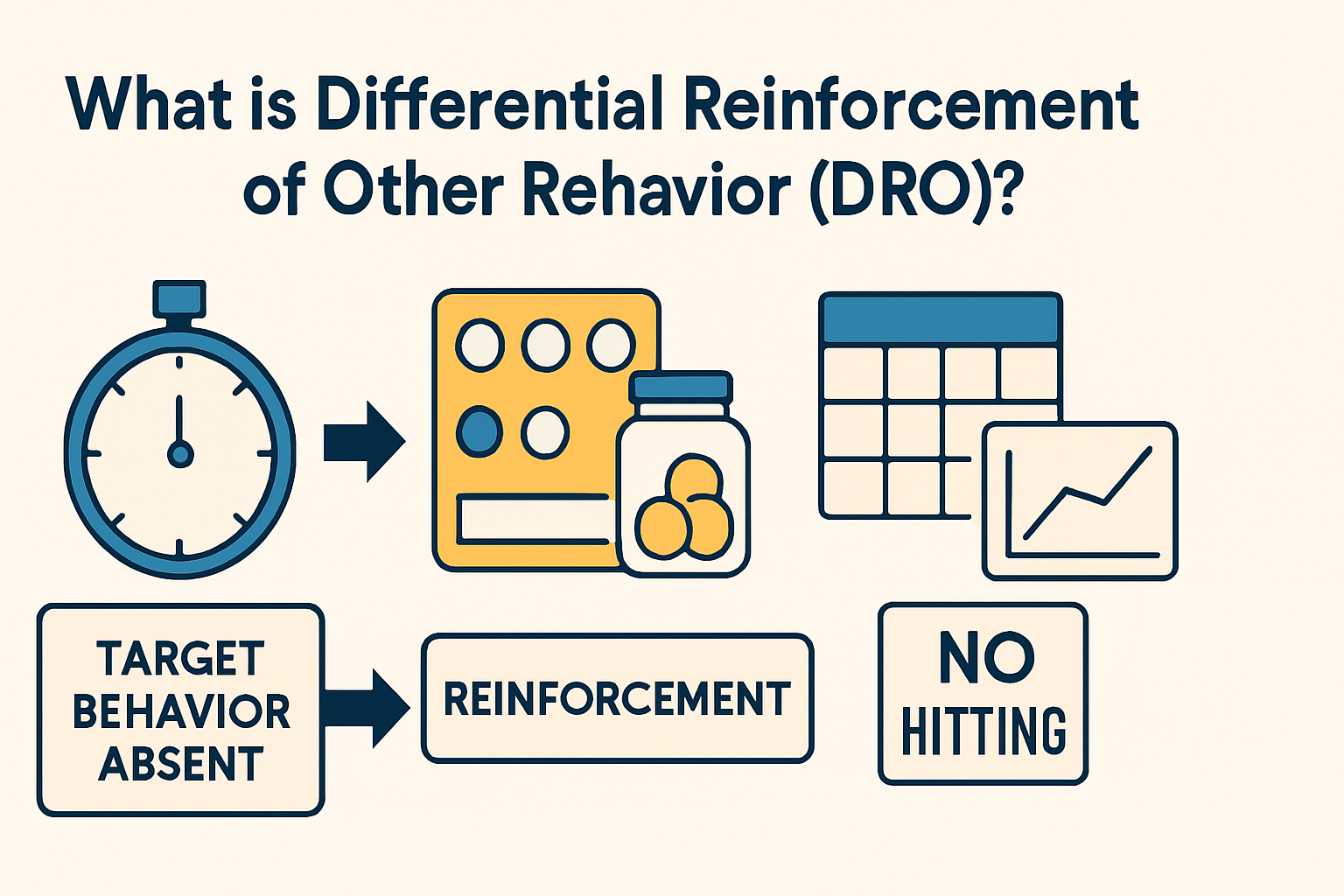
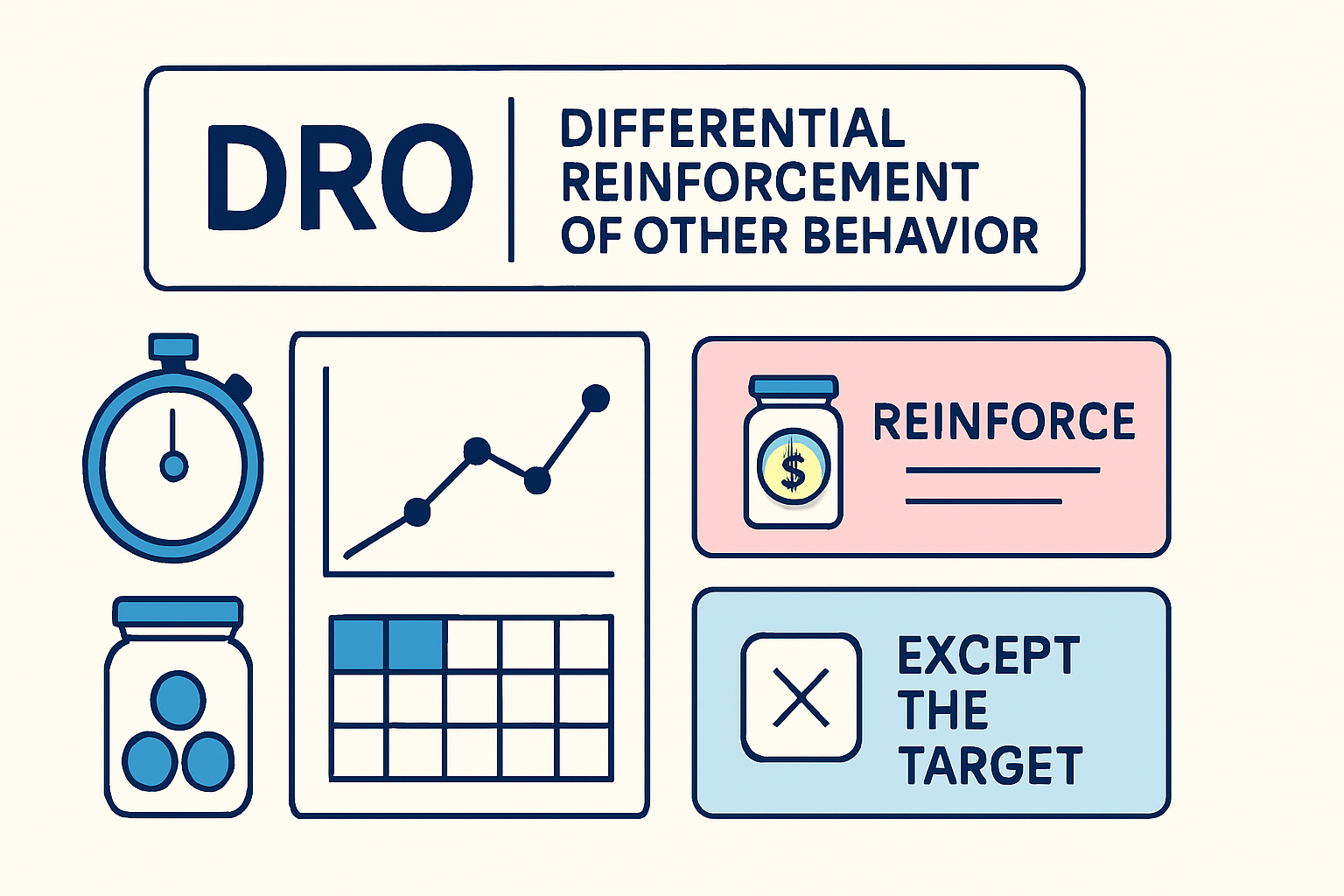
Differential reinforcement of other behavior is an evidence-based intervention that delivers reinforcement contingent on the absence of a target behavior for a specified time interval. This procedure focuses on strengthening any behavior except the one you’re trying to reduce.
Table of Contents
- What is Differential Reinforcement of Other Behavior (DRO)?
- Implementing DRO: Step-by-Step Applied Examples
- DRO on the BCBA Exam: Relevance and Common Traps
- Quick-Reference DRO Implementation Checklist
- Summary and Key Takeaways for Your Studies
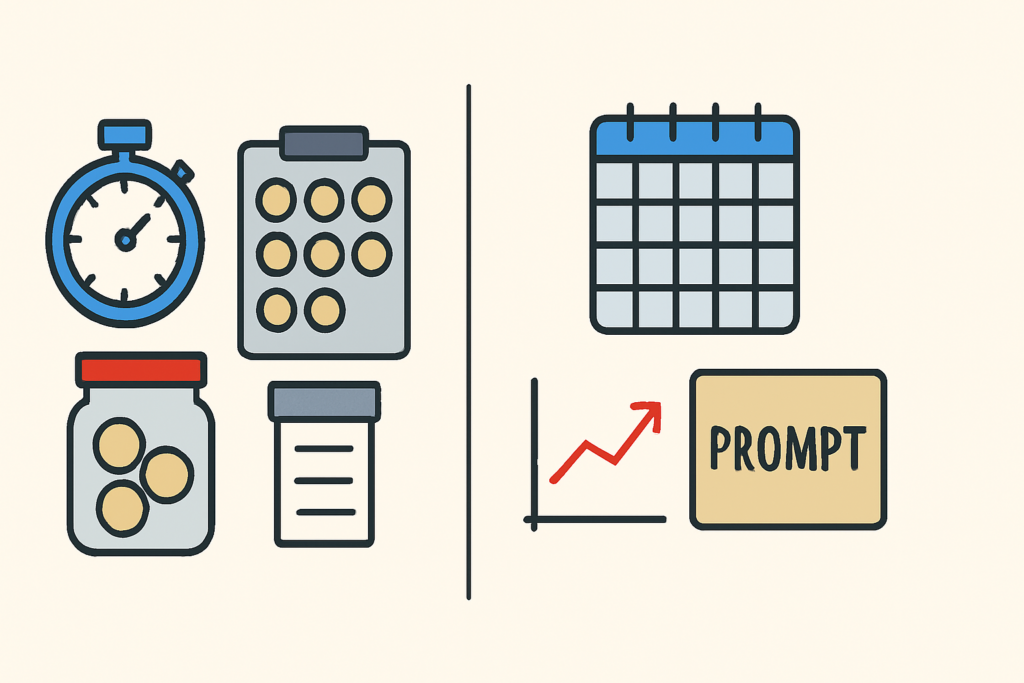
The core principle involves setting a timer and providing reinforcement only if the target behavior doesn’t occur during that interval. If the behavior happens, you reset the timer and start over.
The Core Principle: Reinforcing Anything Else
Unlike other differential reinforcement procedures, DRO doesn’t require teaching a specific alternative behavior. You reinforce the client for engaging in any behavior except the target. This makes it particularly useful when the target behavior serves automatic reinforcement or when multiple alternative behaviors already exist in the client’s repertoire.
There are two main interval types: whole-interval DRO requires the behavior to be absent for the entire interval, while momentary DRO only checks at specific moments. The choice depends on the behavior’s frequency and the practical constraints of implementation.
Implementing DRO: Step-by-Step Applied Examples
Moving from theory to practice requires understanding how to implement DRO procedures effectively. These examples demonstrate the process from assessment to intervention.
Example 1: Reducing Classroom Disruption (Attention-Maintained)
A 4th-grade student frequently shouts out during independent work time. ABC data analysis reveals the function is peer attention, with shouting occurring approximately every 3-5 minutes.
- Step 1: Set initial interval at 2 minutes (slightly below baseline frequency)
- Step 2: Use a visual timer the student can see
- Step 3: Deliver teacher praise and a small token when 2 minutes pass without shouting
- Step 4: If shouting occurs, reset timer immediately without comment
- Step 5: Gradually increase interval to 5, then 10 minutes as success continues
- Step 6: Collect data on both shouting frequency and reinforcement delivery
Example 2: Decreasing Hand Mouthing (Automatic Reinforcement)
A young client with autism engages in hand mouthing during unstructured time. The behavior appears to serve a sensory function, occurring most frequently when the client is bored or transitioning between activities.
- Step 1: Conduct a preference assessment to identify competing sensory items
- Step 2: Implement momentary DRO with 30-second checks
- Step 3: At each check point, if hands are not in mouth, provide access to chewy tube or vibrating toy
- Step 4: Use interval recording to track mouthing occurrence
- Step 5: Systematically thin reinforcement schedule as behavior decreases
- Step 6: Monitor for response generalization to other appropriate sensory behaviors
DRO on the BCBA Exam: Relevance and Common Traps
Understanding differential reinforcement procedures is essential for BCBA candidates. These concepts appear frequently across multiple exam domains.
Distinguishing DRO from DRA and DRI
Many exam questions test your ability to differentiate between similar procedures. DRO reinforces any behavior except the target, while DRA reinforces a specific alternative behavior and DRI reinforces a behavior physically incompatible with the target.
- DRO: “Reinforce any other behavior” – focus on absence
- DRA: “Reinforce this specific alternative” – focus on replacement
- DRI: “Reinforce this incompatible behavior” – focus on physical prevention
For more on differential reinforcement procedures, see our comprehensive guide on differential reinforcement in ABA.
Pitfalls in Procedure and Exam Questions
Common mistakes include confusing interval types, failing to thin reinforcement appropriately, and selecting DRO when another procedure would be more effective.
- Trap 1: Using whole-interval DRO for high-frequency behaviors instead of momentary DRO
- Trap 2: Not adjusting intervals based on baseline data and progress
- Trap 3: Choosing DRO when the client needs to learn a specific replacement skill (DRA would be better)
- Trap 4: Forgetting to pair reinforcement with descriptive praise to build stimulus control
- Trap 5: Overlooking the importance of treatment integrity measures
For additional exam strategies, explore our BCBA exam study framework.
Quick-Reference DRO Implementation Checklist
Use this actionable checklist for both clinical practice and exam preparation.
- Conduct functional assessment to identify behavior function
- Collect baseline data on target behavior frequency
- Select appropriate interval type (whole vs. momentary)
- Set initial interval slightly below baseline frequency
- Identify potent reinforcers through preference assessment
- Establish clear criteria for reinforcement delivery
- Implement data collection system for both behavior and reinforcement
- Train staff on procedure and treatment integrity measures
- Systematically thin reinforcement schedule as behavior decreases
- Monitor for side effects like response bursting or novel problem behaviors
- Plan for generalization and maintenance from the beginning
Summary and Key Takeaways for Your Studies
Differential reinforcement of other behavior is a powerful tool when applied correctly. Remember these essential points for both clinical practice and exam success.
First, DRO reinforces the absence of behavior rather than teaching specific alternatives. This makes it particularly useful for behaviors maintained by automatic reinforcement or when multiple appropriate behaviors already exist. Second, proper implementation requires careful interval selection based on baseline data and systematic schedule thinning as behavior decreases.
For BCBA exam preparation, focus on distinguishing DRO from other differential reinforcement procedures. Understand when each procedure is most appropriate based on assessment data. Remember that DRO should not be your first choice when the client needs to learn a specific replacement skill—in those cases, DRA or functional communication training would be more appropriate.
Finally, always consider ethical implementation and monitor for potential side effects. For more information on ethical considerations in ABA, refer to the BACB Ethics Code and our guide on ethics in ABA practice.


