

What is Differential Reinforcement of Other Behavior (DRO)?
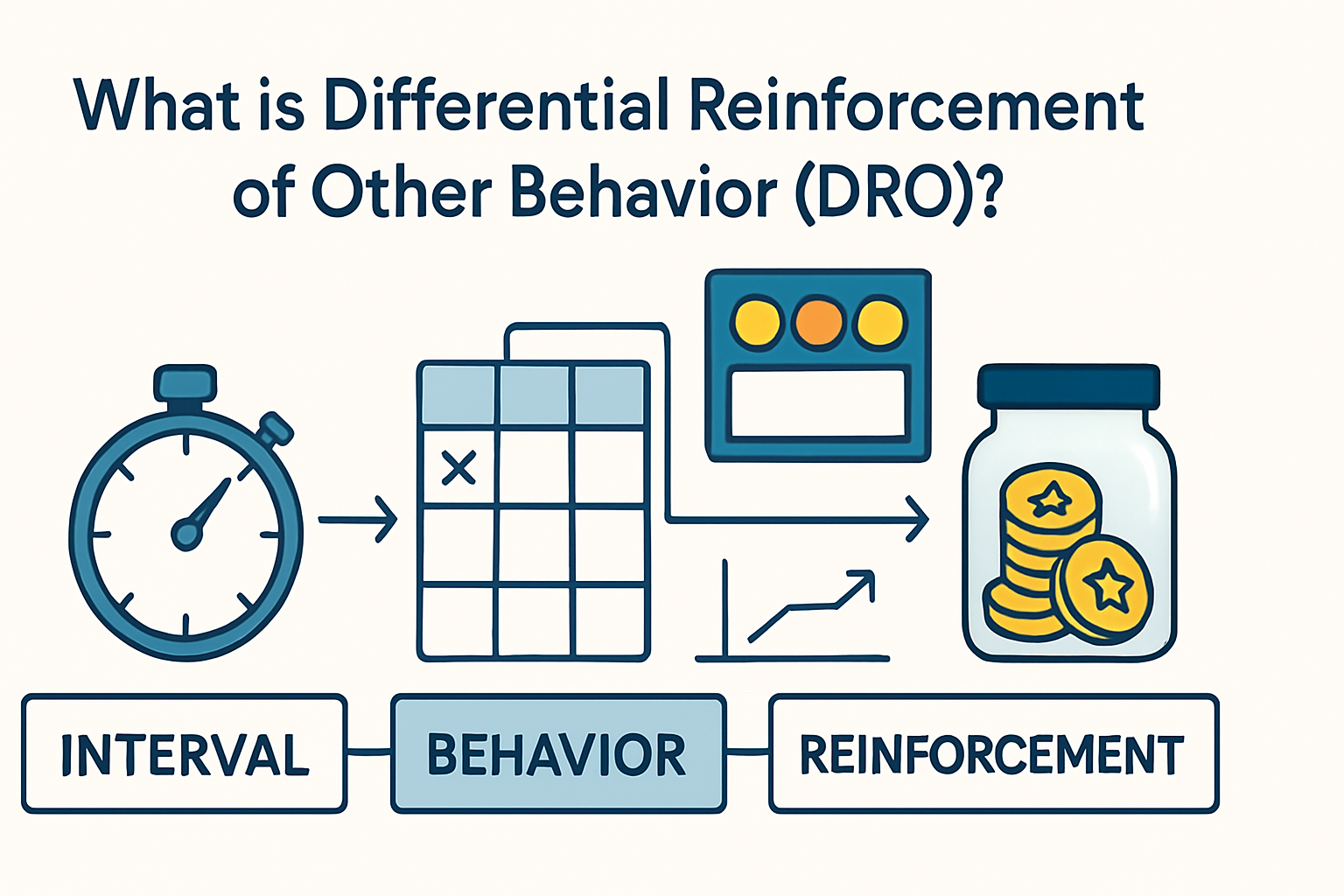
Differential Reinforcement of Other Behavior (DRO) is a reinforcement-based procedure where reinforcement is delivered contingent on the target behavior not occurring during a specified interval. The core principle focuses on strengthening any behavior except the one you want to reduce.
Table of Contents
- What is Differential Reinforcement of Other Behavior (DRO)?
- Implementing DRO: Step-by-Step Examples for BCBAs
- DRO on the BCBA Exam: Relevance and Common Traps
- DRO Quick-Reference Checklist for Practitioners
- Summary and Key Takeaways
- References
This approach differs fundamentally from punishment procedures. While punishment suppresses behavior through aversive consequences, DRO builds alternative behavioral patterns through positive reinforcement.
The Core Principle: Reinforcing Any Other Behavior
In DRO, you establish a time interval and deliver reinforcement only if the problem behavior does not occur during that period. The reinforcement can be delivered for literally any other behavior the individual engages in, making it a versatile tool in behavior reduction plans.
The procedure requires careful monitoring of time intervals and consistent application of reinforcement criteria. When implemented correctly, DRO can effectively reduce challenging behaviors while maintaining a positive therapeutic environment.
DRO vs. Punishment: A Critical Ethical Distinction
A key distinction for BCBA candidates is understanding that DRO is not a punishment procedure. It operates through reinforcement principles rather than suppression. This ethical consideration makes DRO particularly valuable when working with vulnerable populations.
Unlike punishment, which may have side effects like emotional responding or escape behaviors, DRO focuses on building an alternative behavioral repertoire. This aligns with the BACB’s emphasis on least restrictive interventions and positive behavior support approaches.
Implementing DRO: Step-by-Step Examples for BCBAs
Effective DRO implementation requires understanding the function of behavior and designing appropriate reinforcement schedules. Let’s examine two common scenarios with different behavioral functions.
Example 1: DRO for Attention-Maintained Behavior
Scenario: A 7-year-old child engages in table-tapping during academic work sessions. Functional assessment indicates the behavior is maintained by teacher attention (social positive reinforcement).
- Baseline data: Tapping occurs approximately every 45 seconds during work periods
- DRO interval: Start with 30-second intervals based on baseline frequency
- Reinforcement: Verbal praise and a small sticker contingent on no tapping for 30 seconds
- Data collection: Record tapping frequency and successful intervals on a partial interval recording sheet
- Schedule thinning: Gradually increase interval to 1 minute, then 2 minutes as success criteria are met
This example demonstrates how DRO can address attention-maintained behaviors without using extinction bursts that might occur with pure extinction procedures.
Example 2: DRO for Escape-Maintained Behavior
Scenario: A middle school student engages in verbal refusal during math assignments. Functional analysis reveals the behavior is maintained by escape from difficult tasks (negative reinforcement).
- Baseline assessment: Refusals occur approximately every 3 minutes of work time
- DRO procedure: 2-minute work intervals with no refusal earns a 30-second break
- Reinforcer: Brief escape from task demands (negative reinforcement)
- Shaping considerations: Initially accept approximations like partial task completion
- Fading procedure: Gradually increase work interval duration while maintaining reinforcement value
This application shows how DRO can be combined with task modification and appropriate reinforcement schedules to reduce escape behaviors effectively.
DRO on the BCBA Exam: Relevance and Common Traps
Understanding DRO is essential for the BCBA exam, particularly in sections covering behavior reduction procedures and ethical intervention selection. Many questions test your ability to distinguish DRO from similar procedures.
Distinguishing DRO from DRA and DRI
The key differentiator lies in what behavior receives reinforcement. In Differential Reinforcement of Alternative Behavior (DRA), you reinforce a specific alternative behavior. In Differential Reinforcement of Incompatible Behavior (DRI), you reinforce a behavior that cannot occur simultaneously with the target behavior.
- DRO: Reinforces absence of target behavior (any other behavior qualifies)
- DRA: Reinforces a specific alternative behavior that serves the same function
- DRI: Reinforces a behavior physically incompatible with the target behavior
For more on differential reinforcement procedures, see our comprehensive guide on differential reinforcement in ABA.
Top 3 Exam Traps to Avoid
BCBA exam questions often contain subtle distinctions that can trip up unprepared candidates. Here are the most common traps related to DRO:
- Confusing DRO with NCR: Noncontingent reinforcement delivers reinforcement on a time-based schedule regardless of behavior, while DRO is contingent on behavior absence
- Misidentifying interval schedules: Fixed-moment DRO checks only at interval end points, while whole-interval DRO requires absence throughout the entire interval
- Forgetting skill-building limitations: DRO reduces behavior but doesn’t teach new skills; it should often be combined with skill acquisition programs
Understanding these distinctions is crucial for selecting appropriate interventions based on functional behavior assessment results.
DRO Quick-Reference Checklist for Practitioners
Use this checklist when designing or implementing DRO procedures in clinical practice:
- Conduct functional assessment to identify maintaining variables
- Establish baseline data on target behavior frequency
- Select appropriate interval based on baseline (typically 50-75% of inter-response time)
- Identify potent reinforcers through preference assessment
- Define clear criteria for reinforcement delivery
- Train staff consistently on implementation procedures
- Collect ongoing data to monitor effectiveness
- Plan for schedule thinning as behavior reduces
- Consider combining with skill-building procedures when appropriate
- Monitor for side effects like response bursting or novel problem behaviors
This systematic approach ensures ethical and effective implementation of DRO procedures.
Summary and Key Takeaways
Differential Reinforcement of Other Behavior represents a positive, reinforcement-based approach to behavior reduction. Its effectiveness depends on accurate functional assessment, appropriate interval selection, and consistent implementation.
Key points to remember include DRO’s distinction from punishment procedures, its focus on reinforcing behavior absence rather than specific alternatives, and its common combination with other interventions for comprehensive treatment plans. For BCBA candidates, mastering DRO concepts requires understanding both the procedural details and the ethical considerations that guide its application in diverse clinical settings.
When studying for the exam, focus on distinguishing DRO from similar procedures like DRA and DRI, recognizing appropriate applications based on behavioral function, and identifying common implementation errors. These competencies align with the BACB’s emphasis on evidence-based, ethical behavior analytic practice as outlined in resources like the BCBA Test Content Outline
.


