

Differential reinforcement of incompatible behavior represents a proactive approach to behavior reduction that emphasizes teaching rather than suppressing. This ethical intervention strategy focuses on reinforcing behaviors that cannot occur simultaneously with target problem behaviors, making it a cornerstone of compassionate ABA practice.
Table of Contents
- What is Differential Reinforcement of Incompatible Behavior?
- Applying DRI: Worked Examples for BCBA Candidates
- DRI on the BCBA Exam: Relevance and Common Traps
- Quick-Reference DRI Implementation Checklist
What is Differential Reinforcement of Incompatible Behavior?
DRI involves systematically reinforcing a specific alternative behavior that is physically impossible to perform alongside the target problem behavior. The incompatibility requirement distinguishes this procedure from other differential reinforcement approaches.
Core Definition and Key Mechanism
Differential reinforcement of incompatible behavior is defined as reinforcing a behavior that has a response topography making it physically impossible to perform simultaneously with the problem behavior. The incompatible requirement means both behaviors cannot co-occur due to physical constraints.
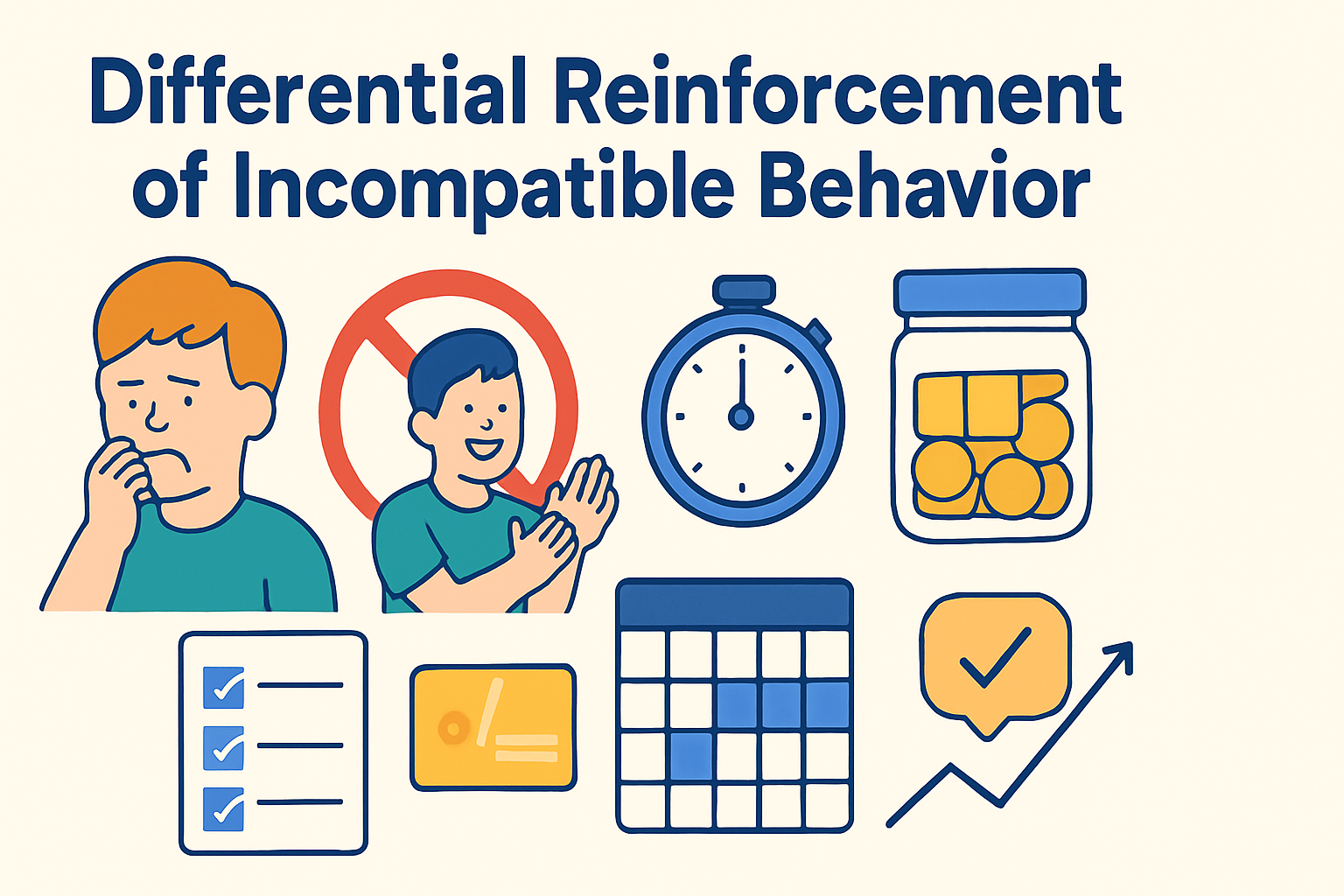
For example, reinforcing ‘hands on desk’ is incompatible with ‘hands flapping’ because the same body parts cannot perform both actions at once. This physical impossibility creates a natural barrier to problem behavior occurrence.
Why DRI Aligns with Ethical ABA Practice
DRI embodies several ethical principles central to modern ABA. It focuses on building skills rather than suppressing behavior, promotes client dignity through positive reinforcement, and aligns with the least restrictive intervention standard.
This approach demonstrates respect for the individual by teaching functional alternatives rather than relying on punishment procedures. For more on ethical considerations in ABA, see our guide on compassionate care and client dignity.
Applying DRI: Worked Examples for BCBA Candidates
Understanding DRI requires seeing it in action. These examples demonstrate how to apply the procedure with different behavior functions and settings.
Example 1: Reducing Hand Mouthing During Academic Work
Scenario: A 7-year-old child frequently mouths hands during table tasks, disrupting academic engagement. Hypothesized function: Automatic reinforcement/sensory stimulation.
ABC Analysis:
- Antecedent: Academic demand presented at table
- Behavior: Hand mouthing (target problem behavior)
- Consequence: Sensory stimulation maintained behavior
DRI Intervention: Reinforce hands manipulating a textured fidget toy or stacking blocks. These behaviors are physically incompatible with hand mouthing because the hands are engaged in alternative manipulation.
Reinforcement contingency: Provide social praise and brief breaks contingent on 30 seconds of appropriate toy manipulation without hand mouthing.
Example 2: Decreasing Out-of-Seat Behavior in a Classroom
Scenario: Student frequently leaves seat during group instruction, disrupting peers. Hypothesized function: Escape from academic demands.
ABC Analysis:
- Antecedent: Group instruction with teacher attention directed elsewhere
- Behavior: Out-of-seat movement
- Consequence: Brief escape from task demands
DRI Intervention: Reinforce ‘sitting with feet on floor, hands on desk’ position. This specific posture is physically incompatible with standing or walking away from the desk.
Reinforcement schedule: Use a variable interval schedule to reinforce maintained sitting, gradually increasing interval duration as behavior stabilizes.
DRI on the BCBA Exam: Relevance and Common Traps
BCBA exam questions often test your ability to distinguish between different differential reinforcement procedures and select the most appropriate intervention based on scenario details.
Distinguishing DRI from DRA and DRO
Understanding these distinctions is crucial for exam success:
- DRI (Differential Reinforcement of Incompatible Behavior): Reinforces behavior that is physically impossible to perform with target behavior
- DRA (Differential Reinforcement of Alternative Behavior): Reinforces any functionally equivalent alternative behavior, regardless of physical compatibility
- DRO (Differential Reinforcement of Other Behavior): Reinforces absence of target behavior during specific time intervals
The key distinction lies in the physical impossibility requirement unique to DRI. For a broader understanding of differential reinforcement procedures, explore our comprehensive differential reinforcement guide.
Frequent Exam Scenarios and Misconceptions
Exam questions often include subtle distinctions that can trick unprepared candidates:
- Trap 1: Reinforcing ‘quiet hands’ for vocal stereotypy – these are not physically incompatible behaviors
- Trap 2: Selecting DRI when the intervention doesn’t address the behavior function
- Trap 3: Confusing DRI with DRA when the alternative behavior is merely different, not physically impossible
- Trap 4: Overlooking the need for response topography analysis to verify incompatibility
Always ask: “Can both behaviors occur simultaneously?” If yes, it’s not DRI.
Quick-Reference DRI Implementation Checklist
Use this practical checklist to guide DRI implementation and study preparation:
- Conduct functional assessment to identify behavior function
- Analyze response topography to identify physically incompatible behaviors
- Select replacement behavior that serves same function but is physically incompatible
- Establish clear reinforcement contingency with appropriate schedule
- Collect baseline data on both target and replacement behaviors
- Implement intervention consistently across settings and staff
- Monitor treatment integrity and social validity
- Plan for generalization and maintenance from the start
Differential reinforcement of incompatible behavior represents a powerful tool in the ABA practitioner’s toolkit. By focusing on skill building rather than suppression, DRI aligns with contemporary ethical standards while effectively reducing problem behaviors. Remember that successful implementation requires careful response topography analysis and attention to the physical impossibility requirement that distinguishes DRI from other differential reinforcement procedures.
For additional resources on behavior intervention strategies, the BACB Ethics Code provides guidance on ethical intervention selection, and our article on functional communication training offers complementary approaches to behavior reduction.


