
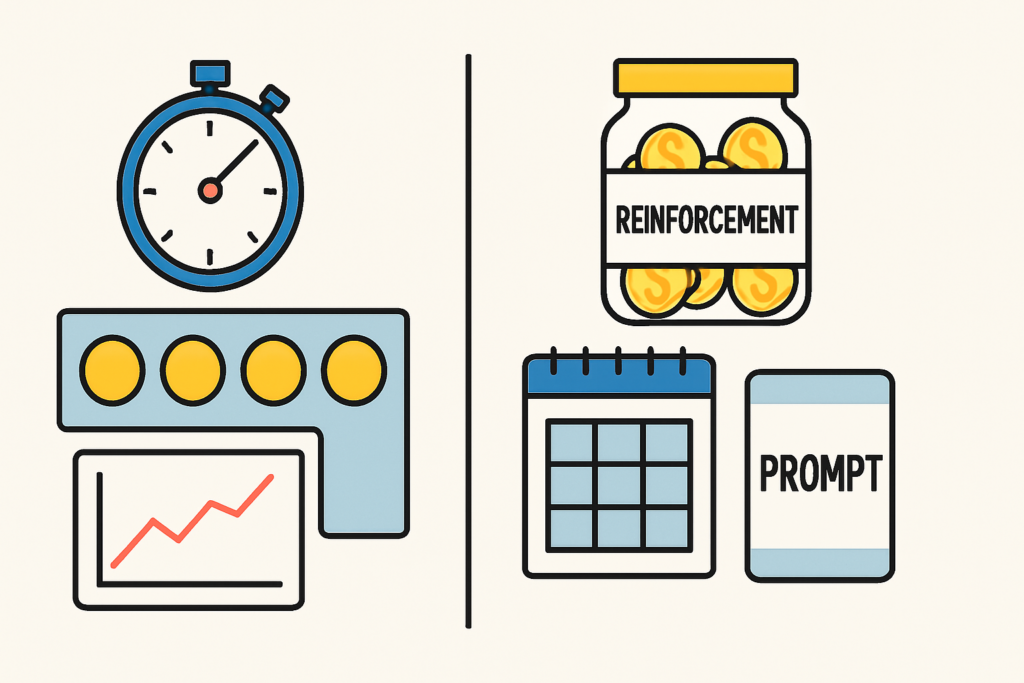
Differential reinforcement of high rates (DRH) is a specialized behavioral procedure that targets increasing the frequency of an existing behavior to a more desirable level. This technique involves delivering reinforcement only when the target behavior occurs at or above a predetermined high-rate criterion. Understanding DRH is essential for both clinical practice and exam preparation.
Table of Contents
- What is Differential Reinforcement of High Rates (DRH)?
- Applying DRH: Worked Examples from Practice
- DRH on the BCBA Exam: Relevance and Common Traps
- Quick-Reference Checklist: Implementing DRH
- Summary and Key Takeaways
What is Differential Reinforcement of High Rates (DRH)?
DRH focuses on building behavioral fluency by reinforcing responses that meet or exceed a specific frequency threshold. The procedure assumes the target behavior already exists in the individual’s repertoire but needs to occur more frequently to be functionally useful.
The Core Definition and Goal
In differential reinforcement of high rates, reinforcement is contingent upon the target behavior occurring at or above a preset criterion within a specified time period. The primary goal is to increase the rate of responding to establish fluency and efficiency. This differs from acquisition-focused procedures, as DRH targets behaviors that are already present but insufficiently frequent.
DRH vs. Other Differential Reinforcement Schedules
Understanding how DRH differs from other differential reinforcement procedures is crucial for exam success and clinical decision-making.
- DRH vs. DRO (Differential Reinforcement of Other Behavior): DRH reinforces high rates of a specific behavior, while DRO reinforces the absence of that behavior for a time interval
- DRH vs. DRA (Differential Reinforcement of Alternative Behavior): DRH increases frequency of an existing behavior, while DRA reinforces a different, more appropriate behavior
- DRH vs. DRL (Differential Reinforcement of Low Rates): DRH increases behavior frequency, while DRL decreases it by reinforcing lower rates of responding
- DRH vs. Shaping: DRH requires the behavior already exists, while shaping builds new behaviors through successive approximations
Applying DRH: Worked Examples from Practice
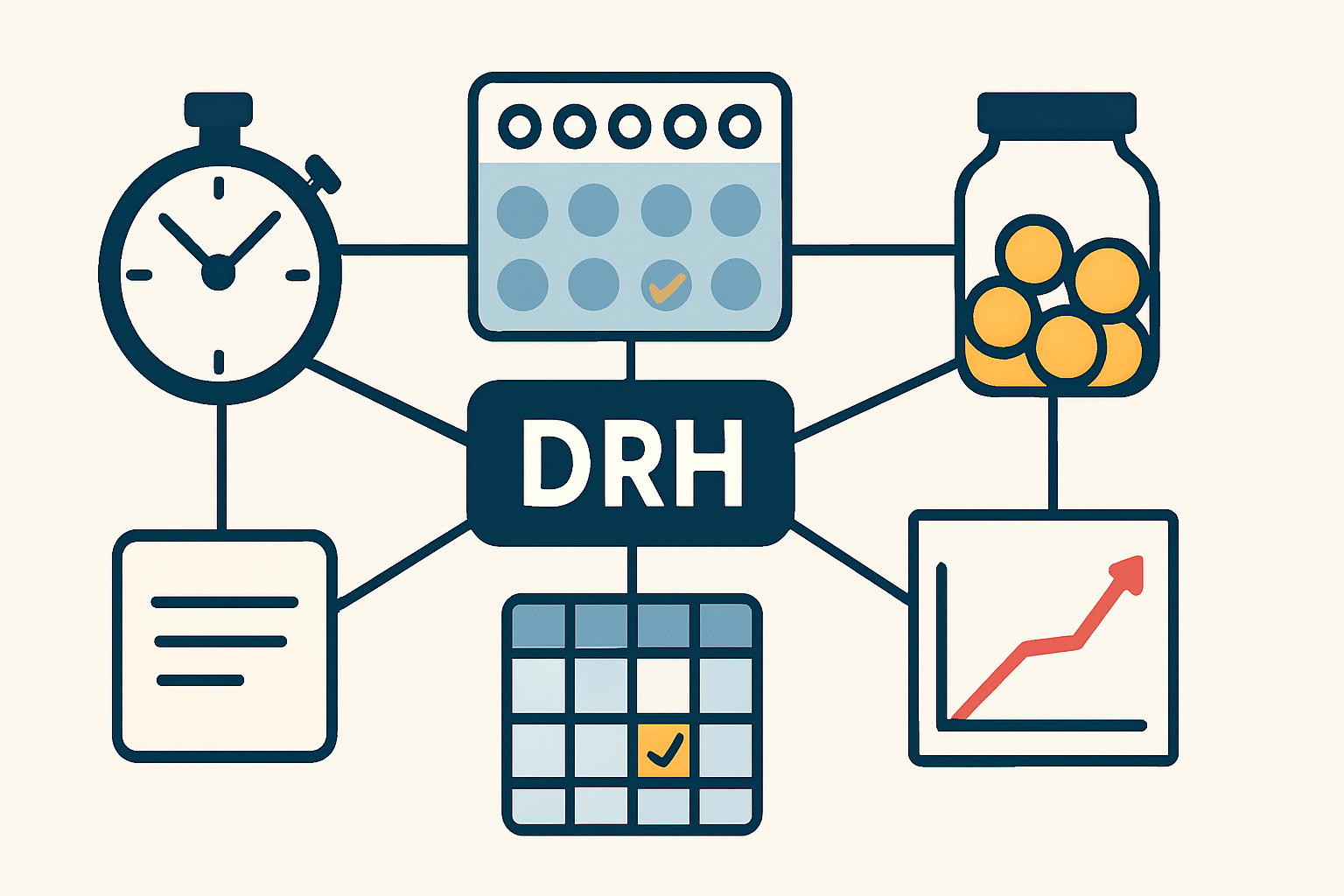
These practical scenarios demonstrate how DRH operates in real-world applications, complete with ABC analysis and hypothesized functions.
Example 1: Increasing Academic Response Fluency
A student correctly solves math facts but completes only 3-4 problems per minute. The goal is to increase this to 10 correct responses per minute using differential reinforcement of high rates.
- Antecedent: Math worksheet presented with 20 single-digit addition problems
- Behavior: Writing correct answers on the worksheet
- Consequence: Access to preferred computer time after completing 10 correct answers within 2 minutes
- Hypothesized Function: Positive reinforcement via access to preferred activity
- DRH Criterion: 10 correct responses within 2 minutes
Example 2: Improving Task Completion Rate in Vocational Training
An adult in a vocational program assembles widgets correctly but at a rate of 5 per hour, below the production benchmark of 12 per hour.
- Antecedent: Workstation with assembly materials and clear instructions
- Behavior: Complete widget assembly following quality standards
- Consequence: Token economy points exchangeable for breaks after assembling 6 widgets in 30 minutes
- Hypothesized Function: Positive reinforcement via token economy system
- DRH Criterion: 6 completed widgets within 30-minute work period
Example 3: Building Social Initiation Fluency
A child with autism initiates appropriately with peers but only 1-2 times during a 15-minute play session. The goal is to increase initiations to 5 times per session.
- Antecedent: Structured play period with preferred toys and peer present
- Behavior: Appropriate social initiation (sharing, asking to play, commenting)
- Consequence: Social praise and immediate peer response after 3 initiations within 10 minutes
- Hypothesized Function: Social reinforcement through peer interaction
- DRH Criterion: 3 appropriate social initiations within 10 minutes
DRH on the BCBA Exam: Relevance and Common Traps
DRH questions frequently appear on the BCBA examination and require careful analysis of behavioral scenarios. Understanding common question formats and misconceptions is essential for exam success.
How Exam Questions Are Framed
Exam questions typically present scenarios where a behavior exists but needs increased frequency. Common stems include: “Which differential reinforcement procedure would be most appropriate…” or “To increase the rate of an existing behavior…” Questions often require selecting DRH from among other differential reinforcement options like DRO, DRA, or DRL.
Frequent Misconceptions and Exam Traps
- Confusing DRH with DRL: The most common error is mixing up procedures that increase versus decrease behavior frequency
- Overlooking the pre-set criterion: Forgetting that DRH requires a specific, measurable rate criterion for reinforcement
- Mistaking for shaping: Assuming DRH builds new behaviors rather than increasing frequency of existing ones
- Ignoring baseline measurement: Failing to establish current performance levels before setting DRH criteria
- Confusing with other schedules: Mixing up DRH with fixed ratio or other reinforcement schedules
Quick-Reference Checklist: Implementing DRH
Use this actionable checklist when implementing differential reinforcement of high rates in practice or analyzing exam scenarios.
- Identify target behavior that already exists in the individual’s repertoire
- Measure baseline rate to establish current performance levels
- Set realistic criterion slightly above baseline but achievable
- Select potent reinforcer that will maintain increased responding
- Define time interval for measuring the rate criterion
- Implement consistently and monitor progress through data collection
- Adjust criteria gradually as performance improves toward ultimate goal
- Program for generalization across settings and maintain gains over time
Summary and Key Takeaways
Differential reinforcement of high rates is a valuable procedure for increasing behavioral fluency when skills exist but need to occur more frequently. Key points to remember include:
- DRH reinforces behaviors that meet or exceed a pre-set rate criterion
- The target behavior must already exist in the individual’s repertoire
- DRH differs fundamentally from DRL, which decreases behavior frequency
- Effective implementation requires careful baseline measurement and criterion setting
- On the BCBA exam, carefully analyze whether the scenario calls for increasing frequency of an existing behavior
- Common exam traps include confusing DRH with DRL or mistaking it for shaping procedures
For more information on related behavioral procedures, see our guide on differential reinforcement techniques and positive reinforcement strategies. Additional resources on behavioral fluency can be found through the Behavior Analyst Certification Board and peer-reviewed journals on applied behavior analysis.


