
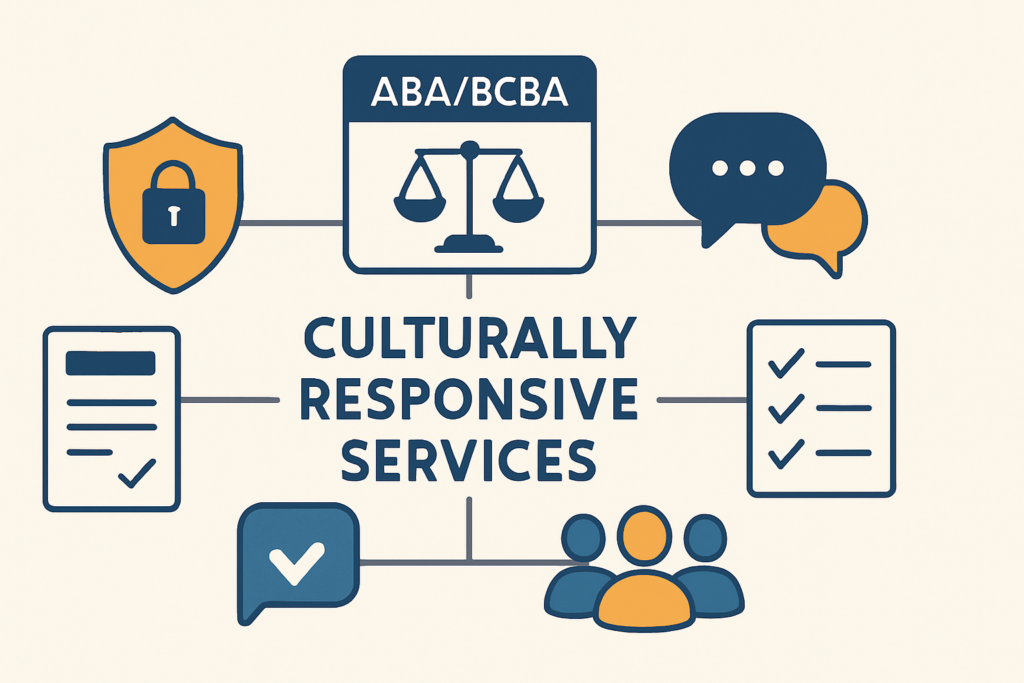
What Are Culturally Responsive Services in ABA?
Culturally responsive services represent a fundamental ethical requirement in applied behavior analysis practice. This approach goes beyond simple awareness to actively adapting assessment and intervention strategies based on cultural variables.
Table of Contents
- What Are Culturally Responsive Services in ABA?
- Applying the Principle: Three Worked Examples
- Culturally Responsive Services on the BCBA Exam
- Your Quick-Start Checklist for Practice
- Summary and Next Steps for Mastery
- References
The BACB Mandate: More Than Just Awareness
The BACB Ethics Code, specifically Code 1.07, requires behavior analysts to actively consider how cultural variables influence their work. This mandate emphasizes responsiveness rather than passive sensitivity. The core ethical principles of beneficence and respect for autonomy directly support this requirement.
Responsive practice means actively seeking consultation, adapting procedures, and collaborating with stakeholders to ensure interventions align with cultural values.
Defining ‘Culture’ for Behavioral Practice
In ABA practice, culture extends far beyond ethnicity to include multiple dimensions that influence behavior. These include:
- Family values and traditions that shape daily routines
- Communication styles including verbal and non-verbal patterns
- Family roles and decision-making structures
- Disability identity and community perspectives
- Socioeconomic factors affecting resource access
- Religious beliefs and dietary practices
- Educational experiences and learning expectations

Applying the Principle: Three Worked Examples
These concrete scenarios demonstrate how cultural factors influence assessment and intervention planning. Each example includes an ABC analysis and hypothesized function.
Example 1: Family Routines and Sleep Intervention
A bedtime intervention fails because it conflicts with a cultural norm of co-sleeping. The antecedent is the proposed solo bedtime routine, while the behavior shows parent non-adherence. The consequence maintains family routine and comfort.
The hypothesized function is escape from aversive social context (perceived rejection of family value). The responsive service involves collaborating to adapt the intervention within the existing co-sleeping framework.
Example 2: Eye Contact and Social Skills
A social skills program mandates eye contact for a child from a culture where direct eye contact with elders is disrespectful. The antecedent is the instruction ‘look at me,’ leading to behavior of non-compliance or aversive reaction. The consequence is avoidance of perceived disrespect.
The function is negative reinforcement (escape social transgression). The responsive service modifies the target behavior to ‘orient toward speaker’ or ‘verbal acknowledgment’ instead of direct eye contact.
Example 3: Reinforcement Selection and Religious Practice
A food reinforcer (gummy candy) is ineffective and causes tension due to family dietary restrictions (halal, kosher, vegetarian). The antecedent is offering a non-preferred or forbidden item, resulting in behavior of refusal. The consequence is loss of learning opportunity.
The function is escape from morally aversive stimulus. The responsive service involves conducting a preference assessment using culturally appropriate items and activities.
Culturally Responsive Services on the BCBA Exam
This topic appears frequently in application questions that test your ability to integrate cultural considerations into behavioral assessment and intervention planning.
Spotting Exam Traps and Key Distractors
Common traps include:
- Choosing ‘refer out’ as a first resort instead of seeking consultation or adaptation
- Confusing cultural sensitivity (knowledge) with cultural responsiveness (action)
- Overlooking intersectional cultural identities (autistic culture + ethnic culture)
- Assuming client values based on superficial characteristics
- Failing to consider how cultural variables affect social validity measures
Linking to the Task List
Culturally responsive services map directly to several Task List items:
- B-10: Cultural variables in assessment
- E-8: Considering contextual variables in interventions
- F-4: Communication with stakeholders
- G: Ethical practice and professional conduct
These connections emphasize how cultural considerations integrate throughout the behavior change process.
Your Quick-Start Checklist for Practice
Use this practical tool to implement culturally responsive services immediately in your practice and study.
Pre-Assessment and Planning Checklist
- Have I explicitly asked about family values, routines, and traditions relevant to the target behavior?
- Have I examined my own cultural assumptions about ‘appropriate’ behavior?
- Does my intervention plan allow for flexibility based on stakeholder input?
- Are my materials, reinforcers, and examples relevant to the client’s environment?
- Have I identified a colleague or resource for consultation if I encounter an unfamiliar cultural context?
- Have I considered how cultural factors might affect treatment integrity and social validity?
Summary and Next Steps for Mastery
Culturally responsive services require active adaptation rather than passive awareness. Successful implementation involves ongoing self-assessment, stakeholder collaboration, and flexible intervention design.
For exam preparation, focus on application questions that test your ability to integrate cultural considerations into functional assessment, intervention planning, and ethical decision-making. Review the ethics guidelines and practice applying them to diverse scenarios.
Continue developing your skills by seeking consultation, reading peer-reviewed literature on cultural competence in ABA, and participating in continuing education on this topic. Remember that culturally responsive practice enhances both ethical compliance and intervention effectiveness.


