

Understanding the distinction between cultural humility and cultural competence is essential for ethical ABA practice and BCBA exam success. While both concepts address working with diverse populations, they represent fundamentally different approaches to cultural understanding. This guide breaks down these critical concepts with practical applications for behavior analysts.
Table of Contents
- cultural humility cultural competence: Defining the Core Concepts for BCBA Practice
- Applied Examples: Humility vs. Competence in Action
- BCBA Exam Relevance and Common Traps
- Quick Checklist for Culturally Humble Practice
- Final Summary and Next Steps
cultural humility cultural competence: Defining the Core Concepts for BCBA Practice
Before applying these concepts in practice or on the exam, you need clear definitions. Both terms appear in the BACB Ethics Code, but they serve different functions in professional practice.
What is Cultural Competence in ABA?
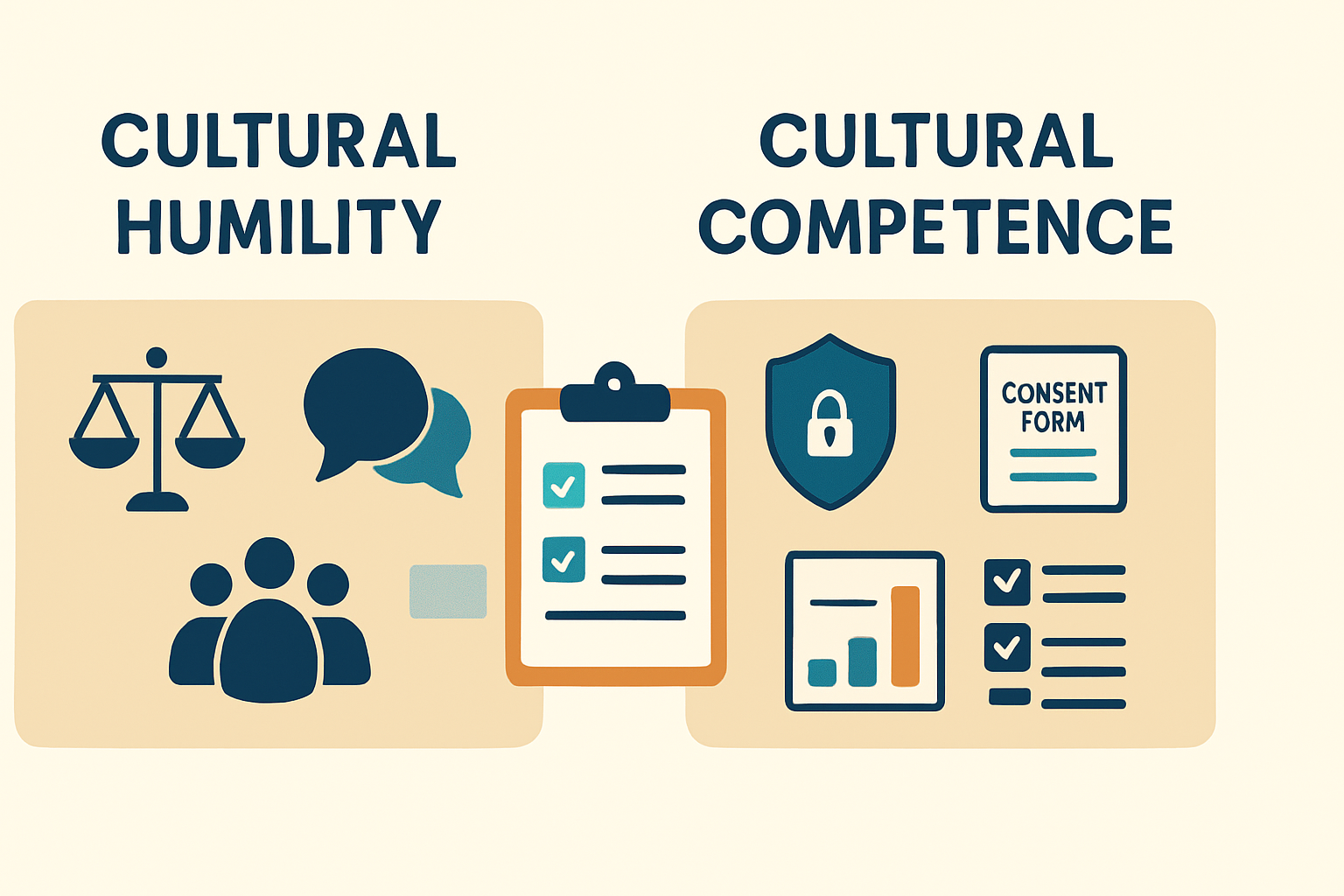
Cultural competence refers to the acquisition of knowledge and skills about specific cultural groups. It involves learning about cultural norms, values, and practices to work effectively with clients from different backgrounds. This approach focuses on developing a knowledge base about various cultures.
However, cultural competence has limitations. When treated as a checklist or endpoint, it can lead to stereotyping and assumptions about individuals based on group characteristics. The risk is applying generalized knowledge without considering individual variations within cultural groups.
What is Cultural Humility in ABA?
Cultural humility represents an ongoing process of self-reflection, acknowledging power imbalances, and maintaining a lifelong learning stance. Unlike competence, humility emphasizes continuous learning about each client’s unique experience rather than assuming knowledge based on cultural categories.
This approach requires behavior analysts to recognize their own cultural biases and limitations in understanding others’ experiences. Cultural humility aligns directly with ethical practice by prioritizing client autonomy and individualized understanding over presumed expertise.
Applied Examples: Humility vs. Competence in Action
Let’s examine how these approaches differ in real ABA scenarios. These examples illustrate the practical implications for assessment and intervention.
Example 1: Conducting a Functional Assessment
Scenario: You’re assessing a child whose family comes from a background where direct eye contact with authority figures is considered disrespectful.
A cultural competence approach might involve applying general knowledge about this cultural norm. The analyst might assume that avoiding eye contact is culturally appropriate behavior rather than potential escape behavior. This could lead to incomplete functional assessment data.
A cultural humility approach would involve:
- Asking the family about their specific communication norms
- Observing interactions within the family context
- Adapting assessment procedures to account for cultural factors
- Considering multiple potential functions for the behavior
The humility approach yields more accurate ABC data by avoiding assumptions based on cultural generalizations.
Example 2: Developing a Reinforcement Menu
Scenario: Designing reinforcement options for a teenage client from a specific cultural background.
A cultural competence approach might involve selecting reinforcers commonly associated with that age group or culture. This could include popular items or activities presumed to be motivating based on cultural knowledge.
A cultural humility approach would involve:
- Conducting collaborative preference assessments with the client
- Respecting individual preferences that may differ from cultural norms
- Considering family values around specific rewards or activities
- Adjusting reinforcement strategies based on ongoing client feedback
This approach ensures social validity by respecting individual and family values rather than applying cultural stereotypes.
BCBA Exam Relevance and Common Traps
Understanding these concepts is crucial for exam success. The BCBA exam frequently tests your ability to distinguish between these approaches in ethical scenarios.
Linking to the BACB Ethics Code
The BACB Ethics Code explicitly addresses cultural considerations. Code item 1.07, Cultural Responsiveness and Diversity, requires behavior analysts to actively engage in ongoing learning about cultural differences. This aligns more closely with cultural humility than with static competence.
Code item 2.0, Behavior Analysts’ Responsibility to Clients, emphasizes client-centered practice that respects individual differences. Cultural humility supports this ethical obligation by prioritizing understanding each client’s unique perspective over applying generalized cultural knowledge.
For comprehensive ethics preparation, review our ethics in ABA practice guide.
Spotting the Exam Distractors
Exam questions often include tempting but incorrect answers. Watch for these common traps:
- Answers that confuse cultural awareness with cultural humility
- Options promoting a checklist approach to cultural understanding
- Distractors that treat cultural competence as an endpoint rather than beginning
- Answers missing the ongoing process aspect of cultural humility
- Options emphasizing knowledge acquisition over relationship building
Remember that exam questions often test whether you recognize cultural humility as a lifelong learning process rather than an achieved state.
Quick Checklist for Culturally Humble Practice
Use this practical checklist to implement cultural humility in your ABA practice and prepare for exam questions on this topic.
- Regularly examine your own cultural biases and assumptions
- Approach each client as an individual, not a cultural representative
- Ask questions rather than assuming cultural knowledge applies
- Acknowledge power imbalances in therapeutic relationships
- Adapt assessment and intervention procedures based on client feedback
- Engage in continuous learning about diverse perspectives
- Collaborate with clients and families in decision-making processes
- Respect individual variations within cultural groups
For more on client-centered approaches, explore our guide on compassionate care and client dignity.
Final Summary and Next Steps
Cultural humility represents the ethical standard for modern ABA practice, emphasizing ongoing learning and client-centered approaches. While cultural competence provides foundational knowledge, it risks stereotyping when treated as an endpoint rather than a starting point.
For exam preparation, focus on questions that test your understanding of humility as a process-oriented approach rather than a knowledge-based achievement. Practice identifying scenarios where cultural humility leads to better clinical outcomes than cultural competence alone.
Remember that the BACB Ethics Code emphasizes cultural responsiveness as an ongoing professional responsibility. Integrate these concepts into your study of ethical decision-making and client-centered practice.
For additional exam preparation resources, consider our BCBA exam prep guide to strengthen your understanding of all exam domains.


