
continuous measurement ABA: What is Continuous Measurement in ABA?
Continuous measurement refers to recording every instance of a target behavior during an observation period. This approach provides the most accurate and complete data picture possible. It’s fundamental to ethical practice and aligns with the BACB Code requirements for data-based decision making.
Table of Contents
- continuous measurement ABA: What is Continuous Measurement in ABA?
- Key Continuous Measurement Procedures with Worked Examples
- Continuous Measurement on the BCBA Exam: Common Traps and How to Avoid Them
- Quick-Reference Checklist for Continuous Measurement
- Summary: From Study to Practice
The Core Definition and Its Importance
In applied behavior analysis, continuous measurement means documenting each occurrence of a behavior as it happens. This method captures the true frequency, duration, or intensity of behavior without estimation. The precision of continuous data collection directly supports effective intervention planning and evaluation.
Accurate measurement forms the foundation of evidence-based practice. Without reliable data, behavior analysts cannot determine if interventions are working or make ethical decisions about treatment modifications.
Continuous vs. Discontinuous: Knowing the Difference
The key distinction lies in data collection completeness. Continuous methods record all behavior instances, while discontinuous methods sample behavior at specific intervals. Momentary time sampling and partial interval recording are common discontinuous approaches.
Continuous measurement is ideal when you need precise data about behavior frequency, duration, or timing. Discontinuous methods may be necessary when resources are limited or when observing multiple behaviors simultaneously. The BCBA exam often presents scenarios requiring you to choose the appropriate method based on practical constraints and measurement goals.
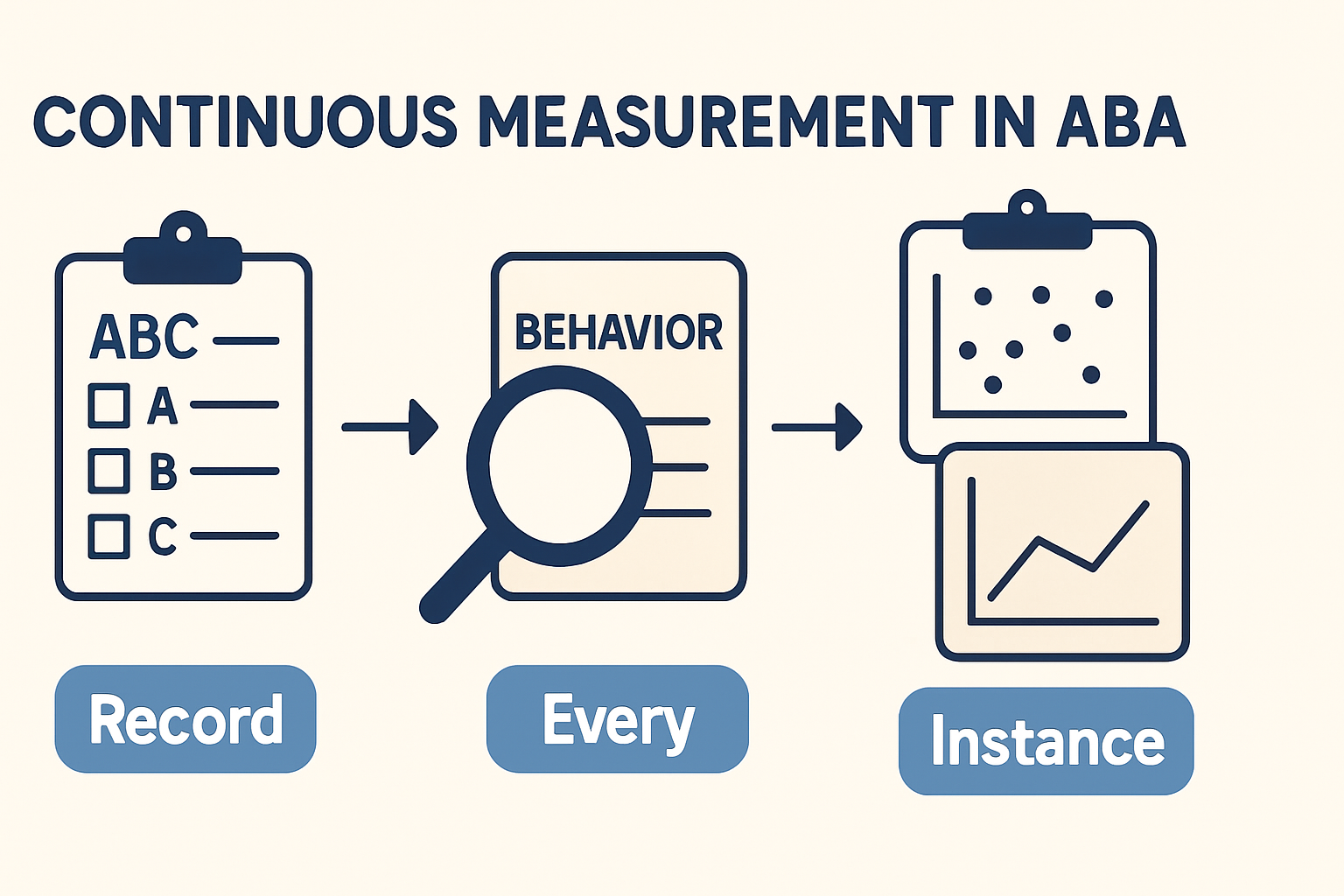
Key Continuous Measurement Procedures with Worked Examples
Understanding theory is essential, but application separates competent practitioners. Each continuous measurement procedure serves specific purposes and fits particular behavior topographies.
Frequency: Counting Each Instance
Frequency measurement involves counting discrete behavior occurrences. This method works best for behaviors with clear beginnings and endings.
Example: Hand-raising in classroom sessions
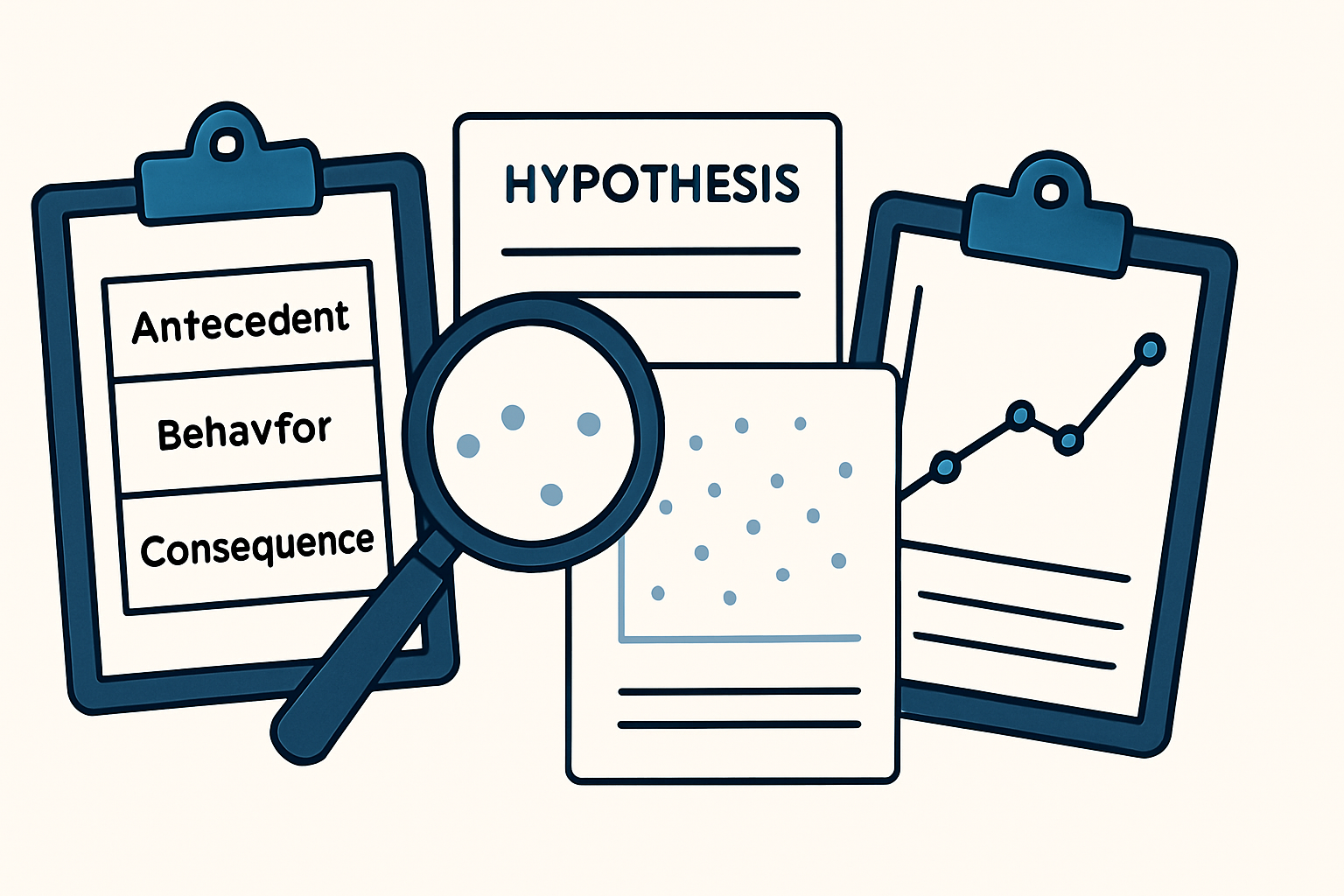
- Antecedent: Teacher asks a question to the class
- Behavior: Student raises hand (counted as one instance)
- Consequence: Teacher calls on student
- Hypothesized function: Access to adult attention and opportunity to answer
Frequency is appropriate for discrete behaviors like vocalizations, correct responses, or specific motor movements. When behaviors occur rapidly, consider using rate (frequency divided by time) instead.
Duration: Tracking How Long a Behavior Lasts
Duration recording measures the total time a behavior occurs. This method is essential for behaviors that vary in length rather than frequency.
Example: Tantrum behavior during transitions
- Antecedent: Transition from preferred activity (playground) to non-preferred (math work)
- Behavior: Crying, flopping, screaming (timed from start to stop)
- Consequence: Transition is delayed by 5 minutes
- Hypothesized function: Escape from academic demand
Related concepts include latency (time from antecedent to behavior onset) and inter-response time (time between behavior instances). Duration data helps identify patterns in behavior persistence.
Rate and Intensity: Adding Crucial Context
Rate measurement combines frequency with time, expressed as behaviors per minute or hour. This provides context about behavior density. Intensity or magnitude measures the force or severity of behavior, often using rating scales.
Example: Vocal stereotypy measured as 15 instances per minute (rate) or aggression measured on a 1-5 severity scale (intensity). These derived measures from continuous measurement procedures offer richer behavioral understanding.
For comprehensive data collection strategies, see our guide on data collection methods in ABA.
Continuous Measurement on the BCBA Exam: Common Traps and How to Avoid Them
Exam questions test both knowledge and application skills. Recognizing common pitfalls can improve your performance significantly.
Trap 1: Misapplying Measurement to the Wrong Behavior Topography
Selecting inappropriate measurement procedures is a frequent error. For example, attempting to use frequency recording for crying behavior often fails because defining discrete ‘instances’ of crying is challenging.
The correct choice might be duration recording or a partial interval method. Always consider whether the behavior has clear onset and offset points before choosing frequency measurement.
Trap 2: Confusing Continuous with Discontinuous Procedures
Many candidates struggle to distinguish between similar-sounding methods. Momentary time sampling (discontinuous) records whether behavior occurs at specific moments, while duration recording (continuous) tracks total time.
Remember: Continuous methods capture all behavior during observation. Discontinuous methods estimate behavior based on samples. The BACB provides detailed guidelines on measurement selection in their resources.
Trap 3: Overlooking Practical Constraints
Exam scenarios often present ideal measurement situations alongside real-world limitations. Continuous measurement might be theoretically best but impractical given available resources.
- One staff member observing five children simultaneously
- Limited observation time due to scheduling constraints
- Need to measure multiple behaviors concurrently
In such cases, discontinuous methods like whole interval recording or momentary time sampling may be more appropriate despite sacrificing some precision.
Quick-Reference Checklist for Continuous Measurement
Use this actionable summary for last-minute review and clinical decision-making.
- Define behavior operationally with clear onset/offset criteria
- Select measurement method based on behavior topography
- Choose frequency for discrete, countable behaviors
- Use duration for behaviors varying in length
- Calculate rate when frequency needs temporal context
- Consider intensity for behaviors varying in magnitude
- Assess resources before committing to continuous methods
- Document procedures clearly for replication and integrity checks
For more on measurement systems and their applications, explore our article on the seven dimensions of ABA.
Summary: From Study to Practice
Mastering continuous measurement procedures bridges the gap between academic knowledge and clinical competence. These skills support ethical practice by ensuring data accurately reflects behavioral reality.
On the BCBA exam, expect scenario-based questions testing your ability to select appropriate measurement methods. In practice, these decisions directly impact intervention effectiveness and client outcomes. Remember that measurement is not just technical—it’s an ethical responsibility.
Continuous measurement provides the foundation for all subsequent analysis and decision-making in ABA. Whether preparing for certification or refining clinical skills, prioritizing measurement accuracy remains essential. For additional exam preparation resources, visit the Behavior Analyst Certification Board website for official guidelines and updates.


