

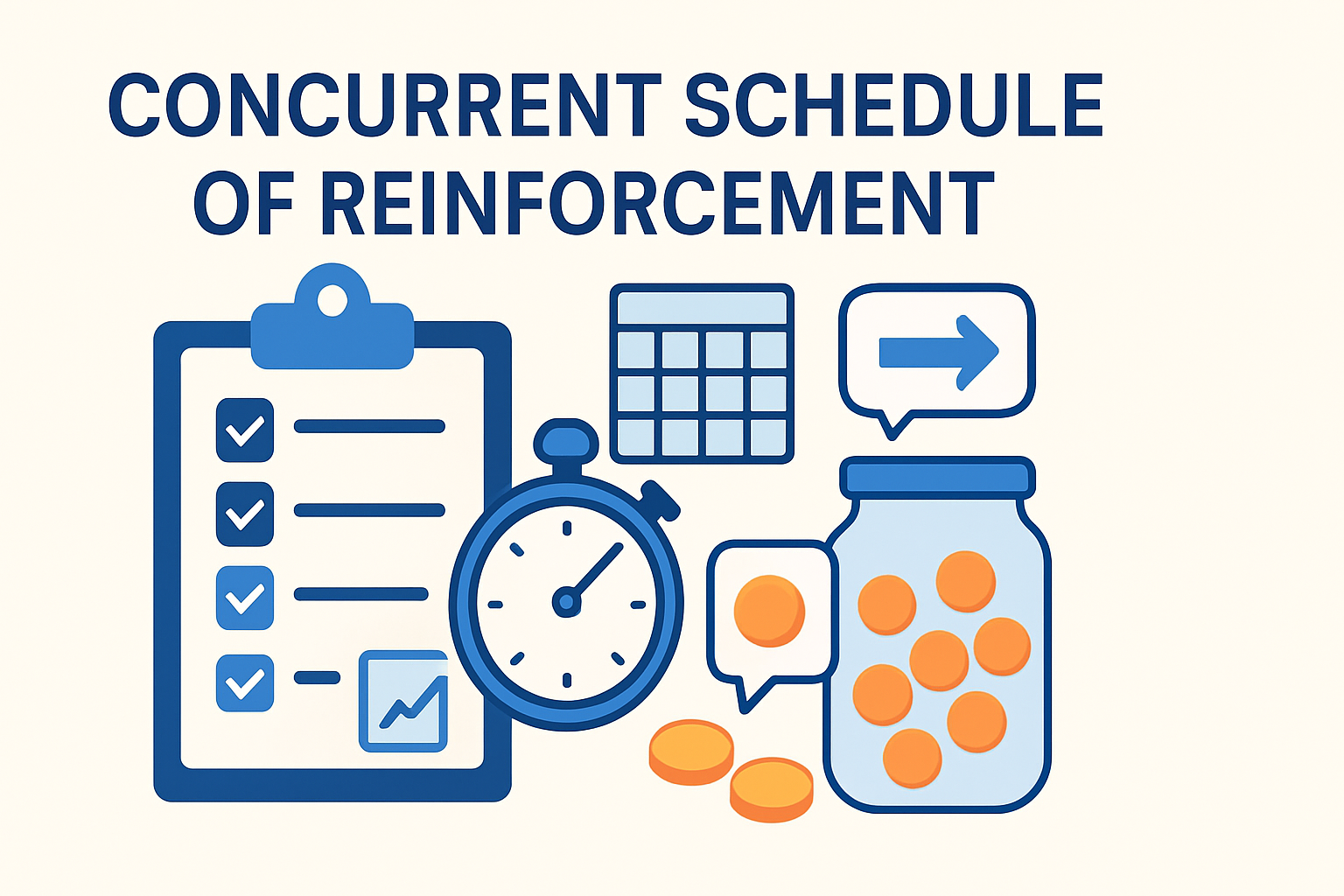
In applied behavior analysis, understanding how organisms allocate their responses between available options is crucial for designing effective interventions. A concurrent schedule of reinforcement represents one of the most important concepts for analyzing choice behavior. This arrangement occurs when two or more reinforcement schedules operate independently and simultaneously, allowing the individual to choose between them at any moment.
Table of Contents
- Concurrent Schedules of Reinforcement: What is a Concurrent Schedule of Reinforcement?
- Concurrent Schedules in Action: Applied ABA Examples
- The Matching Law and Response Allocation
- Concurrent Schedules on the BCBA Exam: Relevance and Common Traps
- Quick-Study Checklist for Concurrent Schedules
- References
Concurrent Schedules of Reinforcement: What is a Concurrent Schedule of Reinforcement?
A concurrent schedule involves two or more independent schedules that are simultaneously available to the organism. The key feature is that the individual can freely allocate their responses between the options based on the reinforcement contingencies in effect for each schedule.
This differs from other compound schedules where choice is not the primary focus. In concurrent arrangements, the organism’s response allocation provides valuable data about preference and reinforcer effectiveness.
The Defining Feature: Simultaneous Choice
The critical element that defines a concurrent schedule is the constant availability of choice. Unlike multiple schedules or mixed schedules, where distinct discriminative stimuli signal which schedule is active, concurrent schedules maintain both options as continuously available alternatives.
This simultaneous availability means the organism can switch between options at any time, creating a dynamic environment where response patterns reveal underlying preferences and the relative value of different reinforcers.
Concurrent Schedules in Action: Applied ABA Examples
Understanding theoretical definitions is important, but seeing how concurrent schedules operate in real-world ABA settings solidifies the concept. These examples demonstrate how choice behavior manifests in clinical and educational environments.
Example 1: The Homework Station (Client Choice)
Consider a child at a homework station with two academic tasks available simultaneously. The math worksheet follows a fixed-ratio 5 schedule where the child receives praise after every five problems completed. The reading task operates on a variable-interval 2-minute schedule where praise is delivered approximately every two minutes of sustained reading.
The antecedent is the presentation of both tasks. The concurrent availability allows the child to choose between them. The behavior involves allocating responses to either math or reading. The different consequences maintain the choice patterns. This arrangement might reveal a preference for more predictable reinforcement or easier task demands.
Example 2: Staff Engagement in a Clinic
In a clinical setting, a behavior technician might choose between assisting with a demanding self-care routine (following a fixed-interval 3-minute schedule for breaks) or preparing materials for a matching activity (following a variable-ratio 3 schedule for supervisor praise).
The staff member’s response allocation might shift based on factors like reinforcer potency, delay to reinforcement, or response effort. This example demonstrates how concurrent schedules can help supervisors identify which tasks staff find more reinforcing and adjust supervision strategies accordingly.
The Matching Law and Response Allocation
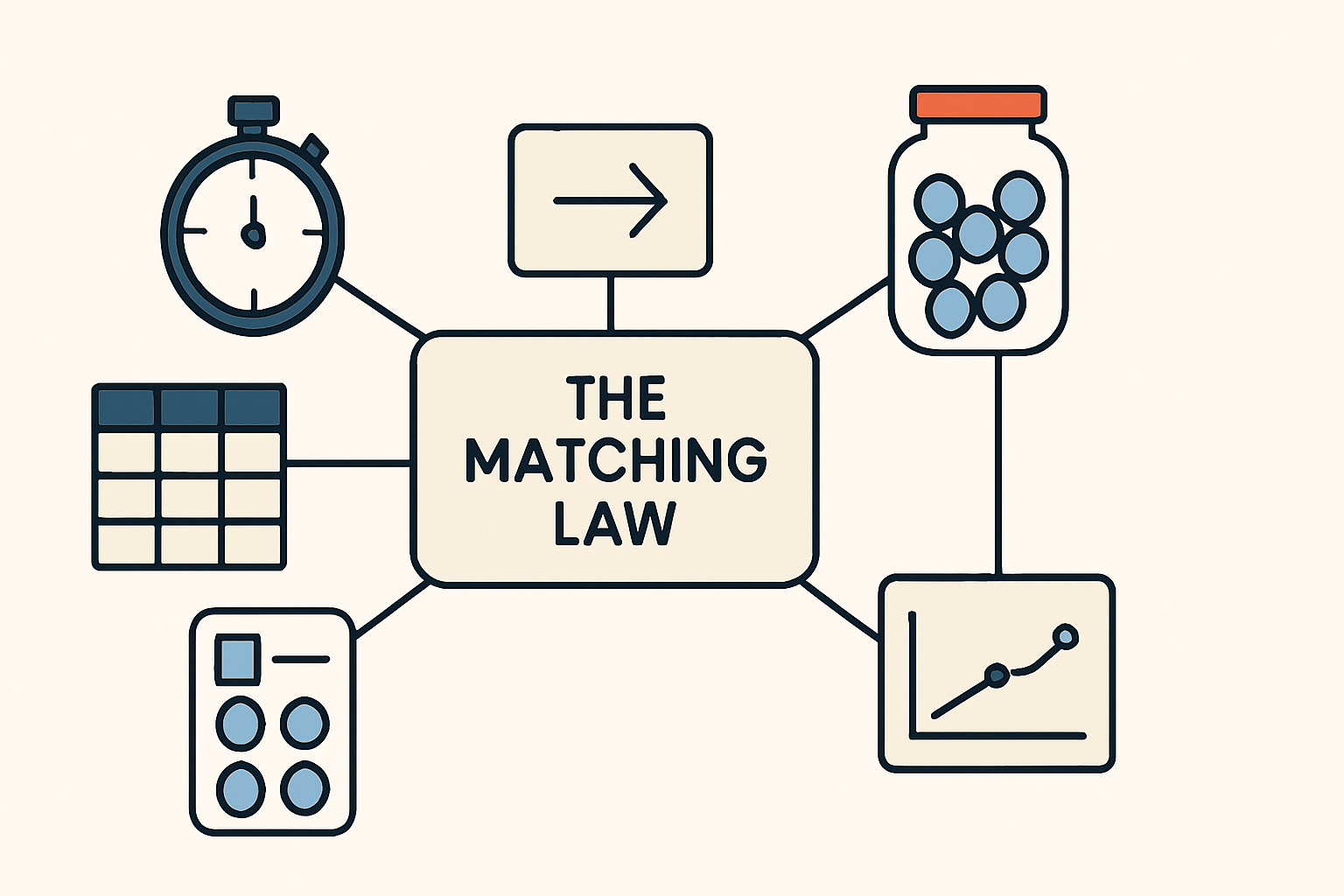
The matching law, developed by Richard Herrnstein, provides the predictive principle behind behavior in concurrent schedules. This fundamental concept states that organisms distribute their responses in proportion to the reinforcement obtained from each available option.
In practical terms, if Schedule A delivers approximately 70% of the total reinforcers, we would expect about 70% of responses to be allocated to that option. This quantitative relationship helps behavior analysts predict and influence choice behavior systematically.
From Herrnstein to the Exam
The matching law represents more than just a mathematical formula—it’s a powerful explanatory principle for understanding response allocation in natural environments. When preparing for the BCBA exam, understanding that responses match reinforcement rates helps answer scenario-based questions about behavior change.
For example, if a client spends 80% of their time engaging with a tablet program that provides frequent, immediate reinforcement and only 20% with a social game offering less predictable rewards, the matching law explains this distribution pattern. This principle connects directly to practical intervention design and matching law applications in ABA practice.
Concurrent Schedules on the BCBA Exam: Relevance and Common Traps
Concurrent schedules appear frequently on the BCBA exam because they test understanding of fundamental behavioral principles and their application. Recognizing these schedules and avoiding common misconceptions is essential for exam success.
Many candidates struggle with distinguishing between similar-sounding schedules. The key is remembering that concurrent means simultaneous choice—both options are always available, and the organism can switch between them freely.
Trap 1: Confusing Concurrent with Multiple or Mixed Schedules
This is perhaps the most common error on the BCBA exam. Understanding the distinctions is crucial:
- Concurrent schedules: Two or more schedules available simultaneously; choice is always possible; no distinct SD changes
- Multiple schedules: Two or more schedules presented in alternation; each has its own distinct SD; no choice between schedules when one is active
- Mixed schedules: Similar to multiple schedules but without distinct SDs; schedules alternate without signaling changes
The critical difference is that only concurrent schedules maintain continuous choice availability. This distinction becomes particularly important when analyzing scenarios involving compound schedules of reinforcement.
Trap 2: Overlooking the Matching Law in Scenarios
Exam questions often describe scenarios where response rates shift between options. The underlying principle is frequently the matching law, not merely the presence of concurrent schedules. Candidates who identify the schedule type but miss the matching law application may select incorrect answers.
When you encounter questions describing proportional response allocation or shifts in preference based on reinforcement rates, think immediately of the matching law. This principle explains why organisms distribute their behavior as they do in concurrent arrangements.
Quick-Study Checklist for Concurrent Schedules
Use this actionable checklist for efficient review and to ensure you’ve mastered the key concepts:
- Identify the defining feature: simultaneous availability of two or more independent reinforcement schedules
- Recognize that choice between options is available at all times (not alternated or signaled)
- Apply the matching law to predict response allocation based on reinforcement rates
- Distinguish concurrent from multiple and mixed schedules (continuous choice vs. alternation)
- Analyze applied examples using ABC format: antecedents (both options available), behaviors (choice allocation), consequences (different schedules)
- Remember that response patterns reveal relative reinforcer value and preference
- Connect concurrent schedule data to practical intervention decisions and preference assessment outcomes
Mastering concurrent schedules requires understanding both the structural arrangement and the behavioral principles that govern choice within that arrangement. The matching law provides the explanatory framework for why organisms allocate responses as they do, making this concept essential for both exam success and effective ABA practice.



