

Chaining in ABA is a systematic teaching procedure that links individual behaviors into a meaningful sequence. This method transforms discrete responses into complex, functional skills that learners can perform independently. For BCBA candidates, understanding chaining procedures is essential for both clinical practice and exam success.
Table of Contents
- chaining in ABA: What is Chaining in Applied Behavior Analysis?
- Three Types of Chaining Procedures
- Chaining on the BCBA Exam: Key Terms and Common Traps
- Implementing Chaining: A Practitioner’s Checklist
- Summary and Next Steps for Mastery
chaining in ABA: What is Chaining in Applied Behavior Analysis?
Chaining involves teaching a series of specific behaviors that form a complete skill. Each step in the chain serves as both a discriminative stimulus for the next behavior and a conditioned reinforcer for the previous one. This creates a seamless flow where completion of one step naturally cues the next.
Core Definition and Purpose
A behavior chain consists of multiple discrete responses linked together in a specific order. The purpose is to teach multi-step skills like handwashing, making a sandwich, or tying shoes. Unlike shaping, which modifies existing behavior topography, chaining adds new steps in sequence.
Each chain link serves dual functions: it’s reinforced by the previous step’s completion and signals the opportunity for the next response. This creates natural stimulus control throughout the entire sequence.
The Prerequisite: Task Analysis
Effective chaining requires a well-constructed task analysis. This involves breaking down complex skills into smaller, teachable components. To create a reliable task analysis:
- Observe competent performers completing the skill multiple times
- Consult with subject matter experts when necessary
- Pilot test the sequence with typical learners
- Record each discrete step in observable, measurable terms
- Ensure steps are logically sequenced and developmentally appropriate
Without a proper task analysis, chaining procedures lack the foundation needed for effective teaching.
Three Types of Chaining Procedures
Three primary chaining methods exist, each with distinct teaching sequences and clinical applications. Choosing the right procedure depends on the learner’s needs and the skill being taught.
Forward Chaining: Teaching from Start to Finish
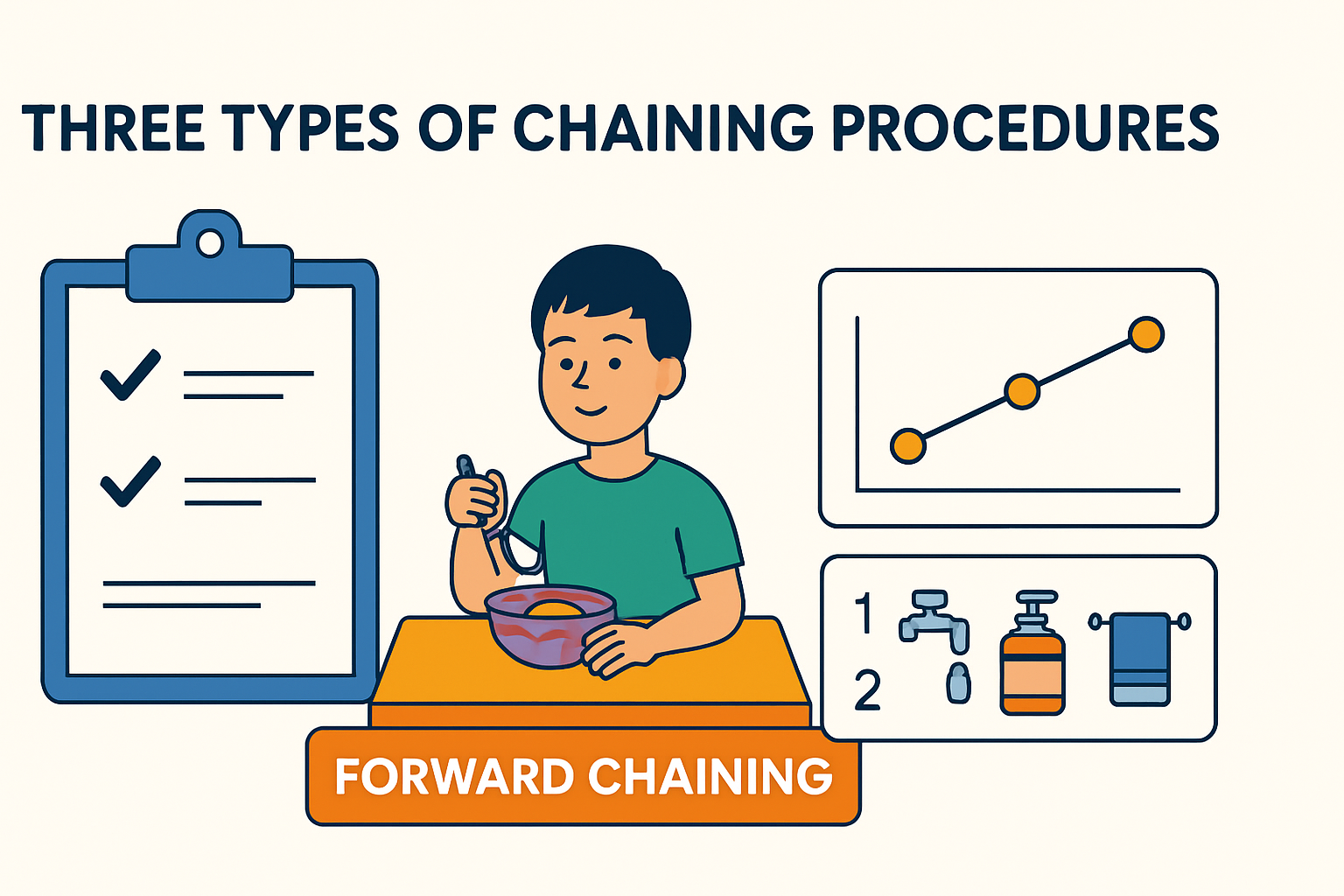
Forward chaining begins with teaching the first step in the sequence. Once mastered, the second step is added, then the third, and so on. This method follows the natural order of the skill.
Consider teaching jacket zipping: First, teach aligning the zipper ends. Then teach inserting the zipper pull. Finally, teach pulling the zipper up. The natural reinforcement comes from completing the entire chain at the end.
Forward chaining works well when the terminal reinforcer is powerful enough to maintain effort through early learning stages. It’s particularly effective for skills where immediate success on early steps builds momentum.
Backward Chaining: Building from the Final Step
Backward chaining starts with the last step in the sequence. The instructor completes all previous steps, then teaches the learner to perform the final action. Once mastered, the second-to-last step is added.
For shoe tying: First, teach pulling the loops tight. Then teach making the second loop. Finally, teach the initial cross-over. This approach provides immediate access to the terminal reinforcer after every teaching trial.
Backward chaining is ideal for learners who need quick reinforcement or who struggle with delayed gratification. The establishing operation for the terminal reinforcer remains strong throughout training.
Total Task Chaining: Practicing the Entire Sequence
Total task chaining involves teaching all steps in the chain on every trial. The instructor provides prompts as needed for any step where assistance is required.
Setting a table provides a clear example: The learner attempts all steps—placing mats, plates, utensils, glasses—with prompt fading applied to challenging components. This method promotes fluency development across the entire sequence.
Total task chaining suits learners with partial proficiency on most steps or when building endurance for longer chains. It’s also efficient for skills where error patterns need identification across the whole sequence.
Chaining on the BCBA Exam: Key Terms and Common Traps
BCBA exam questions often test your ability to distinguish between chaining procedures and related concepts. Understanding these distinctions is crucial for exam success.
Essential Vocabulary and Concepts
- Behavior chain: A sequence of responses where each produces the stimulus change that serves as both reinforcement for the previous response and the discriminative stimulus for the next
- Chain link: An individual component within the larger behavior chain
- Task analysis: The process of breaking a complex skill into smaller, teachable units
- Establishing operation: The motivational variable that affects the effectiveness of the terminal reinforcer
- Unconditioned vs. conditioned reinforcers: Natural versus learned reinforcers within the chain
- Prompt hierarchy: The systematic fading of assistance used within chaining procedures
Frequently Confused Concepts and Exam Pitfalls
Several common traps appear on BCBA exams. First, confusing chaining vs. shaping: Chaining adds new steps in sequence while shaping changes existing behavior topography. Second, mixing up forward vs. backward chaining sequences—remember which step is taught first.
Third, missing the role of the establishing operation. Exam questions may hinge on identifying the motivational variable that makes the terminal reinforcer effective. Fourth, confusing total task chaining with errorless learning procedures—they serve different purposes.
Finally, overlooking stimulus control transfer requirements. Each chain link must eventually come under natural stimulus control rather than instructor prompts.
Implementing Chaining: A Practitioner’s Checklist
Use this actionable checklist when designing chaining procedures for clinical practice or exam scenarios:
- Conduct a thorough task analysis before beginning instruction
- Select the appropriate chaining method based on learner characteristics and skill requirements
- Establish clear mastery criteria for each step in the chain
- Identify potent reinforcers for the terminal step
- Develop a systematic prompt fading plan
- Collect data on each step’s acquisition and independence
- Program for generalization and maintenance from the beginning
- Monitor for prompt dependency and adjust procedures as needed
- Consider environmental arrangements that support chain completion
- Evaluate social validity of both the procedure and outcomes
This checklist ensures you address all critical components of effective chaining implementation. For more on related procedures, see our guide to differential reinforcement strategies.
Summary and Next Steps for Mastery
Mastering chaining procedures requires understanding three key methods: forward chaining, backward chaining, and total task chaining. Each serves different clinical purposes based on learner needs and skill characteristics.
For BCBA exam preparation, focus on distinguishing between chaining and related procedures like shaping. Practice identifying when to use each chaining method based on scenario details. Remember that effective chaining always begins with a solid task analysis.
To deepen your understanding, create task analyses for common daily living skills. Practice implementing different chaining procedures with hypothetical learners. Review the BACB Task List sections related to behavior-change procedures. Finally, apply these concepts to real-world scenarios to build practical competence alongside theoretical knowledge.


