
What Is Chaining in ABA? A Practical Guide
Chaining is a fundamental teaching strategy in applied behaviour analysis (ABA). It is commonly used to teach complex skills that consist of multiple steps, such as self-care routines, academic tasks, or vocational skills.
Many ABA students and BCBA® candidates understand the general idea of breaking tasks into steps but feel unsure about how chaining works in practice, when to use different types, or how it appears on exams and in treatment plans.
This practical guide explains step-by-step teaching approach in clear, straightforward language. You will learn the definition, see everyday examples, understand the main types, and review common mistakes so you can apply this concept confidently in real programs.
What Is Chaining in ABA?
Definition (task-list style)
Chaining is a teaching procedure used to teach a complex behavior by breaking it down into smaller, teachable steps and teaching those steps in a specific sequence.
Each step in the sequence serves as:
-
A response
-
A discriminative stimulus (SD) for the next step
When all steps are linked together, the learner can perform the entire skill independently from start to finish.
Why Chaining Is Used in ABA Programs
Many important life skills cannot be taught in a single response. Tasks like brushing teeth, getting dressed, or completing a worksheet involve multiple behaviours performed in order.
Using this approach helps:
-
Teach skills systematically
-
Reduce learner frustration
-
Increase success and reinforcement
-
Build independence gradually
Instead of expecting a learner to perform a long sequence all at once, instruction is structured so success happens step by step.
Task Analysis: The Foundation of Chaining
Before any chaining procedure begins, the practitioner completes a task analysis.
A task analysis involves:
-
Breaking a complex skill into individual steps
-
Defining each step clearly and objectively
-
Ordering the steps logically
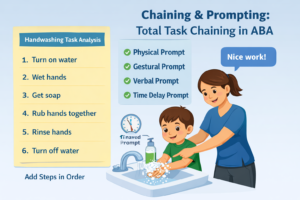
Example: Handwashing task analysis
-
Turn on the water
-
Wet hands
-
Get soap
-
Rub hands together
-
Rinse hands
-
Turn off water
-
Dry hands
Once the steps are defined, the instructor decides how to teach the sequence using a specific step-by-step teaching approach method.
Types of Chaining in ABA
There are three main types commonly taught in ABA and tested on the BCBA® exam.
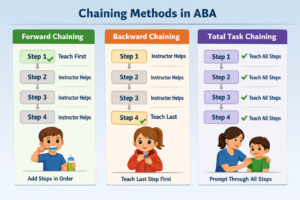
Forward Chaining
In forward chaining, the learner is taught the first step first.
-
Step 1 is taught until mastered
-
The instructor completes the remaining steps
-
New steps are added one at a time in order
Example:
A child learns to put toothpaste on the toothbrush independently. The adult completes the rest of the brushing routine.
This method works well when the first step is easy or naturally motivating.
Backward Chaining
In backward chaining, the learner is taught the last step first.
-
The instructor completes all steps except the final one
-
The learner completes the last step and immediately contacts reinforcement
-
Earlier steps are added gradually
Example:
An adult completes most of a dressing routine, and the learner pulls up the zipper as the final step.
This approach is especially useful when the final step naturally produces reinforcement (e.g., finishing a task).
Total Task Chaining
In total task chaining, the learner attempts all steps in the sequence during each teaching trial.
-
Prompts are provided as needed for each step
-
All steps are practiced every time
-
Independence increases across the entire chain
This method is often used when the learner already has some of the required skills.
Chaining and Prompting
Prompting is a critical component of chaining procedures.
Prompts may include:
-
Physical prompts
-
Modeling
-
Gestural prompts
-
Verbal prompts
Prompts are provided to ensure correct responding and are systematically faded over time. If prompts are not faded, the learner may become prompt dependent, which limits independence.
Everyday Example of Chaining
A student is learning to pack their backpack independently.
The instructor creates a task analysis:
-
Put homework folder in backpack
-
Put pencil case in backpack
-
Put lunchbox in backpack
-
Zip backpack
Using forward chaining, the student learns step 1 independently while the instructor helps with the remaining steps. Over time, more steps are added until the student completes the entire routine alone.
Chaining in Treatment Planning
When designing ABA programs, step-by-step teaching approach is especially helpful for:
-
Self-care routines
-
Daily living skills
-
Vocational tasks
-
Academic sequences
Important considerations include:
-
Selecting the appropriate chaining type
-
Ensuring steps are observable and measurable
-
Pairing instruction with reinforcement
-
Monitoring progress through data collection
If progress stalls, the task analysis or prompting strategy may need adjustment.
Common Mistakes to Avoid
ABA students and new practitioners often make these errors:
-
Teaching steps out of order
-
Skipping task analysis
-
Using steps that are too large
-
Failing to fade prompts
-
Expecting independence too quickly
Remember: the goal is independent completion of the entire sequence, not just individual steps.
How Chaining Appears on the BCBA Exam
BCBA exam questions often describe scenarios without using the word “chaining.”
Look for clues such as:
-
A complex skill broken into steps
-
Teaching one step at a time
-
Different methods for sequencing instruction
-
Prompts and reinforcement across steps
If the question asks which procedure best teaches a multi-step skill, step-by-step teaching approach is often the correct answer.
Quick Study Checklist
Before the exam or practical application, make sure you can:
-
Define chaining clearly
-
Explain why task analysis is required
-
Distinguish forward, backward, and total task chaining
-
Identify real-world examples
-
Avoid common implementation mistakes
Final Thoughts
Chaining is a practical and powerful strategy in ABA for teaching complex skills.
By breaking tasks into manageable steps and teaching them systematically, learners experience more success and less frustration. When implemented correctly, this approach supports long-term independence and meaningful skill development.
Understanding how and when to use chaining will strengthen both your exam performance and your clinical decision-making.


