
Understanding carryover effects is essential for behavior analysts working with single-subject experimental designs. These effects represent a specific threat to internal validity that can complicate data interpretation and treatment evaluation.
Table of Contents
- carryover effects ABA: What Are Carryover Effects in Behavior Analysis?
- Identifying Carryover Effects: Worked ABA Examples
- Carryover Effects and the BCBA Exam: Common Traps
- Quick Checklist: Analyzing for Potential Carryover
- Key Takeaways for Your Study Plan
Carryover effects ABA: What Are Carryover Effects in Behavior Analysis?
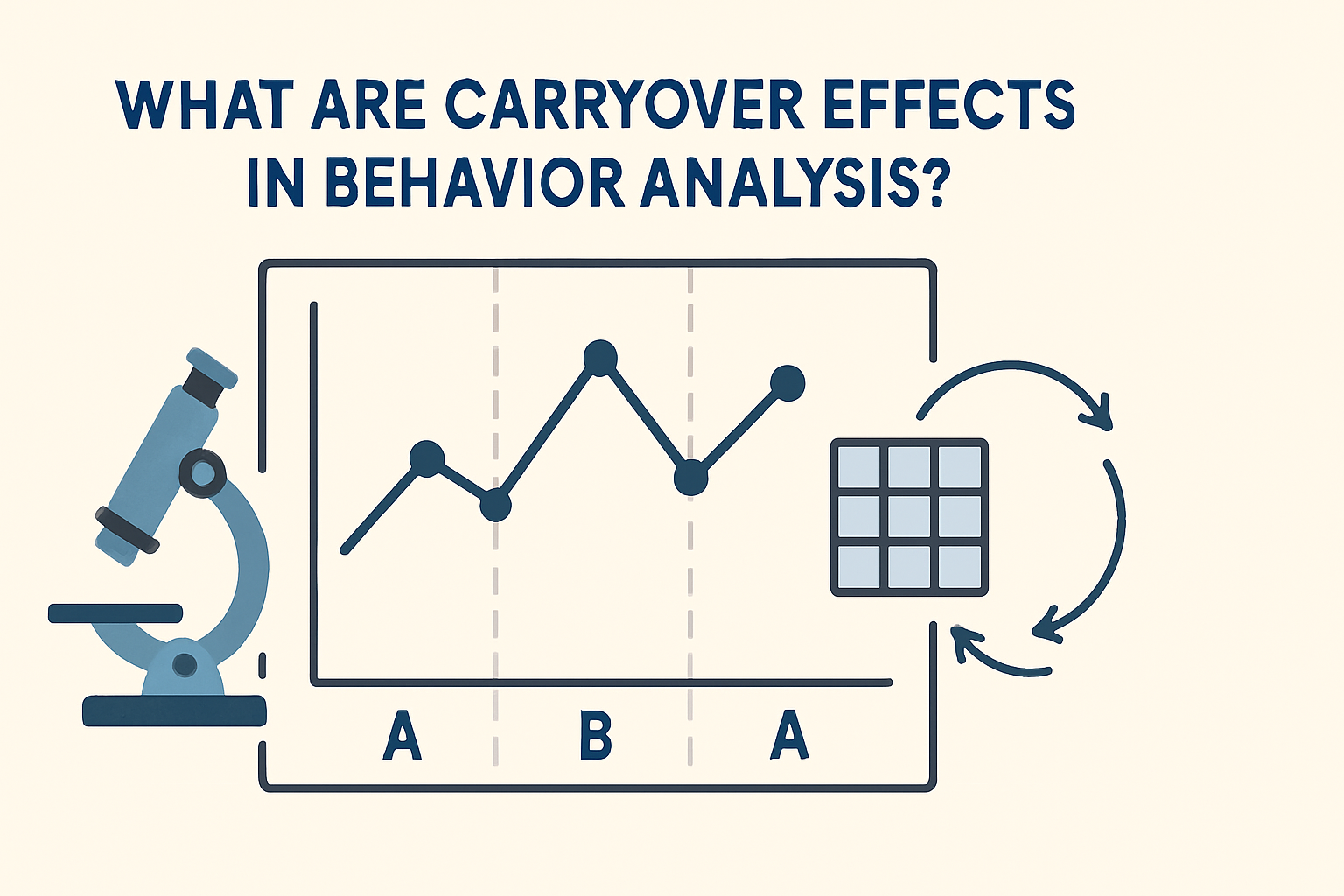
Carryover effects occur when procedures or experiences from one experimental condition influence performance in subsequent conditions. This phenomenon is particularly relevant in within-subject designs where the same participant experiences multiple conditions in sequence.
A Formal Definition for Your Analysis
In behavior analysis, carryover effects are defined as the influence of one experimental condition’s procedures on the performance observed in a subsequent condition. These effects represent a specific threat to internal validity in designs like reversal, alternating treatments, or changing criterion arrangements.
The key characteristic is that the effect persists beyond the condition where it was established, potentially contaminating data in later phases.
Carryover Effects vs. Sequence Effects and Other Threats
It’s crucial to distinguish carryover effects from related concepts. Sequence effects is a broader category that includes carryover effects along with other order-related influences.
- Carryover effects specifically refer to the lingering impact of previous condition procedures
- Practice effects involve improved performance due to repeated exposure
- Fatigue effects involve decreased performance due to exhaustion
- Confounding variables affect between-group designs differently
Unlike confounding variables, carryover effects are specific to within-subject designs where the same participant experiences sequential conditions.
Identifying Carryover Effects: Worked ABA Examples
Let’s examine practical scenarios where carryover effects might appear in applied settings. These examples use the ABC format to illustrate how previous conditions can influence current behavior.
Example 1: The Lingering Reinforcer
A BCBA implements an FR3 schedule (Condition A) to increase task completion for a student. After achieving stable performance, they switch to an FR1 schedule (Condition B).
- Antecedent: Task presentation in Condition B
- Behavior: High rate of task completion persists
- Consequence: Immediate reinforcement on FR1 schedule
The high rates in Condition B may not reflect the new schedule’s effectiveness but rather reinforcement history from Condition A. This represents positive carryover where previous conditioning influences current performance.
Example 2: Learned Avoidance from a Previous Condition
A punishment procedure (time-out) effectively reduces aggression during Condition A. When the BCBA returns to baseline (Condition B), aggression remains low.
- Antecedent: Situations that previously evoked aggression
- Behavior: Aggression remains suppressed
- Consequence: No programmed consequence in baseline
The continued suppression may reflect learned avoidance rather than natural contingencies. The client avoids aggression to prevent potential time-out, demonstrating negative carryover from the punishment condition.
Example 3: Skill Generalization vs. Carryover
Teaching mands with specific prompts in one setting (Condition A) leads to skill use in a new setting (Condition B). The critical question is whether this represents desirable generalization or problematic carryover.
If the skill transfer results from the teaching procedures themselves (carryover), it threatens the isolation of ‘setting’ as an independent variable. If it represents true stimulus generalization, it’s a positive outcome. This distinction requires careful experimental analysis to determine.
Carryover Effects and the BCBA Exam: Common Traps
Exam questions about carryover effects often test your ability to distinguish them from other validity threats. Understanding these common traps will help you avoid mistakes.
Trap 1: Confusing It with a Confounding Variable
Many candidates incorrectly label carryover as a confounding variable. Remember that confounding variables typically affect between-group designs, while carryover effects are specific to within-subject designs where the same participant experiences sequential conditions.
Trap 2: Overlooking the Design Requirement
Carryover effects only occur in designs with sequential conditions. If a question describes a between-groups design, carryover cannot be the correct answer. Always check whether the same participants experience multiple conditions in sequence.
Trap 3: Misidentifying the Direction of Effect
Candidates sometimes struggle to articulate how Condition A affected Condition B. Did it inflate or suppress the behavior? Analyze whether the previous condition’s procedures would likely increase or decrease the target behavior in subsequent conditions.
For more on experimental design considerations, see our guide on single-subject experimental designs.
Quick Checklist: Analyzing for Potential Carryover
Use this practical checklist when evaluating whether carryover effects might be influencing your data or exam scenarios.
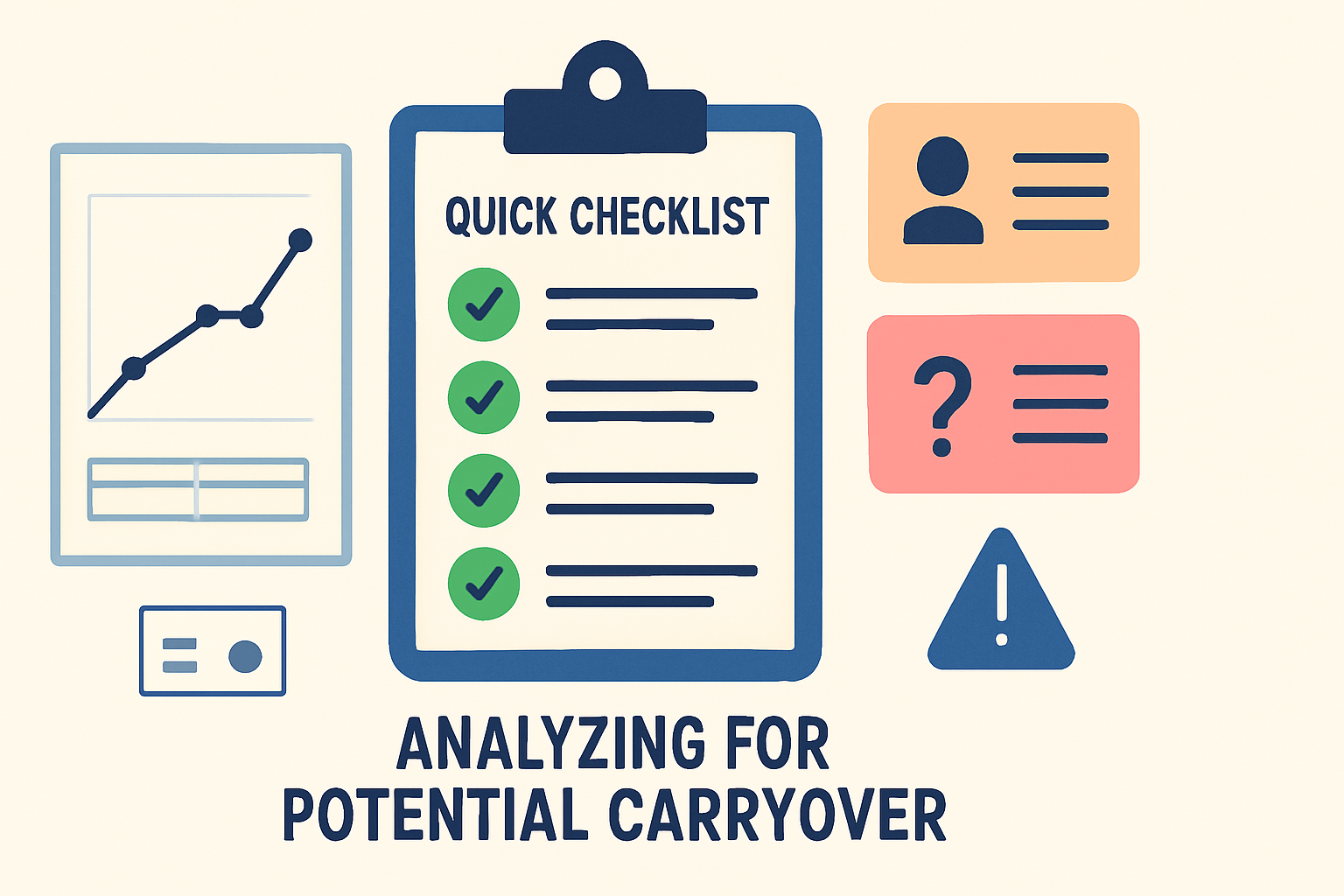
- Verify the design: Is this a within-subject design with sequential conditions?
- Identify condition sequence: What order did conditions occur in?
- Examine behavior patterns: Does performance in later conditions resemble earlier conditions?
- Consider reinforcement history: Could previous conditioning be influencing current behavior?
- Evaluate alternative explanations: Could this be generalization, practice effects, or maturation?
- Check for persistence: Does the effect continue beyond the condition where it was established?
- Assess treatment integrity: Were procedures implemented consistently across conditions?
This systematic approach helps distinguish true carryover effects from other phenomena. For related analysis skills, review our guide on graphing and visual analysis.
Key Takeaways for Your Study Plan
Mastering carryover effects requires understanding both the concept and its practical implications. Here are the essential points to remember.
- Carryover effects are threats to internal validity in within-subject designs
- They involve the persistent influence of one condition on subsequent conditions
- Differentiate from sequence effects, practice effects, and confounding variables
- Always check whether the design involves sequential conditions for the same participant
- Consider both positive (inflation) and negative (suppression) carryover directions
- Use systematic analysis to distinguish from generalization and other phenomena
- Apply ethical considerations when interpreting data potentially affected by carryover
For authoritative guidance on experimental design standards, consult the BACB Ethics Code and relevant peer-reviewed literature on single-subject methodology.
Understanding carryover effects strengthens your ability to design valid experiments and interpret data accurately, both essential skills for competent behavior analysis practice.


