
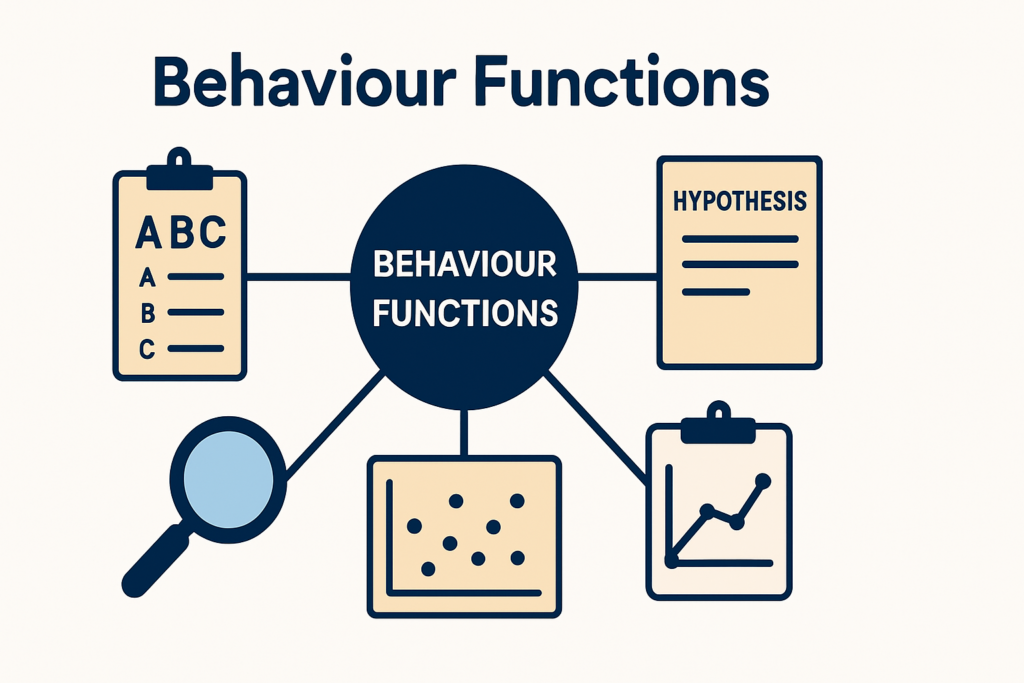
What Are the Functions of Behaviour?
In applied behavior analysis, understanding behaviour functions is fundamental to effective intervention. The function refers to the purpose or reason why a behavior occurs, rather than just its form or appearance. This distinction between topography and function separates ABA from other approaches and forms the basis for ethical, effective practice.
Table of Contents
- What Are the Functions of Behaviour?
- Analyzing Behaviour: From ABC Data to Hypothesized Function
- Behaviour Functions on the BCBA Exam: What to Expect
- Your Study Checklist for Mastering Functions
- References
The Four Key Functions: A Quick Reference
All behaviors can be categorized into four primary functions:
- Escape/Avoidance: Behavior occurs to terminate or avoid an aversive stimulus, situation, or demand.
- Attention (Social Positive): Behavior occurs to gain social interaction, acknowledgment, or response from others.
- Access to Tangibles: Behavior occurs to obtain preferred items, activities, or privileges.
- Automatic Reinforcement (Sensory): Behavior occurs because it produces its own reinforcing sensory consequences.
Why Function Matters More Than Topography
Two individuals might display identical behaviors for completely different reasons. A child might scream in class to escape difficult work, while another might scream to gain peer attention. Effective interventions must address the underlying function, not just suppress the behavior’s form. This principle aligns with the seven dimensions of ABA and ensures interventions are conceptually systematic and effective.
Analyzing Behaviour: From ABC Data to Hypothesized Function
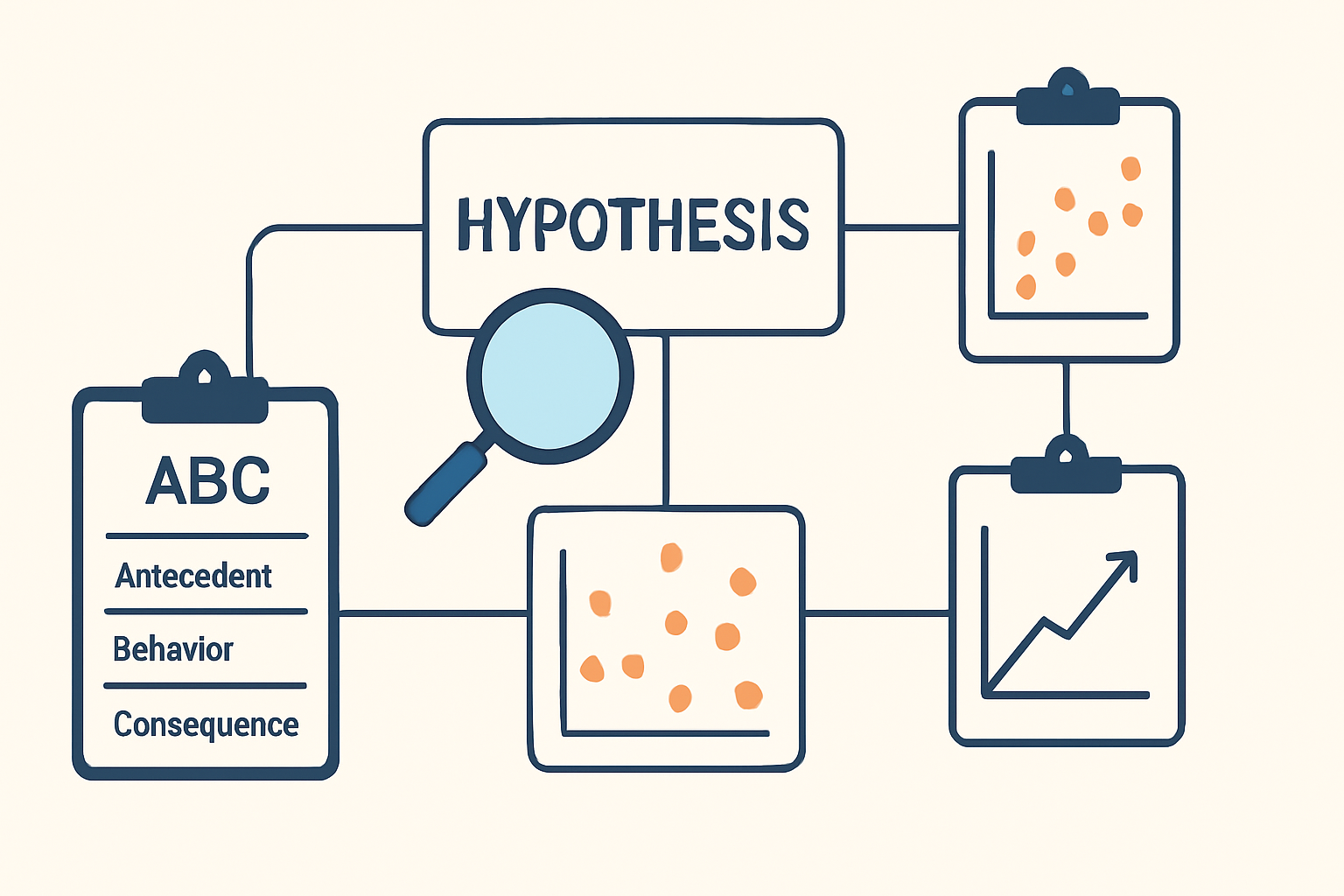
The ABC framework provides the structure for functional analysis. By examining antecedents, behaviors, and consequences, practitioners can develop hypotheses about why behaviors occur. This systematic approach moves beyond guesswork to data-driven decision making.
Example 1: Escape-Maintained Behaviour in a Classroom
Consider this scenario: Antecedent: Teacher presents a challenging math worksheet. Behavior: Student tears the worksheet and throws it on the floor. Consequence: Teacher sends student to timeout area, removing the worksheet.
The analysis reveals escape function. The behavior successfully terminated the aversive task. The timeout, while intended as punishment, actually served as negative reinforcement by removing the demand. This demonstrates why understanding functional relationships is crucial for effective intervention.
Example 2: Attention-Seeking and Tangible Access
In a grocery store: Antecedent: Parent says “no” to candy request. Behavior: Child begins crying and stomping feet. The consequence determines the function.
If the parent scolds the child (attention consequence), the function is likely social attention. If the parent gives in and provides candy (tangible consequence), the function is access to tangibles. This ambiguity highlights why functional behavior assessment requires careful observation of consistent patterns.
Example 3: Automatic Reinforcement (Sensory)
Consider hand-flapping that occurs when a child is alone, during preferred activities, and during non-preferred activities. The behavior persists regardless of social consequences and appears to provide sensory stimulation.
This represents automatic reinforcement, where the behavior itself produces reinforcing consequences. Understanding this function is essential for developing appropriate replacement behaviors that provide similar sensory input without interfering with learning or social participation.
Behaviour Functions on the BCBA Exam: What to Expect
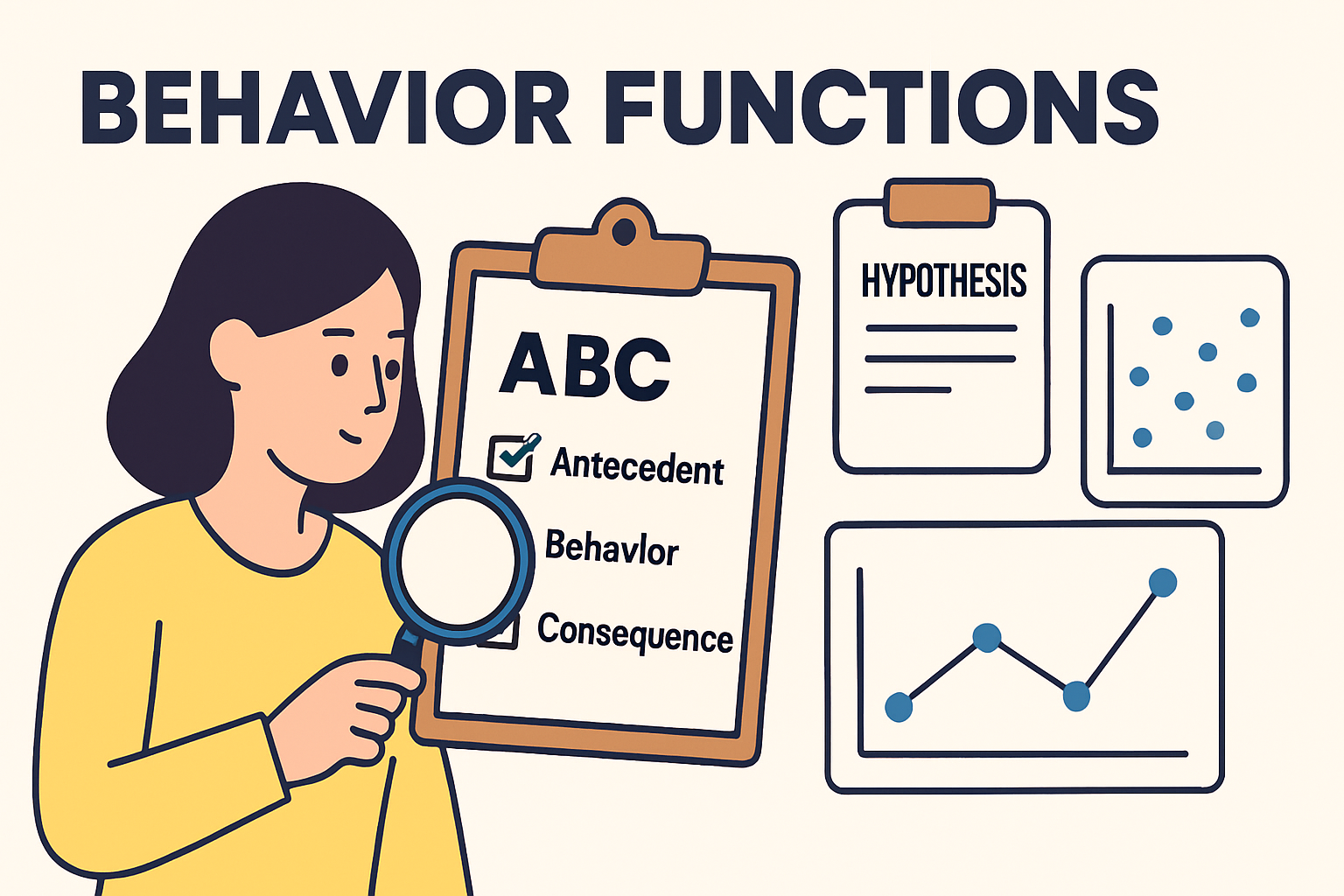
The BCBA exam consistently tests candidates’ ability to identify behavior functions and select appropriate interventions based on functional analysis. Questions often present brief vignettes requiring analysis of ABC data or selection of function-based interventions.
Common Exam Traps and How to Avoid Them
Several patterns consistently challenge candidates:
- Confusing topography for function: Remember that identical behaviors can serve different functions for different individuals or in different contexts.
- Overlooking automatic reinforcement: When behaviors persist in the absence of social consequences, consider sensory functions.
- Misinterpreting ‘negative reinforcement’: This refers to removal of an aversive stimulus, not punishment. Review our guide on negative reinforcement for clarification.
- Selecting interventions without considering function: Effective interventions must match the identified function. For escape behaviors, consider task modification or functional communication training.
Sample Practice Questions
1. A student consistently leaves their seat during independent work time. The teacher redirects them back to work each time. Based on this pattern, what is the most likely function?
2. A child engages in hand-mouthing primarily when alone or during transitions between activities. The behavior decreases when given access to chewy toys. What function does this suggest?
These questions test your ability to analyze behavioral patterns and identify functional relationships rather than making assumptions based on topography alone.
Your Study Checklist for Mastering Functions
Use this checklist to assess your understanding before the exam:
- Define all four functions without hesitation and provide clear examples of each
- Analyze ABC data to hypothesize function in various scenarios
- Differentiate between socially-mediated and automatic reinforcement
- Match interventions to functions appropriately (e.g., extinction for attention functions, functional communication for escape)
- Recognize common exam traps and strategies to avoid them
- Practice with varied examples across different settings and populations
Mastering behaviour functions requires moving beyond memorization to conceptual understanding. The ability to analyze why behaviors occur forms the foundation for ethical, effective ABA practice. For additional study resources, explore our comprehensive guide to functional behavior assessment and review the seven dimensions of ABA to understand how function analysis fits within the broader framework of behavior analysis as a science.


