
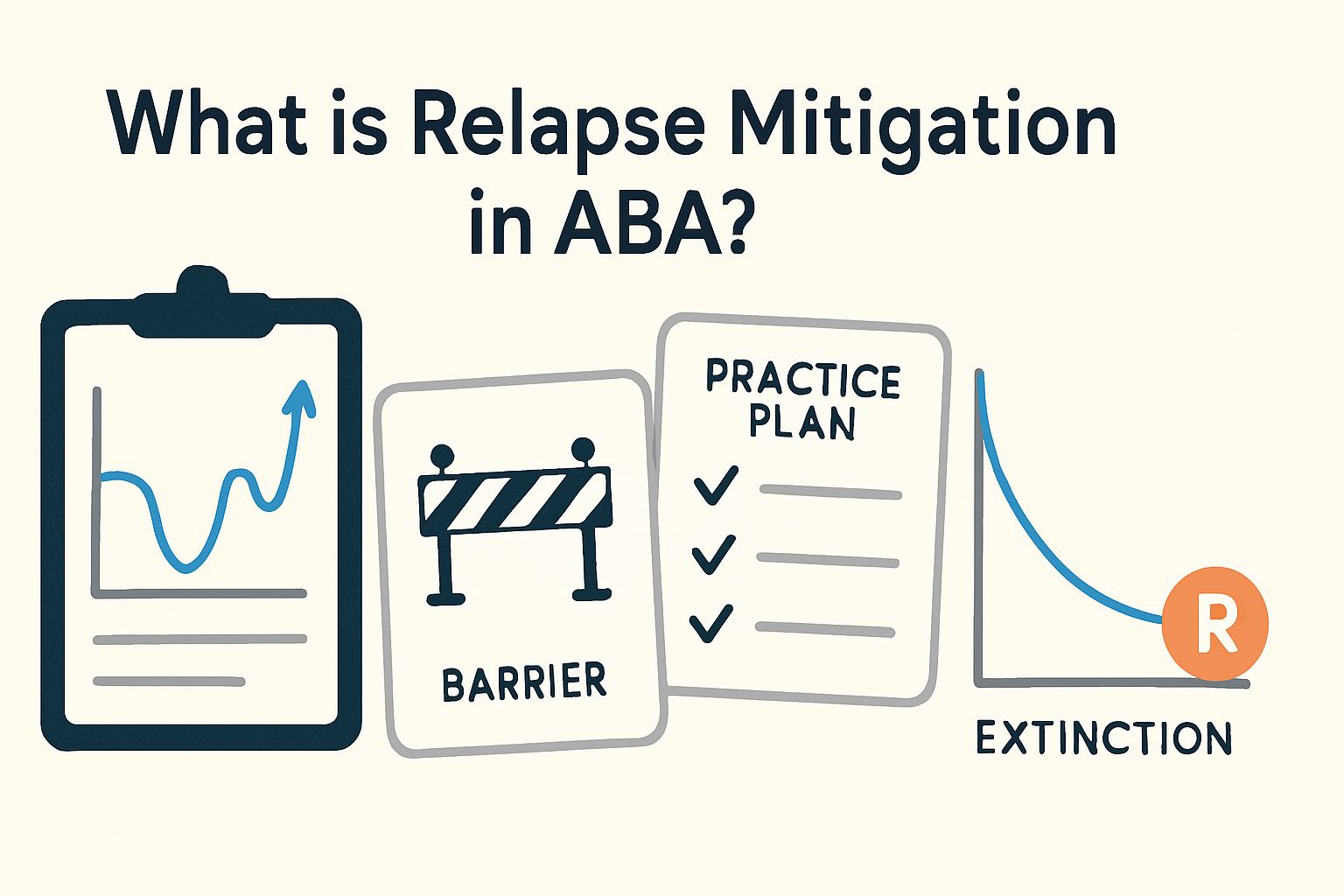
What is Relapse Mitigation in ABA?
Relapse mitigation represents a critical component of ethical behavior analytic practice, specifically addressed in the BACB 6th Edition Task List as Task H.5. This concept goes beyond simple prevention to encompass systematic strategies that reduce both the likelihood and impact of behavioral regression.
Table of Contents
- What is Relapse Mitigation in ABA?
- Applying Relapse Mitigation: Three Worked Examples
- Relapse Mitigation and the BCBA Exam
- Your Relapse Mitigation Action Checklist
- Summary: From Knowledge to Ethical Practice
Effective relapse mitigation requires understanding that behavior change is not always linear and that even well-established interventions can face challenges over time.
Defining Task H.5: Beyond Simple Prevention
The Behavior Analyst Certification Board defines relapse mitigation as implementing strategies to reduce the probability that a client’s behavior will return to baseline levels. This involves proactive planning rather than reactive crisis management.
Unlike general prevention approaches, mitigation specifically addresses the contextual factors that might trigger regression and prepares contingency plans for when challenges arise.
Relapse vs. Lapse: A Critical Distinction for BCBAs
A behavioral lapse refers to a temporary setback or isolated incident where a previously reduced behavior occurs again. In contrast, relapse indicates a full return to baseline levels of the target behavior.
Understanding this distinction is essential because mitigation strategies differ based on whether you’re addressing isolated incidents versus systematic regression. Lapses may require minor adjustments, while relapse signals the need for comprehensive intervention review.
Applying Relapse Mitigation: Three Worked Examples
Real-world application of relapse mitigation requires analyzing potential triggers and designing proactive strategies based on behavioral principles. These examples demonstrate how to approach common clinical scenarios.
Example 1: Mitigating Relapse of Elopement After a Schedule Change
Scenario: A child with a history of elopement maintained via escape has successfully learned functional communication training (FCT) to request breaks. A new school year brings schedule changes.
Potential relapse trigger: The antecedent change (new schedule) may create uncertainty, increasing the likelihood of escape-maintained behavior returning.
- ABC analysis: Antecedent – unfamiliar schedule; Behavior – elopement; Consequence – escape from demands
- Mitigation plan: Implement visual schedules with priming sessions before transitions
- Use temporary increased reinforcement for appropriate break requests during adjustment period
- Train staff on consistent prompting procedures for the new routine
Example 2: Preventing the Return of Attention-Maintained Screaming
Scenario: Screaming maintained by social attention was successfully reduced through teaching mands and implementing extinction. A new staff member joins the team.
Risk factor: The untrained staff member might accidentally reinforce screaming through attention, potentially triggering relapse.
- Mitigation strategy: Implement comprehensive staff training with competency checks
- Create environmental supports like visual reminders of extinction procedures
- Establish supervision protocols for new staff during initial sessions
- Use behavioral skills training (BST) to ensure procedural integrity
Example 3: Planning for Relapse in a Self-Injurious Behavior (SIB) Protocol
Scenario: Self-injurious behavior maintained by automatic reinforcement was treated successfully using matched stimulation and response blocking.
Relapse considerations: Changes in stimulus availability or medical factors could trigger regression of this high-risk behavior.
- Mitigation approach: Teach a broader response class of alternative behaviors
- Ensure consistent availability of matched stimulation across settings
- Develop caregiver crisis protocols for immediate implementation
- Schedule regular maintenance probes to monitor response strength
Relapse Mitigation and the BCBA Exam
Task H.5 appears across multiple exam domains, testing both conceptual understanding and practical application. Candidates must recognize how relapse mitigation integrates with other behavioral concepts.
Successful exam performance requires distinguishing mitigation strategies from other intervention components and selecting the most proactive approaches in scenario-based questions.
Common Exam Traps and How to Avoid Them
Several recurring patterns can trip up even well-prepared candidates on relapse mitigation questions.
- Confusing mitigation with crisis management – mitigation is proactive, not reactive
- Selecting reactive strategies instead of proactive prevention measures
- Misidentifying the precipitating context for potential relapse
- Overlooking generalization programming as a key mitigation component
- Failing to consider staff training and procedural integrity factors
Key Terminology You Must Know
Mastering these concepts is essential for both exam success and clinical practice.
- Behavioral Contrast: Changes in one setting affecting behavior in another
- Renewal Effect: Return of extinguished behavior in a new context
- Resurgence: Return of previously reinforced behavior when current reinforcement fails
- Spontaneous Recovery: Temporary return of extinguished behavior after time passes
- Generalization Programming: Systematic teaching across settings and people
- Maintenance Strategies: Procedures to sustain behavior change over time
Your Relapse Mitigation Action Checklist
This practical checklist summarizes key steps for implementing effective relapse mitigation in clinical practice.
- Conduct risk assessment for potential relapse triggers during treatment planning
- Identify contextual changes that might challenge behavior maintenance
- Develop proactive strategies addressing identified risk factors
- Program for generalization across settings, people, and materials
- Establish maintenance schedules with regular progress monitoring
- Train all implementation staff on mitigation procedures
- Create crisis protocols for immediate implementation if relapse occurs
- Schedule follow-up assessments to evaluate long-term effectiveness
- Document mitigation strategies in the behavior intervention plan
- Review and update plans based on ongoing data collection
Summary: From Knowledge to Ethical Practice
Mastering relapse mitigation extends beyond exam preparation to become a cornerstone of ethical behavior analytic practice. Effective implementation demonstrates commitment to client welfare and long-term success.
By integrating mitigation strategies into every behavior plan, BCBAs ensure that treatment gains are sustainable across changing contexts and over time. This approach aligns with the ethical responsibility to provide effective, durable interventions that respect client dignity.
For comprehensive exam preparation covering all Task List domains, explore our BCBA 6th Edition Concepts Study Guide. Additional resources on related topics include our guide to Generalization and Maintenance and our overview of Ethics in ABA Practice.
For authoritative information on behavior analytic standards, refer to the Behavior Analyst Certification Board and consult peer-reviewed resources like the Behavior Modification journal for current research on relapse prevention strategies.


