
Effective study methods can make the difference between struggling and succeeding on the BCBA certification assessment. While many candidates rely on passive reading, strategic flashcards offer a powerful alternative for mastering the 6th Edition Task List. This guide will show you how to create and use BCBA 6th Edition flashcards that target the specific knowledge and application skills tested on the exam.
Table of Contents
- BCBA 6th Edition flashcards: Why Flashcards Are a High-Impact Tool for the 6th Edition Tas
- Worked Examples: From Task List Item to Effective Flashcard
- Common Flashcard Traps and How the BCBA Exam Exploits Them
- Your Flashcard System Implementation Checklist
- Integrating Flashcards into Your Overall Study Plan
BCBA 6th Edition flashcards: Why Flashcards Are a High-Impact Tool for the 6th Edition Tas
Traditional study methods often fail because they don’t engage active recall or leverage spaced repetition. Flashcards force you to retrieve information from memory, which strengthens neural connections far more effectively than passive review. The BACB Task List structure lends itself perfectly to this approach, with clear domains and specific content areas that can be systematically addressed.
Mapping Your Flashcards to the TCO Domains
Begin by auditing the Task List and creating a card quota system for each section. This ensures comprehensive coverage of all tested areas.
- Concepts & Principles (Section B): Create cards for each definition, principle, and their practical applications
- Measurement (Section C): Focus on data collection methods, graphing conventions, and interpretation skills
- Assessment (Section F): Include functional assessment procedures and preference assessment types
- Intervention (Section G): Cover behavior change procedures and ethical implementation steps
- Ethics (Section 1): Develop scenario-based cards for ethical decision-making
Beyond Definitions: Crafting Application-Focused Cards
The BCBA exam tests application, not just memorization. Move beyond simple term-definition pairs to create cards that build analytical skills.
- Scenario-based cards: Present clinical situations requiring ethical or procedural decisions
- Graph interpretation cards: Include sample graphs requiring analysis of level, trend, and variability
- Procedural step cards: Outline implementation sequences for complex interventions
- Comparison cards: Contrast similar concepts like different types of differential reinforcement
Worked Examples: From Task List Item to Effective Flashcard
Concrete examples demonstrate how to transform Task List items into powerful study tools. These models show the variety needed for comprehensive preparation.
Example 1: Conceptual Understanding (B-1: Define & Provide Examples)
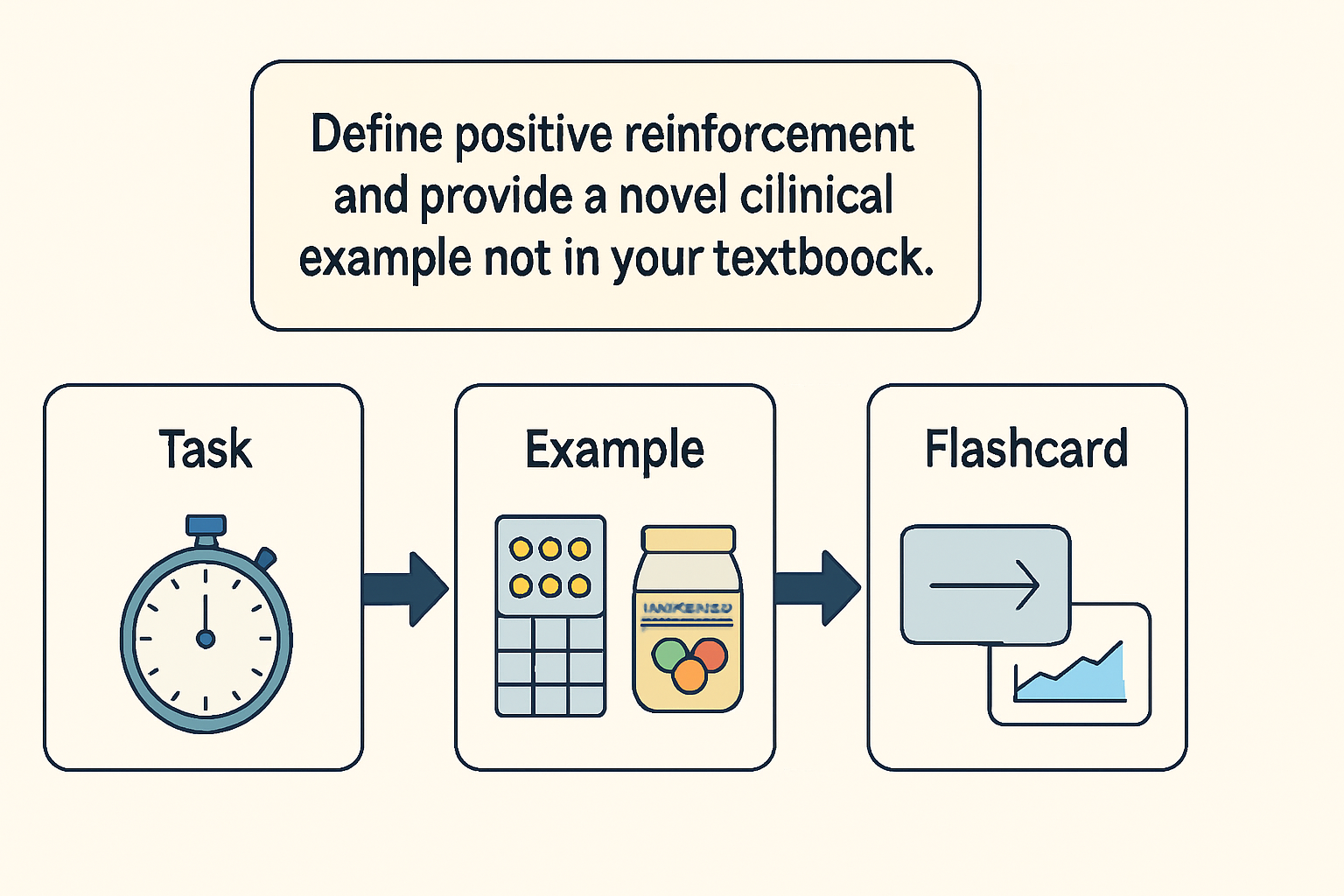
Front: ‘Define positive reinforcement and provide a novel clinical example not in your textbook.’
Back: ‘Positive reinforcement occurs when a behavior is followed by the presentation of a stimulus, increasing the future probability of that behavior. Example: A child says “please” when requesting a toy (behavior), receives immediate access to the toy (reinforcing consequence), and the polite requesting increases in future similar situations.’
Example 2: Ethical Application (Section 1: Responsibility to Clients)
Front: ‘Scenario: A parent requests session data via unencrypted email. What are the relevant ethical codes and your specific actions?’
Back: ‘Relevant codes: 2.06 (Confidentiality) and 2.08 (Using Confidential Information). Actions: 1) Politely decline unsecured transmission, 2) Offer secure alternatives (encrypted portal, password-protected document), 3) Explain risks of unsecured data transmission, 4) Document the interaction and solution offered.’
Example 3: Procedural Knowledge (G-21: Use of Differential Reinforcement)
Front: ‘Outline the steps to implement DRO for attention-maintained behavior, including baseline and schedule considerations.’
Back: ‘1) Conduct functional assessment confirming attention function, 2) Collect baseline data on target behavior frequency, 3) Set initial DRO interval slightly below baseline inter-response time, 4) Deliver attention contingent on absence of target behavior during interval, 5) Gradually increase interval duration based on success criteria, 6) Monitor for side effects and treatment integrity.’
Common Flashcard Traps and How the BCBA Exam Exploits Them
Many candidates make predictable errors in their flashcard approach that lead to wrong answers on the actual assessment. Understanding these traps helps you avoid them.
The Recognition vs. Recall Mismatch
Recognizing a term while reviewing cards is fundamentally different from recalling it during a novel exam item. The exam presents information in unfamiliar contexts to test true understanding.
- Self-test protocol: Shuffle cards randomly and time your responses
- Application checks: Create cards that require generating examples, not just recognizing definitions
- Spaced intervals: Review cards at increasing intervals to strengthen long-term retention
Over-Indexing on Memorization at the Expense of Analysis
The BCBA exam presents complex scenarios requiring analytical thinking, not just factual recall. Memorization alone won’t prepare you for these items.
- Comparison cards: Create cards that require contrasting concepts like MSWO vs. Paired-Stimulus preference assessments
- Scenario variations: Develop multiple cards for the same concept with different clinical contexts
- Error analysis cards: Include cards that ask you to identify procedural errors in described interventions
Your Flashcard System Implementation Checklist
This actionable checklist helps you build momentum and ensure method fidelity in your flashcard system.
- Audit the Task List: Create a spreadsheet tracking card quotas for each domain
- Prioritize application cards: Ensure at least 60% of cards require scenario analysis or procedural steps
- Establish review schedule: Implement spaced repetition with increasing intervals
- Create self-test protocol: Include timed recall sessions with shuffled cards
- Track weak areas: Mark cards that consistently cause difficulty for focused review
- Update regularly: Add new cards as you identify knowledge gaps through mock exams
Integrating Flashcards into Your Overall Study Plan
Flashcards work best as part of a comprehensive study ecosystem. Position them strategically within your broader preparation approach.
Use flashcards for daily active recall practice while reserving longer sessions for complex analysis. Combine them with mock exam performance tracking to identify which domains need additional card creation. Study groups can use flashcards for peer testing scenarios, where members create challenging application cards for each other.
Remember that flashcards complement, but don’t replace, other essential study methods. They’re particularly effective for mastering the Task List structure and building rapid recall of foundational concepts. For comprehensive preparation, balance flashcard work with practice questions, case study analysis, and review of authoritative sources like the BACB Task List document.
By implementing these strategic approaches, you’ll transform your flashcards from simple memorization tools into powerful instruments for mastering the complex application skills tested on the BCBA assessment. The key is consistent, focused practice with cards that mirror the exam’s demands for analysis, ethical reasoning, and procedural knowledge.


