

The BCBA 6th Edition Domains framework organizes the certification exam content into nine logical sections. This structure helps candidates systematically prepare for the comprehensive assessment of applied behavior analysis knowledge and skills.
Table of Contents
- BCBA 6th Edition Domains: Understanding the 6th Edition Task List Structure
- BCBA 6th Edition Domain A to I Breakdown: Core Focus and Exam Links
- Applying Domain Knowledge on the BCBA Exam
- Final Summary and Next Steps
Each domain represents a distinct area of professional competency, from ethical foundations to practical implementation. Understanding how these domains interconnect is crucial for exam success and effective practice.
BCBA 6th Edition Domains: Understanding the 6th Edition Task List Structure
The BACB Task List organizes content into domains A through I. This framework ensures comprehensive coverage of essential behavior analysis competencies.
Domains vary in their exam weighting, with some receiving more questions than others. This distribution should guide your study time allocation.
Why the Domain Structure Matters for Your Study Plan
The domain framework directly mirrors how the BACB categorizes exam questions. Understanding this structure helps you identify knowledge gaps and prioritize study efforts.
Some domains like Domain G (Behavior-Change Procedures) typically receive more exam questions than others. This weighting reflects their importance in daily practice.
A Snapshot of Domains A Through I
- Domain A: Ethics – Professional and ethical compliance code for behavior analysts
- Domain B: Philosophical Underpinnings – Foundational concepts and assumptions of behavior analysis
- Domain C: Measurement, Data, & Interpretation – Data collection methods and analysis techniques
- Domain D: Experimental Design – Research methodologies and single-subject designs
- Domain E: Ethics of Intervention – Ethical considerations in treatment implementation
- Domain F: Behavior Assessment – Functional assessment and analysis procedures
- Domain G: Behavior-Change Procedures – Intervention strategies and techniques
- Domain H: Personnel Supervision & Management – Training and supervising behavior technicians
- Domain I: Implementation, Management, & Supervision – Program oversight and case management
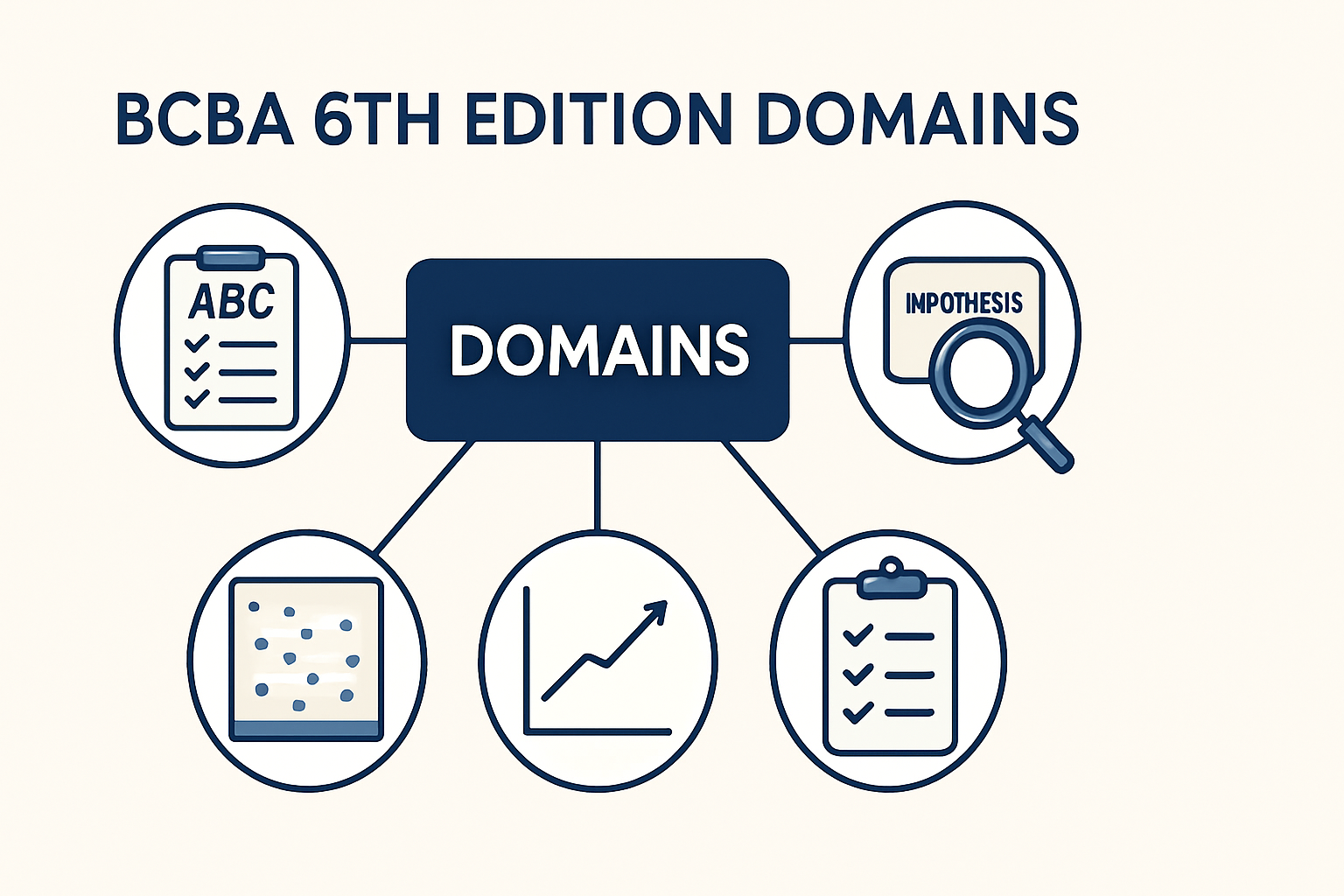
BCBA 6th Edition Domain A to I Breakdown: Core Focus and Exam Links
This comprehensive breakdown examines each domain’s core content and how they connect on the exam. Understanding these relationships is key to answering integrated questions correctly.
Domains A-C: The Foundation (Ethics, Philosophy, Measurement)
Domain A provides the ethical framework for all professional decisions. It intersects with every other domain, ensuring interventions respect client dignity and follow professional standards.
Domain B establishes the philosophical bedrock, including concepts like determinism and pragmatism. These assumptions guide how behavior analysts approach assessment and intervention.
Domain C supplies the measurement toolkit used throughout practice. For example, when a client exhibits tantrums (Domain F), you select appropriate data collection methods (Domain C) while ensuring ethical treatment (Domain A).
Practical example: A behavior analyst observes self-injurious behavior. They apply radical behaviorism principles (Domain B) to understand environmental influences, use partial interval recording (Domain C) to measure occurrence, and ensure interventions respect client autonomy (Domain A).
Domains D-G: The Assessment and Intervention Cycle
These domains form an integrated cycle of practice. Domain D (Experimental Design) provides the research framework, while Domain F (Behavior Assessment) identifies behavioral functions.
Domain G contains the intervention procedures, and Domain E ensures ethical implementation. Exam questions often blend these domains, requiring you to select appropriate measurement (C) for a functional analysis (F) within a specific design (D).
Integrated example: For aggression maintained by escape (Domain F), you design a non-concurrent multiple baseline (Domain D) to test a differential reinforcement procedure (Domain G), while ensuring least restrictive alternatives (Domain E).
For more on experimental designs, see our guide to single-subject experimental designs.
Domains H & I: Implementation, Management, and Supervision
Domain H focuses on supervising personnel, including training behavior technicians and ensuring treatment fidelity. Domain I addresses case management and program oversight.
A common exam trap involves confusing supervisor responsibilities (H) with case manager duties (I). The supervisor ensures staff competency, while the case manager coordinates services and monitors progress.
Example: When implementing a new behavior plan, Domain H tasks include training staff on procedures, while Domain I tasks involve monitoring client progress and adjusting interventions as needed.
Applying Domain Knowledge on the BCBA Exam
Translating domain knowledge into exam success requires strategic thinking. The test often presents integrated scenarios that cross multiple domains.
Common Exam Traps and How to Avoid Them
Exam questions frequently test your ability to distinguish between related concepts across domains. Recognizing these patterns helps avoid common mistakes.
- Confusing philosophical assumptions (Domain B) with ethical principles (Domain A). Philosophical concepts explain why we approach behavior a certain way, while ethics dictate what we should do.
- Selecting assessment procedures (Domain F) without considering alignment with experimental design (Domain D). Your measurement system must match your research question and design.
- Misidentifying supervision tasks as personnel management (Domain H) versus case management (Domain I). Supervision focuses on staff development, while case management centers on client progress.
- Overlooking ethical considerations (Domain E) when implementing behavior-change procedures (Domain G). All interventions must consider client dignity and least restrictive alternatives.
Your Domain Review Checklist
Use this checklist to assess your readiness for each domain. Focus on areas where you need additional study.
- Domain A: Can I identify ethical violations in case scenarios? Do I understand the Professional and Ethical Compliance Code?
- Domain B: Can I explain the seven dimensions of ABA? Do I understand radical behaviorism versus methodological behaviorism?
- Domain C: Can I select appropriate measurement systems for different behaviors? Do I understand IOA calculation methods?
- Domain D: Can I distinguish between reversal, multiple baseline, and changing criterion designs? Do I understand internal and external validity threats?
- Domain E: Can I identify least restrictive alternatives? Do I understand when to use punishment procedures ethically?
- Domain F: Can I describe functional analysis procedures? Do I understand how to link assessment results to behavioral function?
- Domain G: Can I select appropriate behavior-change procedures based on function? Do I understand differential reinforcement types?
- Domain H: Can I describe effective supervision techniques? Do I understand how to ensure treatment integrity?
- Domain I: Can I develop comprehensive behavior plans? Do I understand how to monitor and adjust interventions?
For additional study resources, explore our BCBA exam prep guide and free mock exam questions.
Final Summary and Next Steps
The BCBA 6th Edition Domains framework provides a structured approach to mastering exam content. Each domain builds upon the others, creating an integrated knowledge system essential for professional practice.
Begin your study by assessing your current knowledge in each domain using the checklist above. Focus additional study time on domains with higher exam weighting and your identified knowledge gaps.
Practice applying domain knowledge to integrated scenarios, as this mirrors the exam format. Review the official BACB Task List for complete domain details and content specifications.
Remember that successful exam performance requires not just memorization, but the ability to apply concepts across domains in practical scenarios. This integrated understanding will serve you well both on the exam and in professional practice.


