
The Board Certified Assistant Behavior Analyst credential represents a significant milestone for professionals in applied behavior analysis. This intermediate certification bridges the gap between direct implementers and fully independent practitioners, offering a structured path for career advancement. Understanding the BCaBA certification process is essential for anyone seeking to advance their ABA career while working under appropriate supervision.
Table of Contents
- What is BCaBA Certification and Who is it For?
- The Path to Certification: Meeting BACB Requirements
- Preparing for and Passing the BCaBA Examination
- After Certification: Maintaining Your Credential and Career Growth
- Quick Checklist for BCaBA Certification Success
- Final Summary
What is BCaBA Certification and Who is it For?
This credential is designed for professionals who have completed bachelor’s-level education in behavior analysis or related fields. The Behavior Analyst Certification Board oversees this certification, ensuring standardized competency across the profession.
The Role of a Board Certified Assistant Behavior Analyst
BCaBAs operate within a tiered service-delivery model, implementing behavior-analytic services under the supervision of a BCBA. Their scope includes assisting with assessment procedures, collecting and analyzing data, and implementing intervention protocols designed by supervising BCBAs. Unlike Registered Behavior Technicians who primarily implement plans, BCaBAs contribute to assessment and data analysis while still requiring supervision for program design.
Core Benefits of Pursuing BCaBA Certification
- Standardized competency recognition from the BACB
- Increased professional opportunities and earning potential
- Structured pathway toward BCBA certification
- Enhanced credibility with employers and clients
- Opportunity to work in supervisory roles under BCBA guidance
The Path to Certification: Meeting BACB Requirements
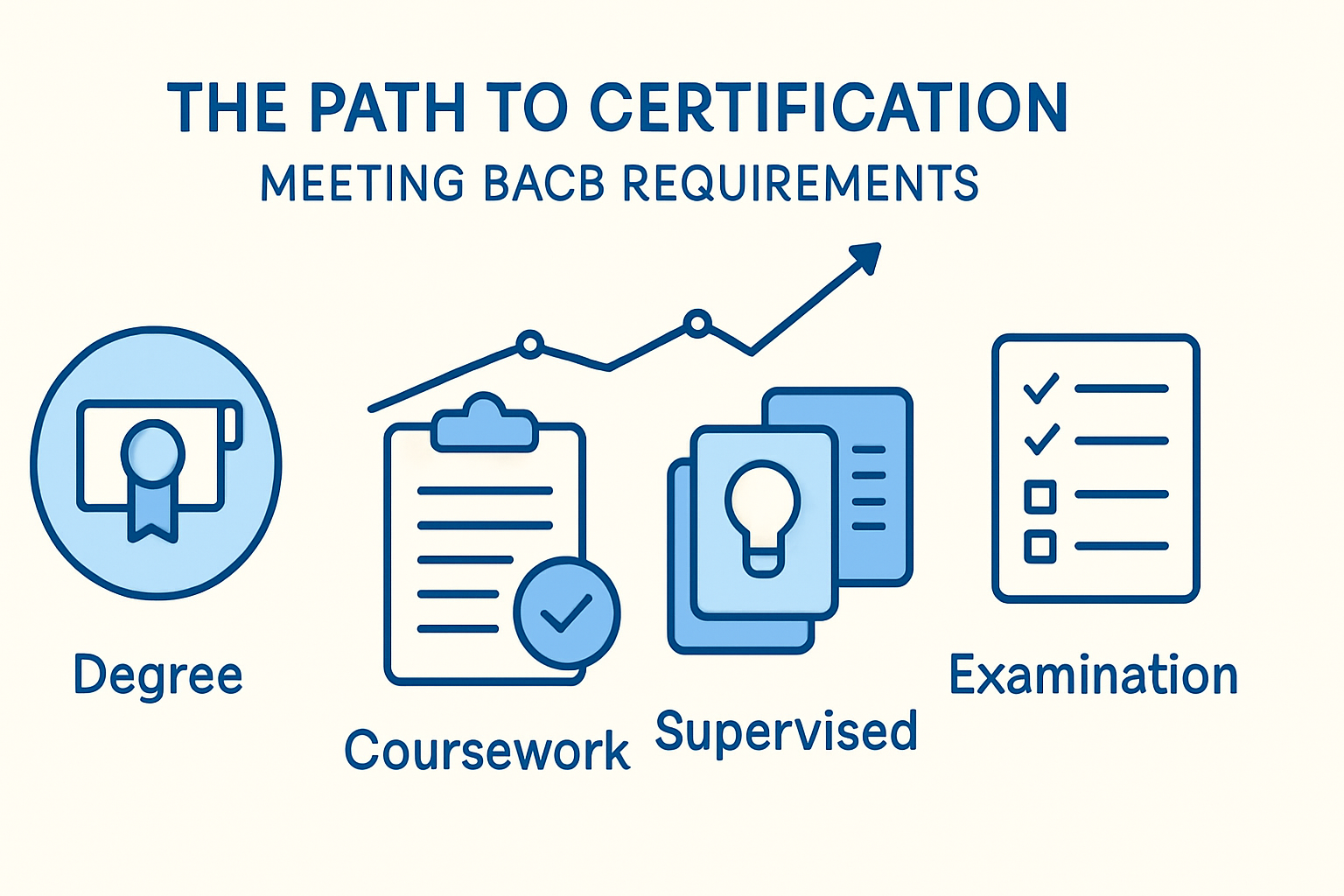
Four core requirements must be met before applying for the examination. Each component builds essential knowledge and skills for competent practice.
Degree and Coursework: Building Your Foundation
Applicants must hold a bachelor’s degree from an accredited institution. The coursework requirement involves completing a Verified Course Sequence covering the BACB’s current task list content areas. These courses provide foundational knowledge in measurement, assessment, intervention design, and ethical practice. Attending a VCS-approved program ensures your coursework meets BACB standards without additional verification.
Supervised Fieldwork: Gaining Practical Experience
Fieldwork requirements include either 1,000 hours of concentrated supervised fieldwork or 1,500 hours of supervised independent fieldwork. A qualified BCBA supervisor must oversee at least 5% of these hours through direct observation and supervision meetings. Proper documentation is crucial – each session should include specific behavior-analytic activities and supervisor feedback.
Navigating the Application and Examination Process
- Submit eligibility application to the BACB with all required documentation
- Receive authorization to test once application is approved
- Schedule examination through Pearson VUE testing centers
- Complete the 160-question multiple-choice exam within 4 hours
- Receive results immediately after completing the computer-based test
Preparing for and Passing the BCaBA Examination
Effective preparation requires strategic study approaches focused on application rather than memorization. The examination tests your ability to apply behavior-analytic principles to real-world scenarios.
Key Content Areas and Exam Weighting
The exam follows the BACB’s test content outline with questions distributed across several domains. Measurement and data analysis typically comprise 12-15% of questions, while assessment procedures account for 17-20%. Intervention design and implementation represent the largest portion at 25-30%, with ethical and professional conduct covering 10-12%.
Effective Study Strategies for BCBA Candidates
- Create a structured study schedule covering all content areas
- Use mock exams to identify knowledge gaps
- Form study groups to discuss application scenarios
- Focus on understanding functional relationships rather than definitions
- Review ethics scenarios and decision-making processes
Common Exam Traps and How to Avoid Them
Many candidates struggle with selecting the best answer rather than simply a correct one. Examination questions often present multiple technically correct options, requiring you to identify the most appropriate solution based on ethical guidelines and best practices. Another common trap involves confusing similar concepts like confidentiality versus privilege, or different types of motivating operations.
After Certification: Maintaining Your Credential and Career Growth
Earning your certification is just the beginning. Ongoing requirements ensure you maintain current knowledge and ethical practice standards throughout your career.
Ethics, Supervision, and Continuing Education
All BCaBAs must abide by the BACB Ethics Code and receive ongoing supervision from a qualified BCBA. Recertification occurs every two years and requires completing 20 continuing education units, including at least 3 ethics CEUs and 1 supervision CEU. Documentation of supervision and CEUs must be maintained for potential audit.
Your Career Pathway: From BCaBA to BCBA and Beyond
BCaBA certification opens doors in various settings including schools, clinics, residential programs, and home-based services. Many professionals use this credential as a stepping stone toward BCBA certification, as the supervised fieldwork hours and foundational knowledge directly apply to graduate-level requirements. Career advancement often involves pursuing a master’s degree in behavior analysis while accumulating additional supervised experience.
Quick Checklist for BCaBA Certification Success
- Verify your bachelor’s degree meets BACB requirements
- Complete a Verified Course Sequence from an approved program
- Accumulate required supervised fieldwork hours with proper documentation
- Submit complete application package to the BACB
- Develop a comprehensive study plan using structured preparation methods
- Schedule and pass the BCaBA examination
- Maintain ongoing supervision and complete CEUs for recertification
Final Summary
The BCaBA credential represents a valuable intermediate step in ABA career development. By meeting specific education, experience, and examination requirements, professionals demonstrate competency in implementing behavior-analytic services under supervision. Successful candidates combine thorough preparation with practical experience, positioning themselves for continued growth in the field. For authoritative information on current requirements, always consult the BACB’s official BCaBA handbook and stay informed about any updates to certification standards.


