

BACB 6th Edition Test Content Outline: What is the 6th Edition Test Content Outline?
The BACB 6th Edition Test Content Outline is the official blueprint published by the Behavior Analyst Certification Board that specifies every topic and skill area covered on the BCBA certification examination. This document serves as the authoritative source for exam content, detailing the specific knowledge and application requirements candidates must master.
Table of Contents
- BACB 6th Edition Test Content Outline: What is the 6th Edition Test Content Outline?
- From Outline to Action: Building Your Study Plan
- Exam Relevance and Common Candidate Traps
- Applied Examples: Seeing the Outline in Practice
- Your Quick-Start Checklist
- Summary and Next Steps
- References
Unlike study guides or textbooks, this outline represents the actual specifications used to develop test questions, making it an essential strategic tool for focused preparation.
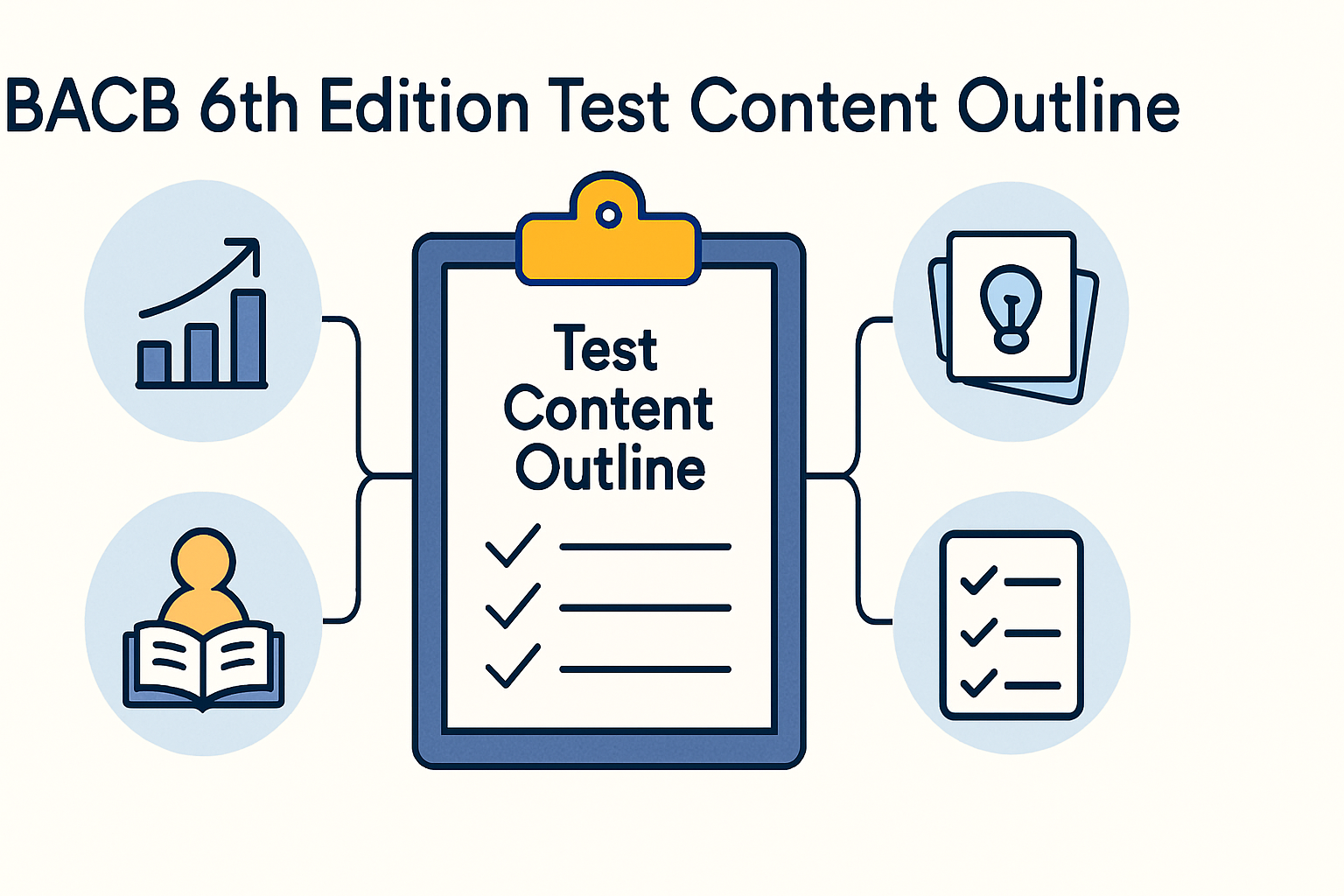
Your Official Exam Blueprint
This document functions as your examination blueprint, systematically organizing content into domains, sections, and specific task items. Each component corresponds directly to potential exam questions, ensuring your study efforts align precisely with what will be assessed.
The outline is not merely a list of topics but a structured framework that defines the scope of professional practice knowledge expected of a Board Certified Behavior Analyst.
Key Changes from the 5th Edition
The transition to the 6th edition introduced several significant modifications that candidates should understand:
- Reorganized content domains with clearer separation between foundational knowledge and applied practice
- Updated task list items reflecting current best practices and ethical standards
- Revised weighting percentages that allocate different emphasis to various content areas
- Enhanced focus on cultural responsiveness and compassionate care in behavior analytic practice
- Integration of emerging technologies and contemporary assessment methods
From Outline to Action: Building Your Study Plan
Transforming the static outline into an effective study strategy requires systematic planning and honest self-assessment. Follow these steps to create a personalized roadmap.
Step 1: Decode the Sections and Weightings
Begin by analyzing the outline’s structure. The document divides content into major sections with specific percentage weightings that indicate their relative importance on the exam. Allocate your study time proportionally to these weights.
For example, if a section carries 25% weighting, approximately one-quarter of your study hours should focus on mastering those concepts and their applications.
Step 2: Conduct a Self-Assessment
Systematically evaluate your current knowledge against each task list item. Create a simple tracking system using three categories: confident, needs review, and unfamiliar.
- Read each task statement carefully
- Assess your ability to define, explain, and apply the concept
- Identify specific areas where you can provide examples or complete procedures
- Note any terminology or procedures that feel unclear or confusing
Step 3: Create a Targeted Study Schedule
Based on your self-assessment and the outline’s weightings, develop a structured study plan that prioritizes your weakest areas while maintaining strength in high-weighted domains.
- Schedule spaced repetition sessions for challenging concepts
- Allocate time for both conceptual understanding and applied practice
- Include regular review sessions for previously mastered material
- Build in practice with scenario-based questions that mirror exam format
Exam Relevance and Common Candidate Traps
Understanding how outline content translates to actual exam questions is crucial for effective preparation. Many candidates struggle not with knowledge itself, but with applying concepts in examination contexts.
How Outline Tasks Translate to Test Questions
Each task list item corresponds to specific question types you’ll encounter. For instance, the outline task ‘Identify potential interventions based on assessment results’ typically appears as scenario-based questions where you must select the most appropriate intervention from multiple options.
Another example: ‘Define and provide examples of positive reinforcement’ might appear as a question requiring you to identify reinforcement examples within a clinical vignette or distinguish reinforcement from other behavioral principles.
Traps to Avoid When Using the Outline
Several common mistakes can undermine your preparation effectiveness:
- Memorizing without understanding – The outline lists concepts, but the exam tests application
- Ignoring lower-weighted sections – Even small percentages can impact your overall score
- Confusing similar terminology – Carefully distinguish between related concepts like discrimination vs. generalization
- Overlooking ethical applications – Many questions integrate ethical considerations with technical knowledge
- Neglecting measurement concepts – Data collection and analysis appear throughout the exam
Applied Examples: Seeing the Outline in Practice
Connecting outline concepts to real-world scenarios strengthens both understanding and exam performance. These examples demonstrate how knowledge translates to practical application.
Example 1: Addressing Escape-Maintained Behavior
Consider a student who engages in disruptive behavior during difficult academic tasks. A functional behavior assessment identifies escape from demands as the maintaining variable.
This scenario connects to multiple outline sections:
- Assessment – Conducting functional behavior assessment (Section F)
- Intervention selection – Choosing evidence-based strategies (Section G)
- Antecedent strategies – Implementing task modification or choice-making (Section G-2)
- Consequence strategies – Applying extinction for escape behavior while reinforcing task completion (Section G-5)
- Data collection – Monitoring intervention effectiveness (Section D)
For comprehensive preparation on behavioral functions, review our guide on the four functions of behavior.
Example 2: Ethical Data Collection & Reporting
A behavior analyst collects data on a client’s self-injurious behavior but notices inconsistent recording across staff. The outline’s Professional & Ethical Compliance section (Section H) provides guidance for this situation.
Key considerations include:
- Ensuring treatment integrity through proper staff training and monitoring
- Maintaining accurate data collection as outlined in measurement principles
- Addressing data reliability concerns through systematic observation checks
- Documenting procedures and modifications according to ethical standards
This example demonstrates how ethical considerations integrate with technical skills throughout behavior analytic practice.
Your Quick-Start Checklist
Implement these immediate actions to maximize your use of the Test Content Outline:
- Download the official document directly from the BACB website
- Print and annotate the outline, highlighting unfamiliar terms and concepts
- Create a tracking spreadsheet to monitor your progress on each task item
- Schedule weekly review sessions focused on different outline sections
- Practice application by creating your own scenario questions for each domain
- Identify resources for challenging areas using textbooks, journals, or supplemental materials
- Connect with study partners to discuss outline concepts and applications
- Schedule mock exams to test your knowledge under timed conditions
Summary and Next Steps
The BACB 6th Edition Test Content Outline is more than a document—it’s your strategic roadmap to exam success. By understanding its structure, translating tasks into study actions, and avoiding common preparation pitfalls, you transform abstract content into mastered competencies.
Your next steps should include focused study using the outline as your primary guide, supplemented by quality resources like our 6th edition mock exams for practical application. Remember that consistent, targeted preparation based on the official blueprint provides the most efficient path to certification.
For additional guidance on study strategies, explore our comprehensive BCBA exam study framework that complements outline-based preparation.


