
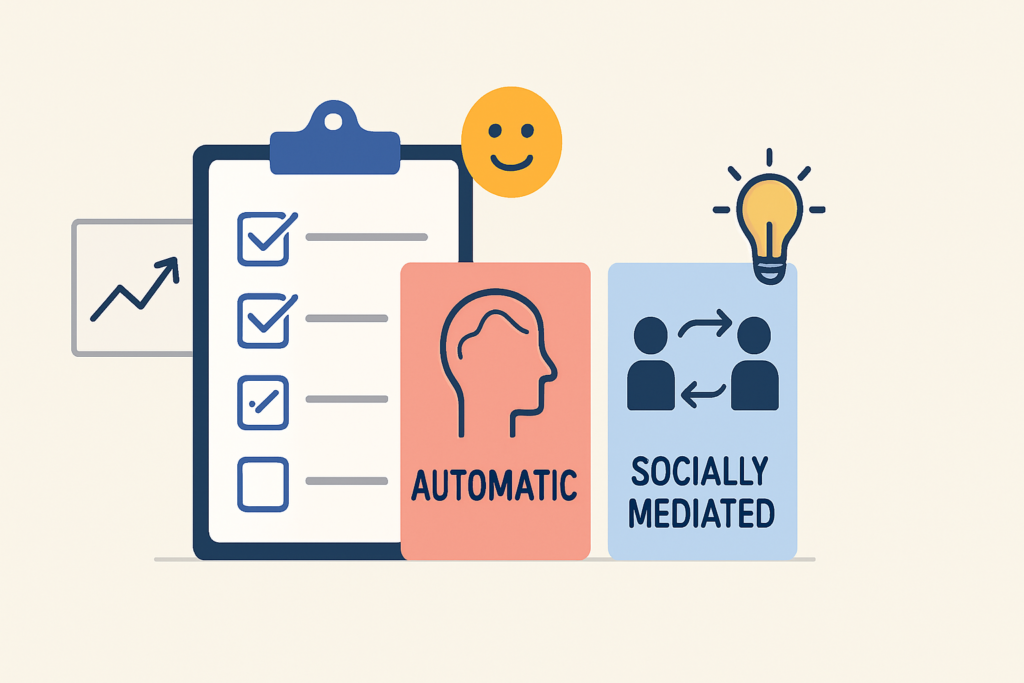
Understanding the distinction between automatic and socially mediated contingencies is fundamental to accurate functional assessment and effective intervention planning. This distinction helps behavior analysts determine whether a behavior’s consequence occurs directly through the behavior itself or requires another person’s action. Mastering this concept is essential for both clinical practice and exam success.
Table of Contents
- automatic and socially mediated contingencies: Defining the Core Concepts
- Identifying Contingencies in Practice: Worked Examples
- Exam Relevance and Common Traps
- Quick-Reference Identification Checklist
- Summary and Next Steps for Mastery
automatic and socially mediated contingencies: Defining the Core Concepts
Before analyzing specific scenarios, establish clear operational definitions. The key difference lies in whether another person mediates the consequence.
What is an Automatic Contingency?
An automatic contingency describes a behavior-consequence relationship where the consequence occurs directly and immediately as a result of the behavior, without any mediation by another person. The behavior itself produces the consequence. This includes both automatic reinforcement (where the behavior produces a reinforcing stimulus) and automatic punishment (where the behavior produces an aversive stimulus).
Common examples involve sensory consequences: a behavior produces proprioceptive, auditory, visual, or tactile stimulation. The reinforcement or punishment is directly produced by the topography of the response.
What is a Socially Mediated Contingency?
A socially mediated contingency describes a behavior-consequence relationship where the consequence requires the action of another person to be delivered or removed. The behavior influences someone else, who then mediates access to reinforcement or removal of aversives. This includes both socially mediated reinforcement and socially mediated punishment.
Most behaviors maintained by attention, access to tangibles, or escape from demands involve socially mediated contingencies because another person typically controls these consequences. For a deeper understanding of behavior functions, see our guide on the four functions of behavior.
Identifying Contingencies in Practice: Worked Examples
Applying these definitions requires careful ABC analysis. Let’s examine common scenarios to build your analytical skills.
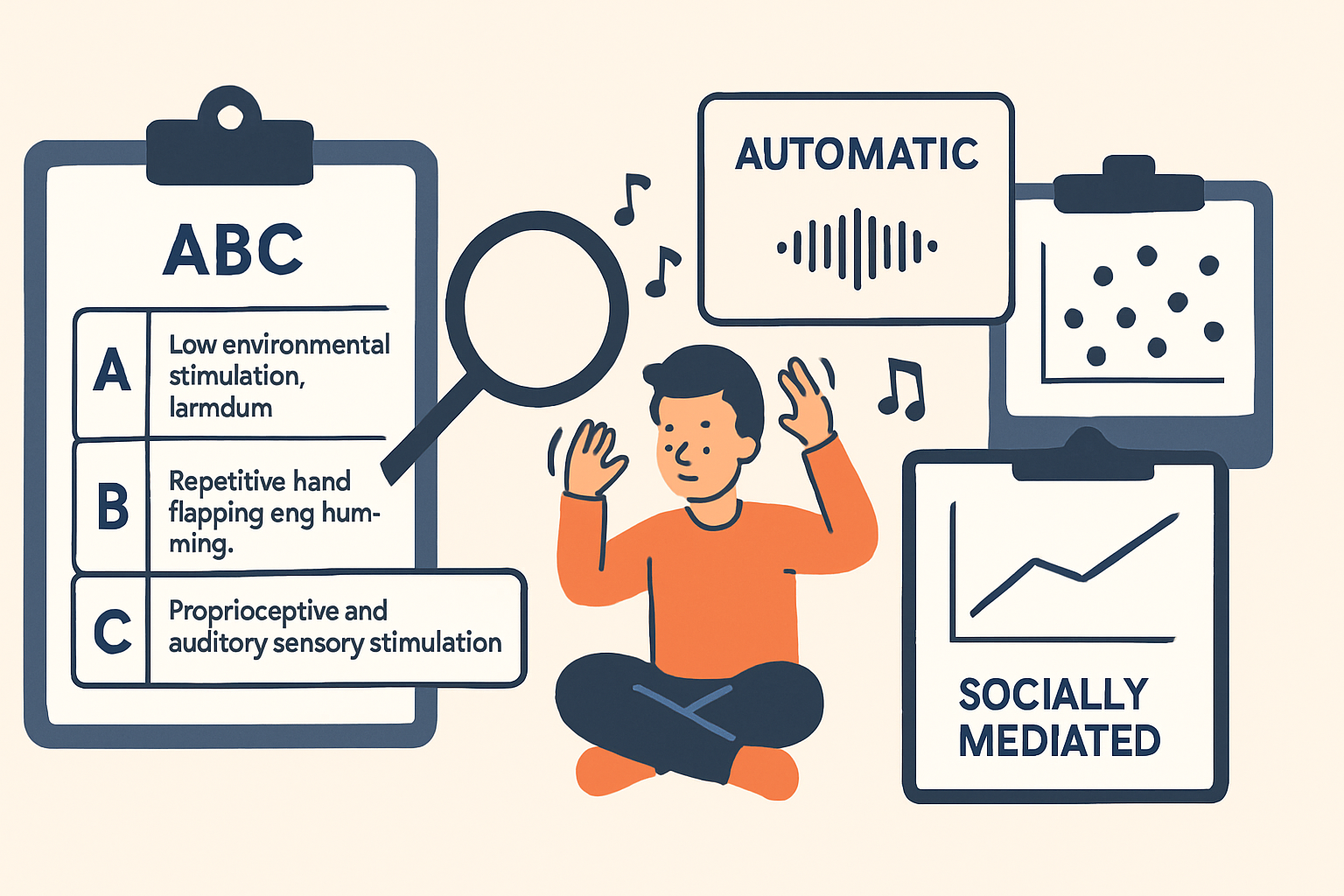
Example 1: Hand Flapping and Humming (Automatic Positive Reinforcement)
Antecedent: Low environmental stimulation, boredom.
Behavior: Repetitive hand flapping and humming.
Consequence: Proprioceptive and auditory sensory stimulation.
Analysis: The behavior directly produces the reinforcing sensory input. No other person is involved in delivering the consequence, making this automatic positive reinforcement.
Example 2: Head Hitting on a Table (Automatic Negative Reinforcement)
Antecedent: Severe earache or headache pain.
Behavior: Hitting head against hard surface.
Consequence: Attenuation of pain through distraction or counter-stimulation.
Analysis: The behavior directly alters the painful private event. This is automatic negative reinforcement because the behavior itself reduces the aversive stimulation without social mediation.
Example 3: Screaming for a Toy (Socially Mediated Positive Reinforcement)
Antecedent: Sees preferred toy on high shelf.
Behavior: Loud screaming and crying.
Consequence: Parent retrieves and gives the toy.
Analysis: The parent’s action mediates access to the tangible reinforcer. This is socially mediated positive reinforcement because another person must act to deliver the consequence.
Example 4: Whining to Avoid Homework (Socially Mediated Negative Reinforcement)
Antecedent: Demand to complete homework presented.
Behavior: Protracted whining and complaining.
Consequence: Parent says ‘Fine, go play’ and removes the demand.
Analysis: The parent’s action mediates the removal of the aversive task. This is socially mediated negative reinforcement because escape requires another person’s intervention.
Exam Relevance and Common Traps
BCBA exam questions often test your ability to distinguish between these contingencies in complex scenarios. Recognizing common traps can prevent errors.
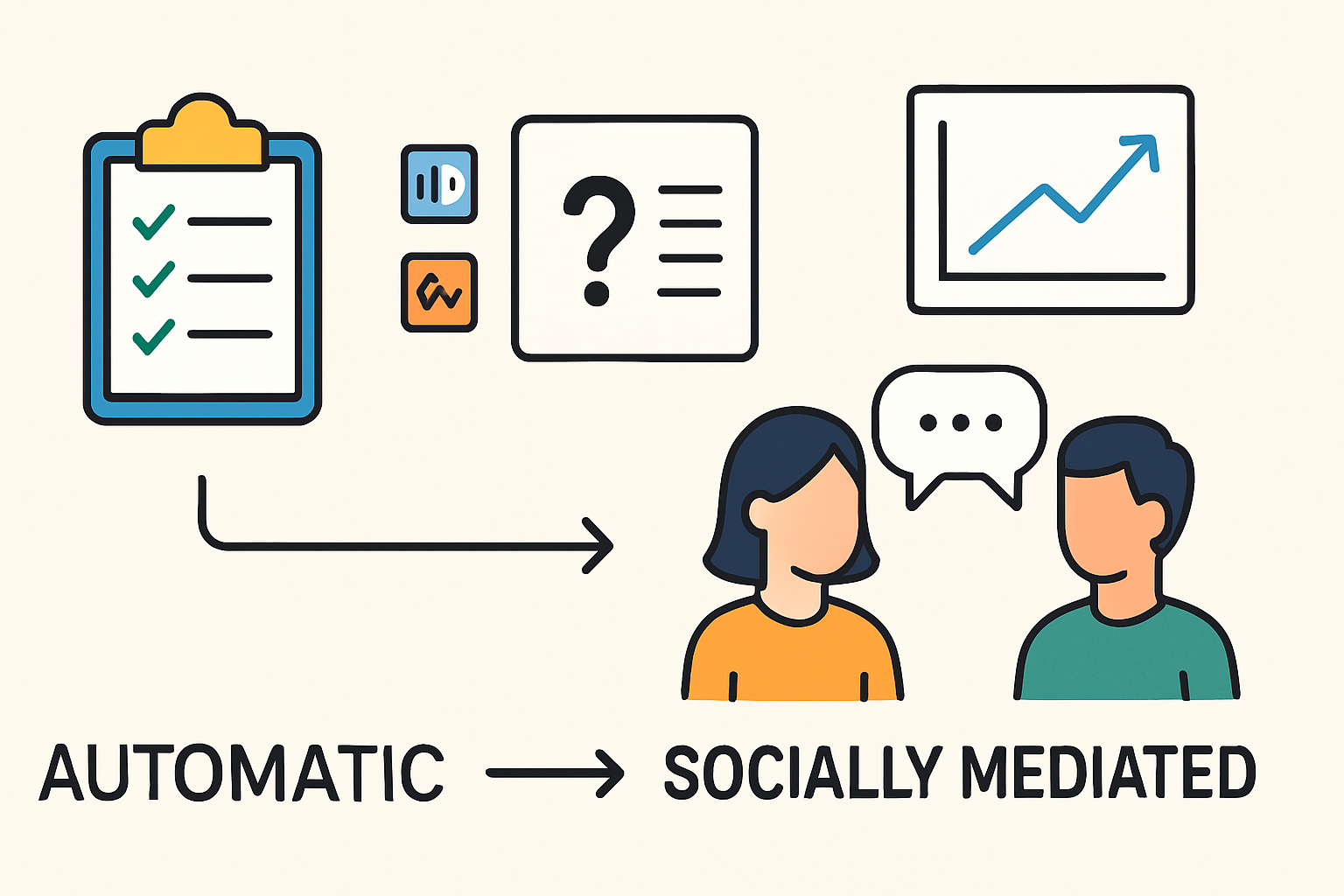
The ‘Mediation’ Question: Your Key Diagnostic
The single most important question to ask is: ‘Does the consequence require another person’s action?’ If yes, it’s socially mediated. If no, it’s automatic. This simple diagnostic cuts through confusing scenario details.
Trap 1: Confusing Automatic Negative Reinforcement with Social Escape
This is perhaps the most common exam trap. Automatic negative reinforcement involves behavior that directly reduces or eliminates an aversive private event (pain, anxiety, hunger). Social escape involves behavior that leads another person to remove an external demand or aversive stimulus. The key distinction is whether the aversive is private/internal or public/external.
Trap 2: Overlooking Tangible as Socially Mediated
Access to tangibles (toys, food, activities) is almost always socially mediated because someone typically controls or provides these items. Even if a child could theoretically access something independently, if in practice another person mediates access, it’s socially mediated. For more on reinforcement principles, see our reinforcement guide.
Trap 3: Missing Sensory Consequences in Automatic Reinforcement
Behaviors maintained by automatic reinforcement often involve subtle sensory consequences that aren’t immediately obvious. Proprioceptive, vestibular, or tactile stimulation can maintain behaviors without social mediation. Always consider whether the behavior’s topography itself produces reinforcing stimulation.
Quick-Reference Identification Checklist
Use this actionable checklist when analyzing behavior scenarios:
- Ask the mediation question: Does the consequence require another person’s action?
- Identify the consequence: What immediately follows the behavior?
- Determine if consequence is direct: Does the behavior itself produce the consequence?
- Check for sensory components: Could the behavior produce reinforcing stimulation?
- Consider who controls access: Who has power over the reinforcer or aversive?
- Look for private events: Is the aversive a private experience (pain, anxiety)?
- Examine social context: Is someone present who could mediate the consequence?
Summary and Next Steps for Mastery
The distinction between automatic and socially mediated contingencies is crucial for accurate functional assessment. Automatic contingencies involve direct behavior-consequence relationships, while socially mediated contingencies require another person’s intervention. This distinction directly impacts intervention planning: automatic reinforcement often requires alternative sensory activities, while socially mediated reinforcement may involve teaching functional communication.
To master this concept for exam success:
- Generate novel examples: Create your own scenarios for both contingency types
- Practice ABC analysis: Systematically analyze case studies using the checklist
- Focus on mediation: Always return to the key question about social mediation
- Study related concepts: Review automatic reinforcement and negative reinforcement principles
- Use mock exams: Test your understanding with practice questions
For authoritative information on behavior analysis terminology and concepts, refer to the BACB Glossary and Cooper, Heron, and Heward’s Applied Behavior Analysis textbook. Consistent practice with varied scenarios will build the analytical skills needed for both clinical practice and exam success.


