

Understanding the functions of behavior is fundamental to effective ABA practice, and automatic negative reinforcement represents one of the more nuanced concepts that often challenges both students and practitioners. This guide breaks down this critical concept with clear definitions and practical examples you can apply immediately.
Table of Contents
- What is Automatic Negative Reinforcement?
- Identifying Automatic Negative Reinforcement in Practice
- Automatic Negative Reinforcement on the BCBA Exam
- Quick-Reference Checklist for Clinicians and Students
- References
What is Automatic Negative Reinforcement?
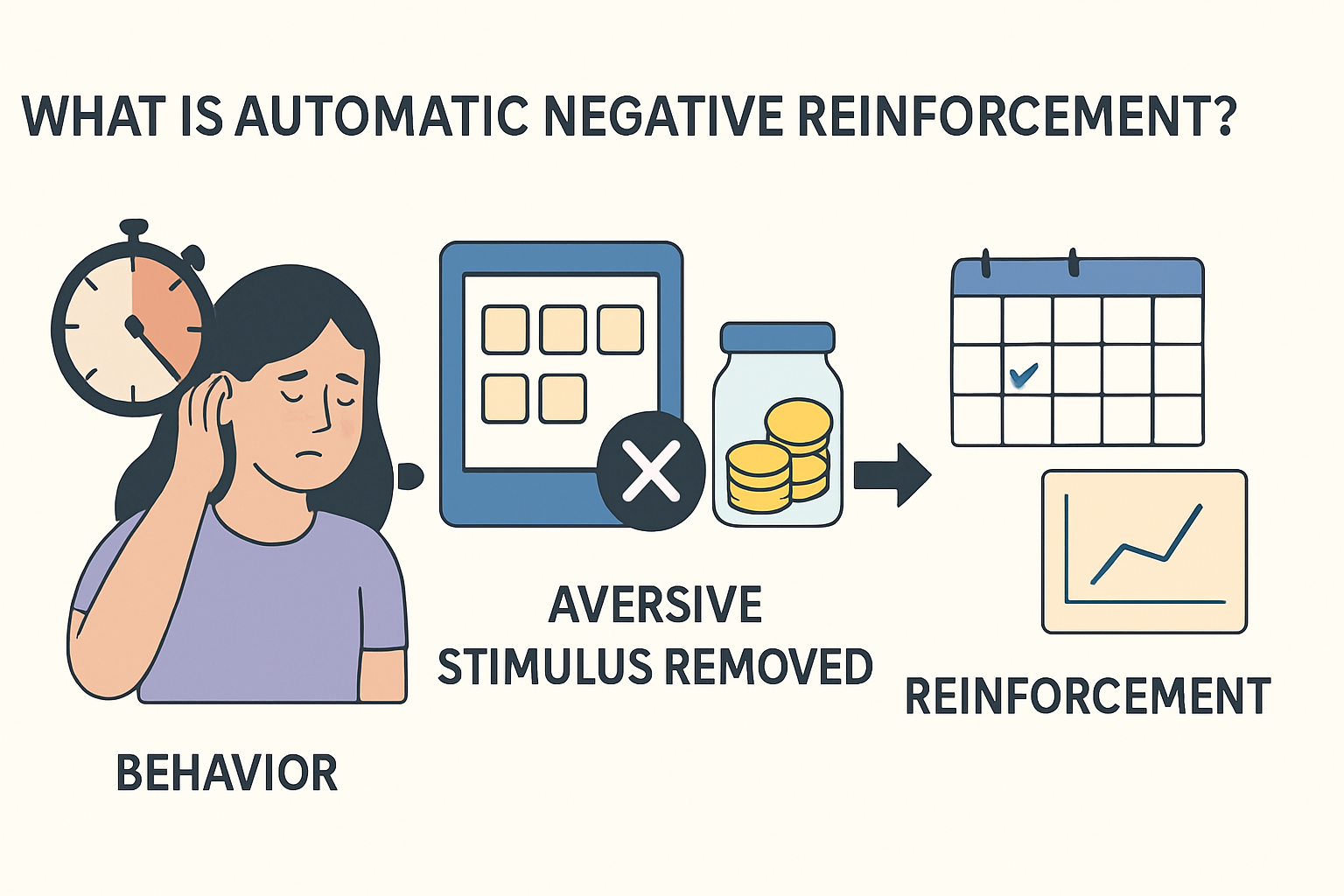
Automatic negative reinforcement occurs when a behavior is strengthened by the removal or reduction of an aversive stimulus that happens automatically, without social mediation. The key distinction lies in the automatic nature of the consequence—it’s not delivered or removed by another person.
The Core Definition and Mechanism
In technical terms, automatic negative reinforcement involves behavior that produces the termination or reduction of an aversive stimulus through direct environmental changes or internal processes. The behavior itself directly alters the individual’s experience, making the aversive condition less intense or removing it entirely.
This differs from social negative reinforcement, where another person’s action mediates the consequence. Understanding this distinction is crucial for accurate functional behavior assessment and effective intervention planning.
Automatic vs. Social Negative Reinforcement: A Critical Comparison
These two reinforcement types share the same outcome—behavior increases—but differ fundamentally in how the consequence occurs:
- Automatic negative reinforcement: The behavior directly removes or reduces the aversive stimulus without another person’s involvement
- Social negative reinforcement: Another person’s action mediates the removal of the aversive stimulus
- Key differentiator: Ask “Who or what removes the aversive stimulus?” If it’s the behavior itself or a direct environmental change, it’s automatic
- Common automatic scenarios: Internal sensations (pain, itch), environmental stimuli (noise, light), or physiological states
- Common social scenarios: Teacher removing demands, parent turning off lights, caregiver providing breaks
Identifying Automatic Negative Reinforcement in Practice
Moving from theory to application requires careful analysis of real-world scenarios. Let’s examine three detailed examples using the ABC framework to illustrate how automatic negative reinforcement operates in practice.
Example 1: Head-Hitting to Reduce Pain
This classic example demonstrates how behavior can be maintained by the automatic reduction of internal discomfort:
- Antecedent: Intense ear pain from an untreated infection
- Behavior: Repeatedly hitting the side of the head with moderate force
- Consequence: The pain sensation momentarily decreases due to distraction or counter-pressure
- Hypothesized function: Automatic negative reinforcement—the behavior directly reduces the aversive internal stimulus of pain
This example highlights why medical evaluation is essential before assuming behavioral functions. The automatic nature means the consequence occurs without social interaction.
Example 2: Skin Picking to Relieve Itch
Skin picking behaviors often serve automatic negative reinforcement functions when they reduce uncomfortable sensations:
- Antecedent: Persistent itching from eczema or dry skin
- Behavior: Picking, scratching, or rubbing the affected skin area
- Consequence: The itching sensation is temporarily relieved through stimulation
- Function analysis: Automatic negative reinforcement—behavior removes the aversive sensory experience
This pattern illustrates how behaviors that appear harmful can be maintained by sensory consequences that provide immediate relief from discomfort.
Example 3: Humming to Block Out Noise
Vocal behaviors can also serve automatic negative reinforcement functions when they alter environmental stimuli:
- Antecedent: Overwhelming noise in a crowded cafeteria or busy classroom
- Behavior: Humming a consistent tone or pattern
- Consequence: Self-generated sound masks or reduces perception of the aversive environmental noise
- Functional relationship: Automatic negative reinforcement—behavior directly alters stimulus perception
This example shows how behaviors can modify how we experience our environment, providing relief through direct environmental changes rather than social means.
Automatic Negative Reinforcement on the BCBA Exam
Exam questions often test your ability to distinguish automatic negative reinforcement from similar concepts. Understanding common traps and practicing application is essential for success.
Common Exam Traps and How to Avoid Them
Several patterns consistently challenge test-takers. Recognizing these traps can improve your accuracy:
- Confusing with automatic positive reinforcement: Remember that negative reinforcement involves removal, while positive reinforcement involves addition
- Mistaking social escape for automatic function: Carefully analyze whether another person mediates the consequence
- Overlooking subtle automatic scenarios: Look for behaviors that directly alter internal states or environmental conditions
- Ignoring sensory consequences: Many automatic functions involve sensory relief that’s not socially mediated
- Assuming all escape is social: Some escape behaviors work through automatic mechanisms
For more on distinguishing reinforcement types, see our guide on negative reinforcement examples.
Practice Application Prompts
Test your understanding with these scenarios. Analyze each using the ABC framework:
Scenario 1: A child rocks back and forth when experiencing stomach cramps. The rocking motion seems to provide pressure that reduces the cramping sensation. What’s the likely function?
Answer rationale: Automatic negative reinforcement. The behavior directly reduces the aversive internal stimulus (stomach cramps) without social mediation.
Scenario 2: An adult taps their fingers rhythmically when feeling anxious in social situations. The tapping seems to help regulate their breathing and reduce anxiety. What’s the likely function?
Answer rationale: Automatic negative reinforcement. The behavior reduces the aversive emotional state through direct physiological effects.
For additional practice with behavior functions, explore our comprehensive four functions of behavior guide.
Quick-Reference Checklist for Clinicians and Students
Use this actionable checklist to systematically analyze potential automatic negative reinforcement scenarios:
- Identify the aversive stimulus: What unpleasant condition exists before the behavior?
- Analyze consequence mediation: Does the behavior itself remove the stimulus, or does another person?
- Check for social involvement: If no other person is involved in the consequence, consider automatic function
- Consider sensory components: Many automatic functions involve relief from sensory discomfort
- Rule out medical causes: Always consider physiological explanations for behavior
- Document ABC patterns: Collect clear antecedent-behavior-consequence data
- Test your hypothesis: Use functional analysis methods to verify the function
This systematic approach helps ensure accurate functional assessment and appropriate intervention planning. For more on assessment methods, see our guide on functional analysis vs descriptive assessment.
Mastering automatic negative reinforcement requires understanding both the theoretical framework and practical application. By recognizing the automatic nature of these consequences and systematically analyzing behavior patterns, you can develop more effective interventions that address the true function of behavior. Remember that accurate identification is the first step toward meaningful change in ABA practice.


