
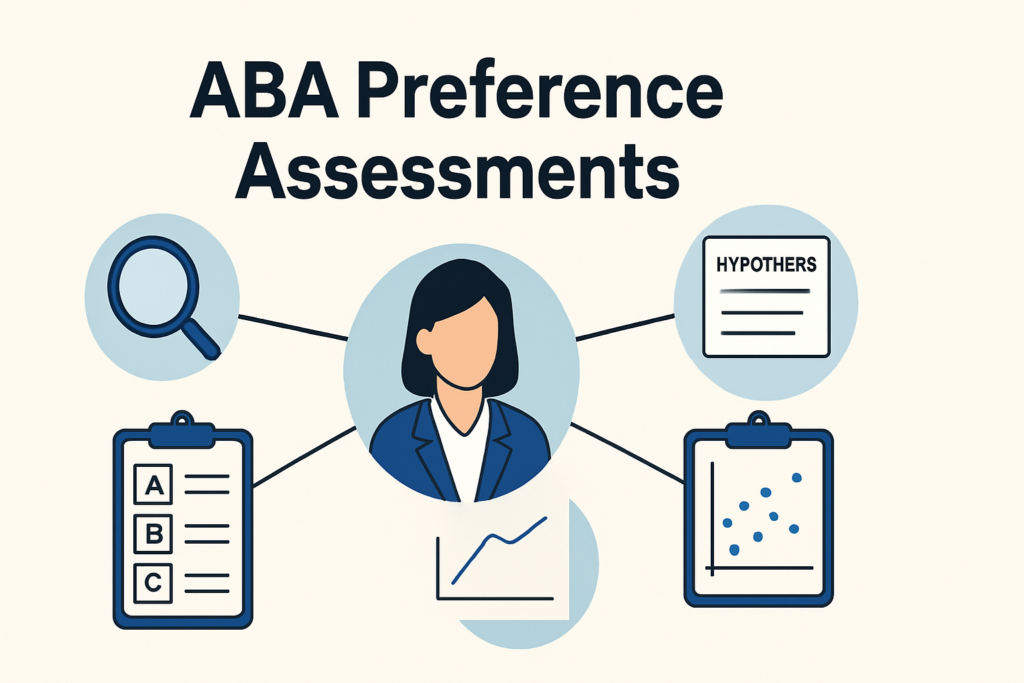
What is a Preference Assessment in ABA?
A preference assessment is a systematic procedure used to identify stimuli that an individual prefers. These assessments help practitioners determine potential reinforcers that may increase target behaviors when delivered contingently.
Table of Contents
- What is a Preference Assessment in ABA?
- Key Types of ABA Preference Assessments
- Applying Assessments: From Theory to Practice and the Exam
- Summary and Next Steps for Mastery
The primary goal is to identify items or activities that can serve as effective reinforcers for intervention programs.
Core Definitions and Goals
A stimulus preference assessment identifies what a person likes, while a reinforcer assessment tests whether those preferences actually function as reinforcers. This distinction is critical for ethical practice and effective intervention design.
The BACB Ethics Code emphasizes client choice and dignity, making systematic preference assessment an ethical imperative rather than just a technical procedure.
Why It’s More Than Just ‘Finding Rewards’
Beyond identifying potential reinforcers, preference assessments build rapport and honor client autonomy. They increase intervention effectiveness by ensuring reinforcers are truly motivating.
This approach aligns with person-centered values and improves treatment outcomes through better reinforcement selection.
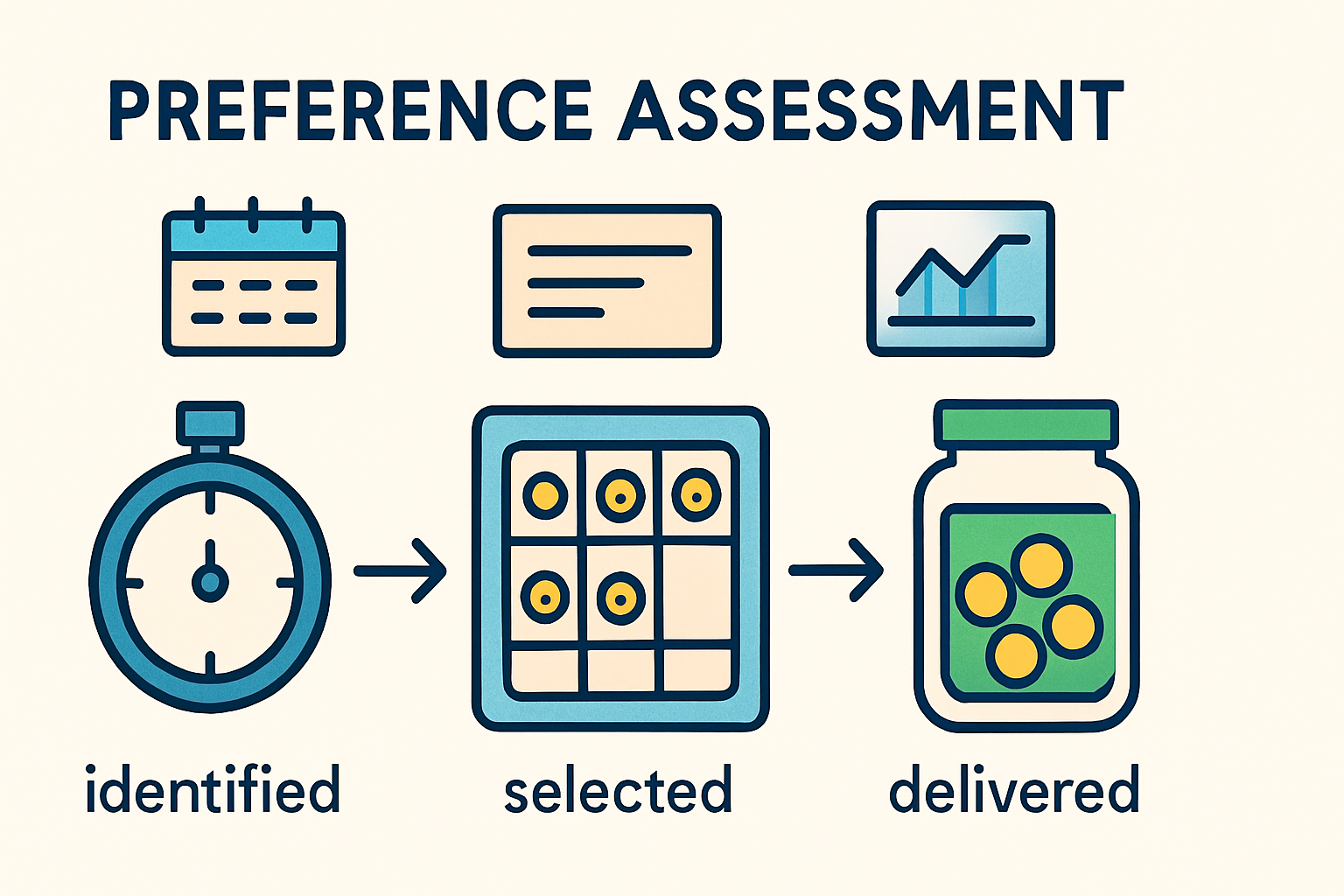
Key Types of ABA Preference Assessments
Different assessment methods serve different clinical needs. Choosing the right method depends on the client’s abilities, time constraints, and assessment goals.
Free Operant Observation: The Naturalistic Starting Point
This method involves observing what items or activities a client engages with freely in their natural environment. No demands are placed, and the observer records duration of engagement or frequency of approach.
Free operant observation is particularly useful for establishing baseline preferences and identifying potential reinforcers before more structured assessments.
- Procedure: Present multiple items simultaneously and observe without prompting
- Data collection: Record duration of engagement with each item
- Advantages: Naturalistic, low-demand, good for initial screening
- Limitations: May not identify all preferences, environmental factors can influence results
Trial-Based Methods: MSWO and Paired Choice
These structured methods present items in controlled trials to systematically identify preferences. Multiple Stimulus Without Replacement (MSWO) and Paired Choice (Forced Choice) assessments are the most common trial-based approaches.
MSWO involves presenting multiple items simultaneously, with the chosen item removed from subsequent presentations. This creates a hierarchy of preferences.
- MSWO steps: 1. Arrange 5-8 items in array 2. Client selects one item 3. Remove chosen item 4. Re-present remaining items 5. Repeat until all items chosen or no selection made
- Paired Choice steps: 1. Present two items simultaneously 2. Client selects one 3. Record choice 4. Present new pair with different combination 5. Continue through all possible pairings
- When to use: MSWO for efficiency, Paired Choice for more precise preference hierarchies
Single Stimulus and Brief Assessments
The single stimulus method presents items one at a time, recording whether the client engages with each item. This successive choice approach is useful for clients who struggle with multiple-item presentations.
Brief assessments like the multiple stimulus with replacement (MSW) provide quick screens when time is limited, though they may be less precise than more comprehensive methods.

Applying Assessments: From Theory to Practice and the Exam
Understanding assessment procedures is only half the battle. Effective application requires connecting assessment results to intervention design and avoiding common pitfalls.
Worked Example: Using MSWO to Inform a DRA Protocol
Consider a client named Alex who engages in property destruction to access preferred toys. ABC data suggest the function is access to tangibles. An MSWO assessment identifies bubbles as the highest preference, followed by a spinning top and playdough.
For the differential reinforcement of alternative behavior (DRA) protocol, bubbles are selected as the reinforcer for appropriate requesting. The functionally matched reinforcer increases the likelihood of the alternative behavior replacing the problem behavior.
This approach demonstrates how preference assessment results directly inform function-based intervention design.
Common Exam Traps and How to Avoid Them
BCBA exam questions often test subtle distinctions between assessment types and their appropriate applications. Common traps include confusing preference assessment with reinforcer assessment.
- Trap 1: Assuming preference equals reinforcement function – always conduct a reinforcer assessment to confirm
- Trap 2: Misidentifying assessment types from procedural descriptions – memorize key procedural differences
- Trap 3: Forgetting that preferences change over time – schedule regular re-assessments
- Trap 4: Overlooking ethical considerations in assessment procedures
Quick-Reference Implementation Checklist
Use this checklist to ensure thorough preference assessment implementation:
- Gather a varied array of potential reinforcers across categories
- Choose assessment method based on client characteristics and time available
- Conduct assessment systematically with proper data collection
- Use results to inform a reinforcer assessment to confirm function
- Document procedures and results thoroughly
- Schedule regular re-assessments to account for changing preferences
Summary and Next Steps for Mastery
Preference assessments are fundamental to ethical, effective ABA practice. They bridge the gap between identifying what clients like and designing interventions that work.
For BCBA exam preparation, focus on distinguishing between assessment types, understanding procedural steps, and recognizing appropriate applications. Practice applying assessment results to intervention scenarios.
Continue your study with our guide to differential reinforcement procedures and functional assessment methods. For authoritative guidance, refer to the BACB Ethics Code and peer-reviewed literature on reinforcement procedures.
Remember that systematic preference assessment is both a technical skill and an ethical obligation in delivering client-centered ABA services.



