

momentary time sampling groups: What is Momentary Time Sampling for Groups?
Momentary time sampling for groups is a discontinuous measurement procedure where an observer records whether a target behavior is occurring at the exact moment predetermined intervals end, applied simultaneously across multiple individuals. This method provides an efficient estimate of behavior occurrence when continuous measurement across an entire group would be impractical.
Table of Contents
- momentary time sampling groups: What is Momentary Time Sampling for Groups?
- Applying the Procedure: Worked Examples from ABA Practice
- Exam Relevance and Common Traps for BCBA Candidates
- Quick-Reference Implementation Checklist
- Summary and Key Takeaways
Unlike other time sampling methods, momentary time sampling captures only what’s happening at specific moments, making it particularly useful for large group settings where one observer must monitor multiple clients.
Core Definition and Key Characteristics
The momentary time sampling procedure involves dividing observation periods into equal intervals and recording whether the target behavior occurs at the precise moment each interval ends. For groups, this means scanning multiple individuals simultaneously at these predetermined moments.
Key characteristics include:
- Discontinuous measurement: Records behavior only at specific moments rather than continuously
- Efficiency advantage: Allows one observer to monitor multiple individuals simultaneously
- Underestimation tendency: Typically underestimates actual behavior occurrence compared to continuous measurement
- Interval-based: Uses predetermined time intervals (e.g., every 2 minutes, every 5 minutes)
When to Choose This Measurement Method
Select momentary time sampling for groups when you need to measure behavior across multiple individuals efficiently. Ideal scenarios include classroom settings, social skills groups, or any situation where continuous measurement would require excessive resources.
Consider this method when:
- Measuring permanent product is impossible or impractical
- Observing multiple clients simultaneously is necessary
- Behaviors have long durations or occur frequently
- Resources for continuous observation are limited
- You need a quick estimate of behavior occurrence rather than precise frequency
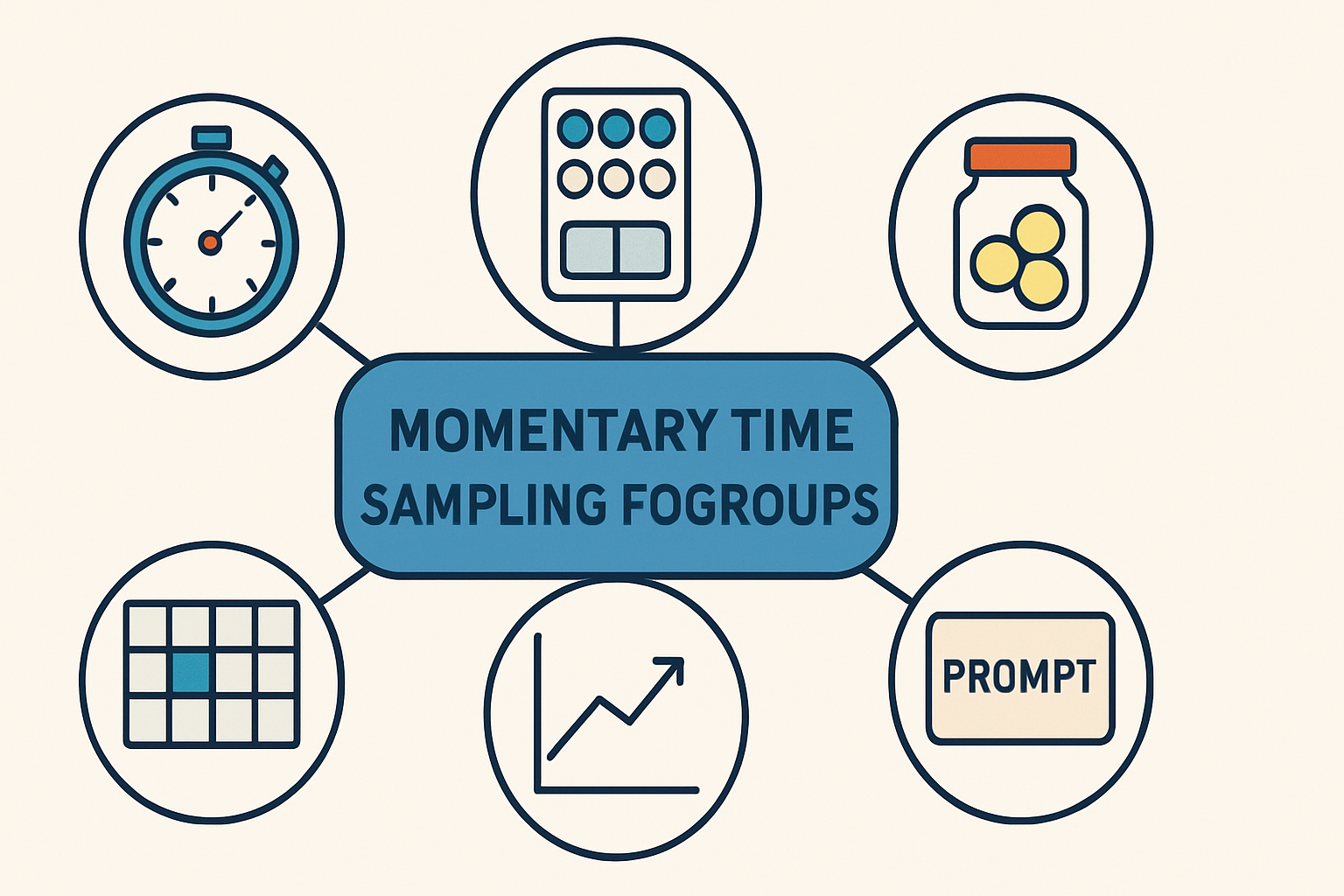
Applying the Procedure: Worked Examples from ABA Practice
Understanding the theory is essential, but applying momentary time sampling for groups requires practical implementation. These examples demonstrate how to translate the procedure into real-world ABA practice with clear operational definitions and data collection strategies.
Example 1: On-Task Behavior in a Classroom Setting
Scenario: You need to measure on-task behavior for five students during independent work time in a classroom. The observation period is 30 minutes, divided into 5-minute intervals.
Operational definition: On-task behavior is defined as eyes oriented toward assigned work materials, hands manipulating relevant materials appropriately, or writing/typing responses to assigned tasks. Off-task includes looking away for more than 3 seconds, engaging with non-assigned materials, or leaving the work area without permission.
Data collection setup:
- Create a data sheet with columns for each student and rows for each 5-minute interval
- Set a timer to signal the end of each interval
- At each interval mark, quickly scan all five students
- Record “+” if on-task behavior is occurring at that moment, “-” if not
Sample data for one interval might show: Student A (+), Student B (-), Student C (+), Student D (+), Student E (-). This yields 60% on-task for that interval. After six intervals, you might calculate an overall percentage of intervals with on-task behavior.
Function hypothesis: The pattern might suggest escape from difficult tasks for Students B and E, warranting further assessment of task difficulty or reinforcement strategies.
Example 2: Vocal Stereotypy in a Social Skills Group
Scenario: Measuring occurrence of non-contextual vocalizations for four clients in a social skills group. The 20-minute session uses 2-minute intervals for more frequent sampling.
Operational definition: Vocal stereotypy includes humming, non-contextual word repetition, or vocal sounds not related to the current social interaction or activity. Context-appropriate vocalizations are not counted.
Implementation details:
- Shorter intervals (2 minutes) provide more frequent sampling points
- Data sheet tracks all four clients simultaneously
- Observer positions to hear all participants clearly
- Recording occurs at the exact moment each interval ends
Sample data analysis might reveal that Client 1 shows vocal stereotypy in 8 of 10 intervals (80%), while others show lower percentages. This data suggests automatic reinforcement as the likely function for Client 1, guiding intervention planning toward replacement behaviors that provide similar sensory input.
For comprehensive assessment strategies, see our guide on functional analysis vs descriptive assessment.
Exam Relevance and Common Traps for BCBA Candidates
Momentary time sampling for groups appears regularly on the BCBA exam, often in scenarios testing your ability to select appropriate measurement procedures for specific contexts. Understanding both its applications and limitations is crucial for exam success.
Linking to the BCBA Task List
This topic connects directly to Domain C: Measurement, Data Display, and Interpretation in the BCBA Task List. Specifically, it relates to:
- C-1: Define behavior in observable and measurable terms
- C-2: Select a measurement system to obtain representative data given the dimensions of behavior and the logistics of observing and recording
- C-3: Use discontinuous measurement procedures appropriately
When selecting measurement systems, you must consider both the behavior’s characteristics and practical constraints like available staff and observation settings.
Frequent Misconceptions and Distractor Answers
Exam questions often include distractors that test subtle distinctions between measurement procedures. Common traps include:
- Confusing momentary time sampling with partial-interval sampling (which overestimates occurrence)
- Mistaking it for whole-interval sampling (which underestimates differently)
- Believing it measures frequency or duration directly rather than estimating occurrence
- Forgetting that it provides an estimate of occurrence, not an exact rate
- Selecting it when momentary absence of behavior is the target (other methods are better)
Remember that momentary time sampling is best for estimating whether behavior occurs, not how often or how long it occurs.
Quick-Reference Implementation Checklist
Use this actionable checklist when implementing momentary time sampling for groups in practice or analyzing exam scenarios:
- Define behavior operationally with clear, observable criteria
- Determine appropriate interval length based on behavior characteristics
- Create a data sheet with columns for each group member
- Set up reliable timing method (timer, app, or watch)
- Position yourself to observe all group members simultaneously
- Record behavior occurrence only at the exact moment each interval ends
- Calculate percentage of intervals with behavior occurrence
- Interpret data as an estimate, not an exact measure
- Consider limitations when making intervention decisions
For more on measurement systems, explore our data collection methods guide.
Summary and Key Takeaways
Momentary time sampling for groups provides an efficient method for estimating behavior occurrence across multiple individuals. Its discontinuous nature makes it practical for resource-limited settings while still yielding useful data for decision-making.
Key points to remember:
- Records behavior only at specific moments when intervals end
- Typically underestimates actual occurrence compared to continuous measurement
- Ideal for measuring multiple individuals simultaneously
- Best suited for behaviors with longer durations
- Provides percentage of intervals data, not frequency or duration
- Connects to BCBA Task List Domain C measurement requirements
- Common exam traps involve confusing it with other time sampling methods
For authoritative guidance on measurement procedures, refer to the BACB Task List and peer-reviewed sources like the Journal of Applied Behavior Analysis.
Understanding when and how to use momentary time sampling for groups demonstrates both practical skill and exam readiness. This measurement approach balances efficiency with data quality, making it a valuable tool in your ABA measurement toolkit.


