
What is Behavioral Momentum? Definition and Theory
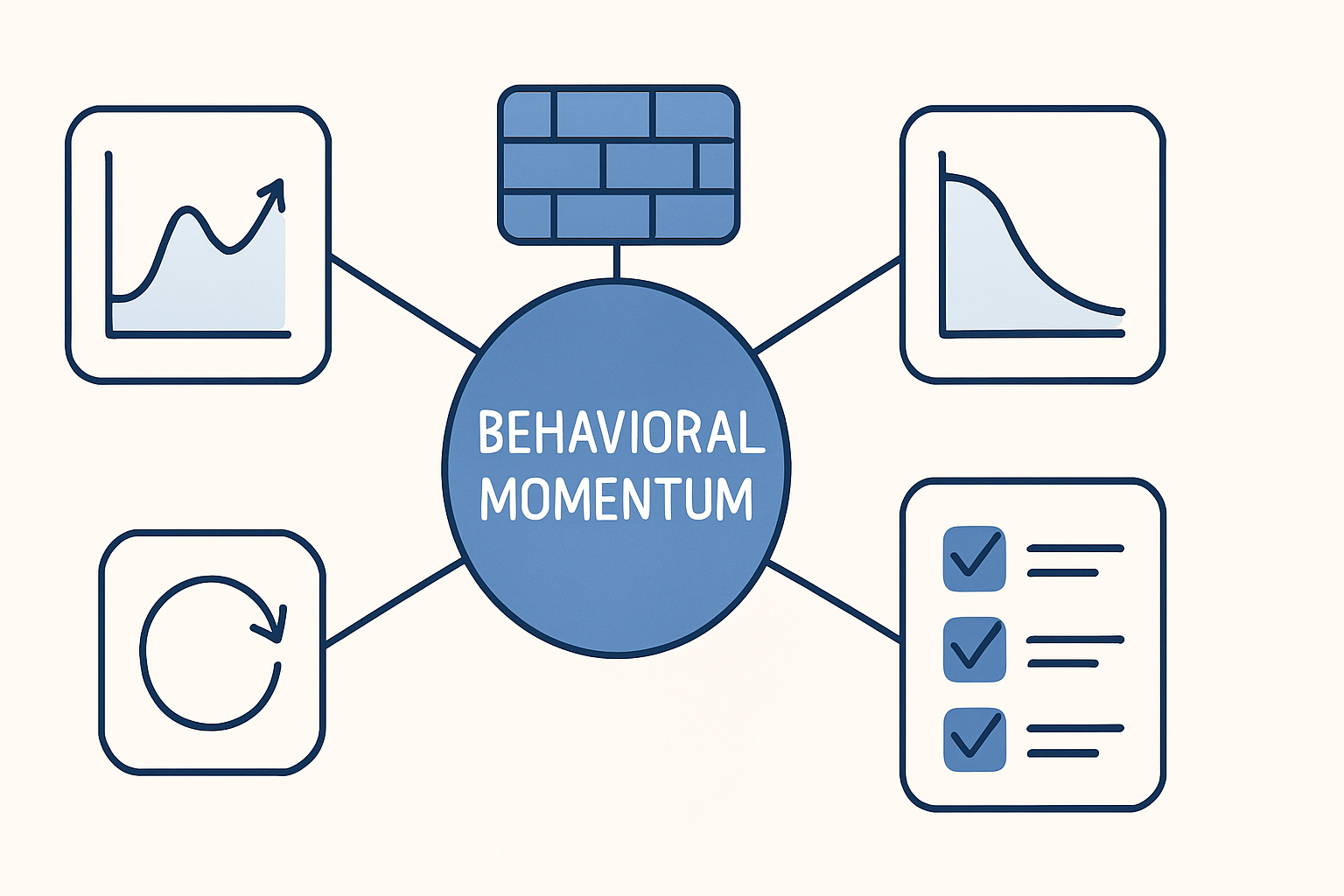
Behavioral momentum refers to an antecedent intervention strategy that builds compliance by presenting a series of high-probability requests before introducing a lower-probability demand. The concept borrows from physics—just as a moving object tends to stay in motion, behavior that has been reinforced repeatedly tends to persist.
Table of Contents
- What is Behavioral Momentum? Definition and Theory
- Applying Behavioral Momentum: Worked ABA Examples
- Behavioral Momentum on the BCBA Exam: Relevance and Common Traps
- Quick Clinical Implementation Checklist
- Summary and Key Takeaways
This approach leverages a client’s reinforcement history with specific tasks to increase the likelihood they’ll comply with subsequent, more challenging demands.
The Core Concept: High-Probability Request Sequences
The fundamental mechanism involves presenting several high-probability (high-p) requests that the client consistently completes successfully. These are followed immediately by a low-probability (low-p) demand that typically evokes escape or avoidance behaviors.
By building momentum through easy successes, the intervention increases the probability that the client will comply with the more difficult task. This strategy is particularly effective for behaviors maintained by negative reinforcement functions.
Key Behavioral Principles at Play
Several established behavioral principles explain why behavioral momentum works effectively:
- Stimulus control: The high-p sequence establishes a context where compliance is reinforced, creating stimulus conditions that support continued responding
- Establishing operations: The intervention may temporarily alter the value of reinforcement for compliance behaviors
- Response persistence: Repeated reinforced responding creates behavioral momentum that carries over to subsequent demands
- Discriminative stimuli: The practitioner’s requests become SDs for compliance rather than avoidance
It’s crucial to distinguish behavioral momentum from simple prompting. While both are antecedent strategies, momentum specifically builds on existing response patterns rather than teaching new skills.
Applying Behavioral Momentum: Worked ABA Examples
Understanding the theory is essential, but seeing practical applications makes the concept concrete for both clinical practice and exam preparation. These examples demonstrate how behavioral momentum functions in real-world scenarios.
Example 1: Increasing Compliance with Academic Tasks
Scenario: A 7-year-old student with autism consistently avoids math worksheets, engaging in task refusal and disruptive behaviors when presented with academic demands. The hypothesized function is escape from demands maintained by negative reinforcement.
Behavioral momentum implementation:
- Begin with three high-p requests: “Give me five!” (student complies), “Point to the window” (complies), “Clap your hands” (complies)
- Immediately present the low-p demand: “Do problem one on your worksheet”
- Provide immediate reinforcement for compliance with the target task
ABC data analysis shows the pattern: Antecedent (high-p sequence + low-p demand), Behavior (compliance with math task), Consequence (praise + brief break). The reinforcement history with the high-p tasks creates momentum that carries over to the academic demand.
Example 2: Reducing Elopement During Transitions
Scenario: A client consistently elopes when asked to leave preferred areas like the playground. The behavior appears maintained by escape from transitions to less preferred activities.
Implementation strategy:
- Approach during playground time and present high-p requests: “Hand me the ball” (complies), “Push the swing once” (complies), “Walk to the fence with me” (complies)
- Immediately follow with transition demand: “Time to go inside for snack”
- Reinforce compliance with preferred snack items
The key is selecting high-p requests that are already in the repertoire and can be completed quickly. This builds behavioral momentum that increases the probability of compliance with the challenging transition demand.
Behavioral Momentum on the BCBA Exam: Relevance and Common Traps
Behavioral momentum appears regularly on the BCBA exam, typically within sections covering antecedent interventions and behavior reduction strategies. Understanding how it’s tested helps avoid common errors.
How the Exam Tests This Concept
Exam questions typically present clinical vignettes where you must:
- Identify behavioral momentum from a description of an intervention
- Select it as the most appropriate antecedent strategy given specific client characteristics
- Distinguish it from similar interventions like noncontingent reinforcement (NCR) or differential reinforcement alternatives
- Recognize when the function of behavior makes behavioral momentum an appropriate choice
Questions often test your understanding of the sequence order (high-p before low-p) and the requirement that high-p requests must already be in the client’s repertoire.

Pitfalls to Avoid: What the Test Wants
Common exam traps include:
- Confusing with reinforcement procedures: Remember that behavioral momentum is an antecedent strategy, not a consequence-based intervention
- Misidentifying sequence order: The high-p requests must come before the low-p demand, not after
- Selecting it for wrong functions: Behavioral momentum is most effective for escape-maintained behaviors, not attention or automatic reinforcement functions
- Overlooking repertoire requirements: High-p requests must be tasks the client can already perform reliably
- Confusing with prompting: While both are antecedent strategies, prompting provides assistance for new skills, while momentum builds on existing compliance patterns
To deepen your understanding of related concepts, explore our guide on antecedent interventions and common exam traps.
Quick Clinical Implementation Checklist
Use this checklist when considering or implementing behavioral momentum in clinical practice:
- Conduct functional assessment to confirm escape/avoidance as the maintaining variable
- Identify high-p requests that are already in the client’s repertoire with 80-100% compliance
- Select 3-5 high-p tasks that can be completed quickly (5-10 seconds each)
- Sequence properly: Present all high-p requests immediately before the low-p demand
- Reinforce compliance with both high-p and low-p tasks initially
- Monitor effectiveness through data collection on compliance with low-p demands
- Fade gradually by reducing the number of high-p requests as compliance improves
- Consider ethical implications and ensure the intervention respects client dignity
For more on ethical implementation, see our resource on compassionate care and client dignity in ABA practice.
Summary and Key Takeaways
Behavioral momentum represents a powerful antecedent intervention strategy that leverages existing compliance patterns to increase responding to challenging demands. Key points for exam success and clinical practice include:
- The intervention involves presenting high-probability requests immediately before low-probability demands
- It’s most effective for behaviors maintained by escape or avoidance functions
- High-p tasks must already be in the client’s repertoire with high compliance rates
- Behavioral momentum differs from reinforcement procedures—it’s an antecedent strategy
- Proper implementation requires careful sequencing and immediate presentation of the low-p demand
- Monitor effectiveness through systematic data collection on compliance rates
For authoritative information on behavior analytic principles, consult the Behavior Analyst Certification Board resources and peer-reviewed literature on antecedent interventions. Remember that while behavioral momentum can be effective, it should always be implemented within an ethical framework that prioritizes client welfare and respects individual dignity.
To further prepare for the BCBA exam, consider practicing with our free mock exam questions that cover antecedent interventions and other key concepts.


