
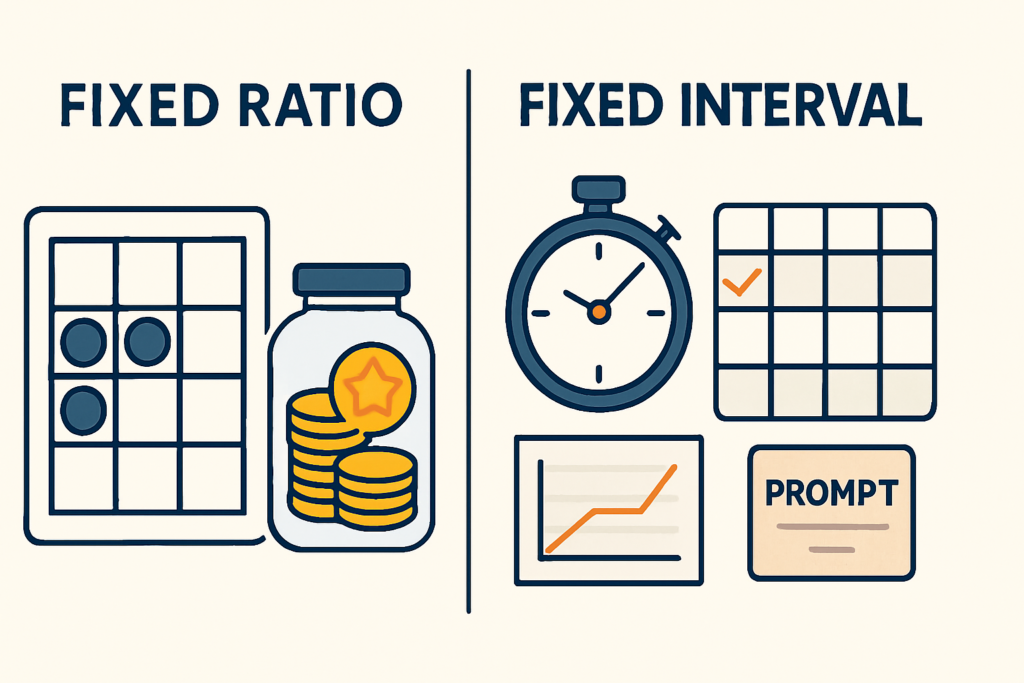
Understanding reinforcement schedules is fundamental to applied behavior analysis, and distinguishing between fixed ratio and fixed interval schedules often appears on the BCBA exam. These two simple schedules produce distinct behavioral patterns that every practitioner must recognize. This guide breaks down their definitions, provides practical examples, and highlights common exam traps to help you master this essential content area.
Table of Contents
- Fixed Ratio vs Fixed Interval: Defining Fixed Ratio and Fixed Interval Schedules
- Fixed Ratio vs. Fixed Interval: A Side-by-Side Analysis
- Exam Relevance and Common Test Traps
- Summary and Key Takeaways for BCBA Candidates
Fixed Ratio vs Fixed Interval: Defining Fixed Ratio and Fixed Interval Schedules
Before comparing these schedules, establishing clear definitions is essential. Both belong to the category of simple schedules of reinforcement, but they operate on fundamentally different principles.
What is a Fixed Ratio (FR) Schedule?
A fixed ratio schedule delivers reinforcement after a predetermined number of responses. The formula R = Srf / #R represents this relationship, where reinforcement follows completion of a fixed response count. This schedule typically produces a high response rate with brief pauses after reinforcement delivery.
When ratio requirements become too demanding, ratio strain may occur, characterized by decreased responding or complete cessation. Understanding this concept helps practitioners design effective intervention programs without overwhelming learners.
What is a Fixed Interval (FI) Schedule?
A fixed interval schedule provides reinforcement for the first response occurring after a fixed time period has elapsed. Responses made during the interval do not affect reinforcement delivery. This schedule creates a distinctive scalloped pattern on cumulative records, with slow initial responding that accelerates as the interval endpoint approaches.
The key feature is that only the first response after time elapses produces reinforcement, making timing rather than response count the critical factor. This distinction forms the basis for many real-world applications and exam questions.
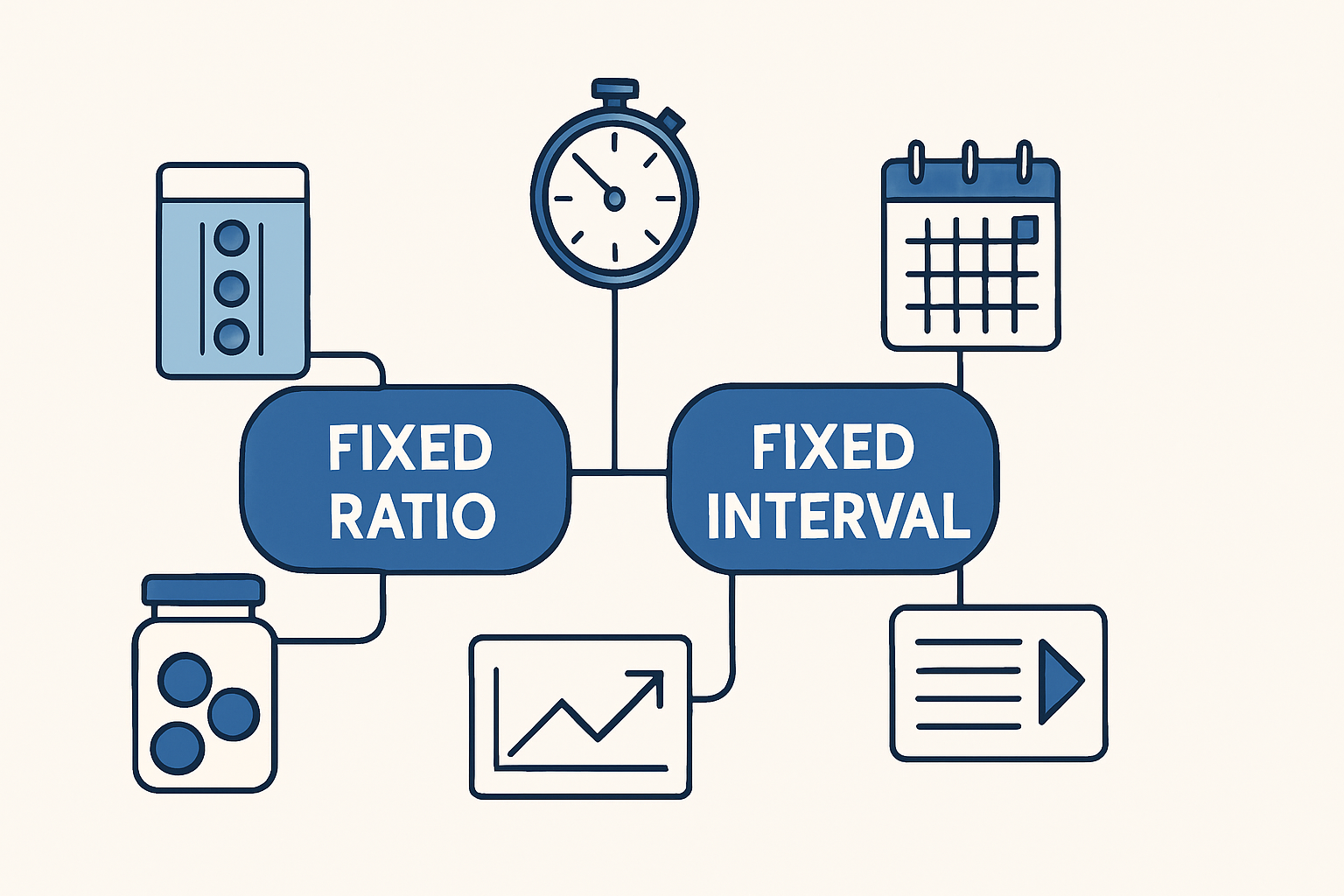
Fixed Ratio vs. Fixed Interval: A Side-by-Side Analysis
Direct comparison reveals why these schedules produce different behavioral outcomes. Understanding their operational differences is crucial for both clinical practice and exam success.
The Governing Rule: Number vs. Time
The fundamental distinction lies in what controls reinforcement delivery. Fixed ratio schedules require counting responses, while fixed interval schedules involve timing the first response after an interval. This difference explains why FR schedules typically maintain higher response rates than FI schedules.
When analyzing scenarios, ask yourself: ‘Is reinforcement based on response count or time passage?’ This simple question often reveals the correct schedule identification.
Typical Response Patterns and Real-World Examples
Practical examples illustrate how these schedules operate in everyday situations and clinical applications:
Fixed Ratio Examples:
- Piecework pay: Factory worker receives payment after assembling 10 units (FR10)
- Token board systems: Child earns token after completing 5 math problems (FR5)
- Sales commissions: Salesperson earns bonus after making 15 sales calls (FR15)
Fixed Interval Examples:
- Weekly quiz: Student can access reinforcement after first correct response following 7 days (FI7-day)
- Checking mail: Person checks mailbox more frequently as delivery time approaches (FI24-hour)
- Paycheck delivery: Employee works steadily but productivity may dip immediately after payday (FI2-week)
Visualizing the Difference: Cumulative Records
Graphical representations clearly distinguish these schedules. Fixed ratio schedules typically show high, steady response rates with possible brief pauses after reinforcement. In contrast, fixed interval schedules display the characteristic scalloped pattern with slow initial responding that accelerates toward interval completion.
Understanding these visual patterns helps with both data interpretation and exam questions involving graph analysis. The scalloped pattern is particularly diagnostic for fixed interval schedules.
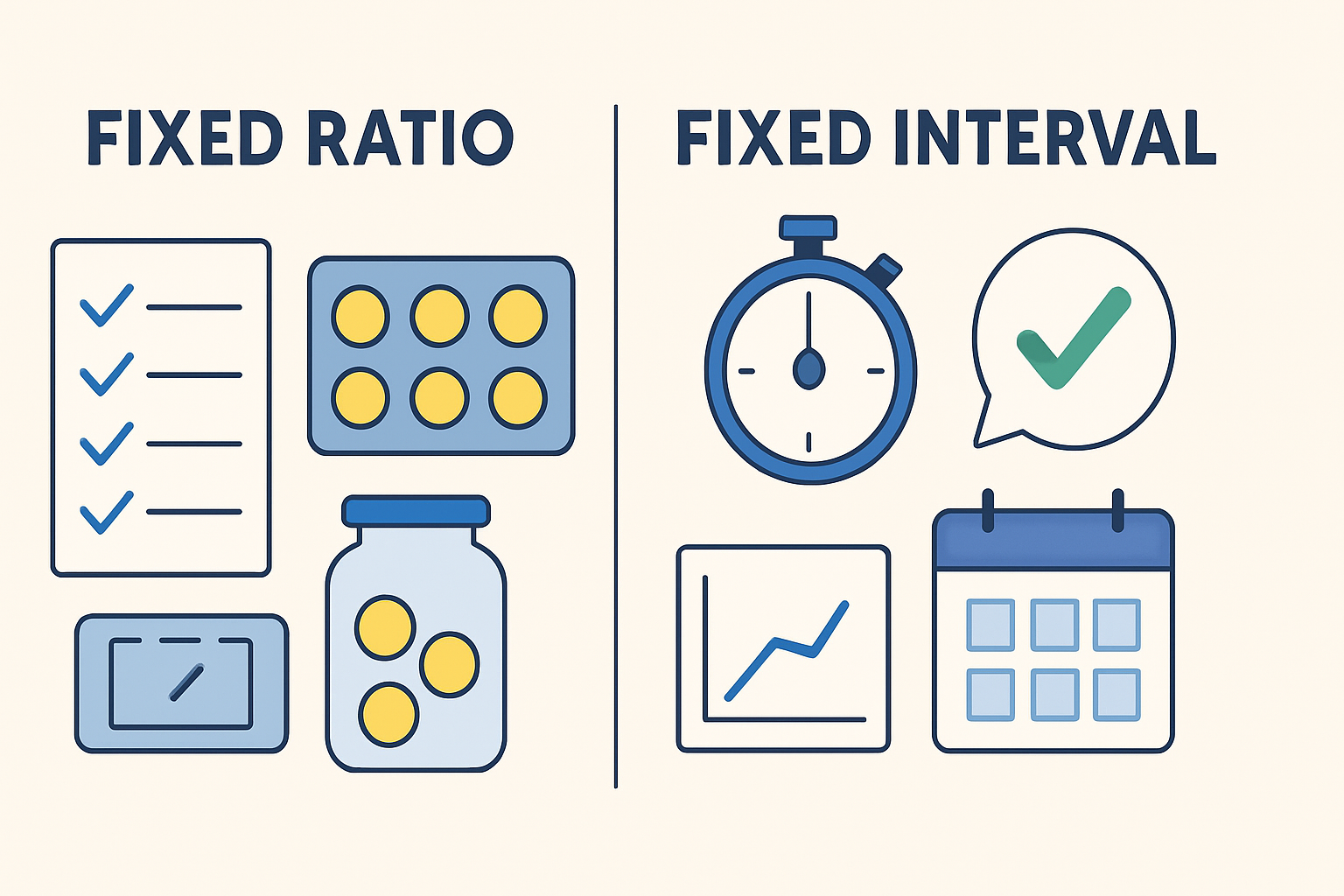
Exam Relevance and Common Test Traps
BCBA exam questions often test your ability to distinguish between these schedules in applied scenarios. Recognizing common traps can prevent costly mistakes.
Spotting the Schedule in Vignettes
Use this systematic approach when analyzing exam scenarios:
- Identify what triggers reinforcement delivery
- Determine if a fixed number of responses is required
- Check if reinforcement follows a fixed time period
- Look for patterns suggesting post-reinforcement pauses or scalloping
- Consider whether responses during intervals affect outcomes
Traps to Avoid: FI vs. FT and FR vs. VR
Several common confusions trip up candidates:
- FI vs. Fixed Time (FT): FI requires a response after time; FT delivers reinforcement non-contingently
- FR vs. Variable Ratio (VR): FR has fixed count; VR has variable count around an average
- Confusing interval with duration: FI measures time between opportunities, not response duration
- Overlooking compound schedules: Real-world examples often combine multiple schedule types
Remember that fixed means consistent, unchanging requirements, whether counting responses or measuring time intervals.
Quick-Reference Comparison Checklist
Use this summary for rapid review:
- Basis of reinforcement: FR = response count; FI = time passage
- Typical pattern: FR = high steady rate; FI = scalloped acceleration
- Key feature: FR = post-reinforcement pause; FI = interval timing
- Common example: FR = piecework; FI = paycheck
- Exam clue: FR = ‘after X responses’; FI = ‘first response after X time’
Summary and Key Takeaways for BCBA Candidates
Mastering the distinction between fixed ratio and fixed interval schedules requires understanding their fundamental operational differences. Fixed ratio schedules reinforce based on response count, producing high, steady response rates. Fixed interval schedules reinforce the first response after time passes, creating scalloped response patterns.
For exam preparation, focus on identifying the reinforcement rule in scenarios. Practice with varied examples and review compound schedules to understand how these simple schedules combine in real applications. Remember that ratio strain can occur with overly demanding FR requirements, while FI schedules often show characteristic acceleration patterns.
These concepts connect to broader ABA principles, including matching law and behavioral economics. For comprehensive exam preparation, explore our study framework guide and practice with realistic scenarios. Consistent practice with schedule identification will build the pattern recognition skills needed for exam success and effective clinical practice.



