
Interobserver Agreement, commonly known as IOA, represents a fundamental measurement concept in applied behavior analysis. This reliability metric ensures that data collected during behavioral interventions maintains consistency across different observers. Understanding IOA in ABA is essential for both clinical practice and BCBA exam preparation, as it directly relates to data validity and treatment integrity.
Table of Contents
- IOA in ABA: What is Interobserver Agreement (IOA) in ABA?
- How to Calculate IOA: Methods and Worked Examples
- IOA on the BCBA Exam: Common Traps and How to Avoid Them
- Quick-Reference IOA Checklist for Practitioners and Students
- Summary and Key Takeaways
- References
IOA in ABA: What is Interobserver Agreement (IOA) in ABA?
Interobserver Agreement refers to the degree of consistency between two or more independent observers measuring the same behavioral events. When properly implemented, IOA provides evidence that your measurement procedures are reliable and that the data you’re collecting accurately reflects what’s actually occurring.
The Core Definition and Purpose
At its essence, IOA quantifies how well observers agree on their recordings of target behaviors. This measurement directly addresses Task List item C-8, which requires behavior analysts to evaluate the validity and reliability of measurement procedures. High IOA percentages indicate that your operational definitions are clear and your observers are well-trained.
Consider IOA as a quality control mechanism for your data collection system. Without adequate IOA, you cannot be confident that changes in your data represent actual behavioral changes rather than observer drift or measurement error.
IOA, Ethics, and Best Practice
The BACB Ethics Code implicitly requires reliable data collection through its emphasis on evidence-based practice. Low IOA undermines the scientific integrity of your interventions and could lead to inappropriate treatment decisions. Professional best practice typically recommends collecting IOA for at least 20-33% of sessions across all conditions.
When IOA falls below acceptable thresholds (usually 80%), this signals the need for observer retraining and potentially recollecting data. This ethical approach ensures that your clinical decisions rest on solid, reliable information rather than potentially flawed measurements.
How to Calculate IOA: Methods and Worked Examples
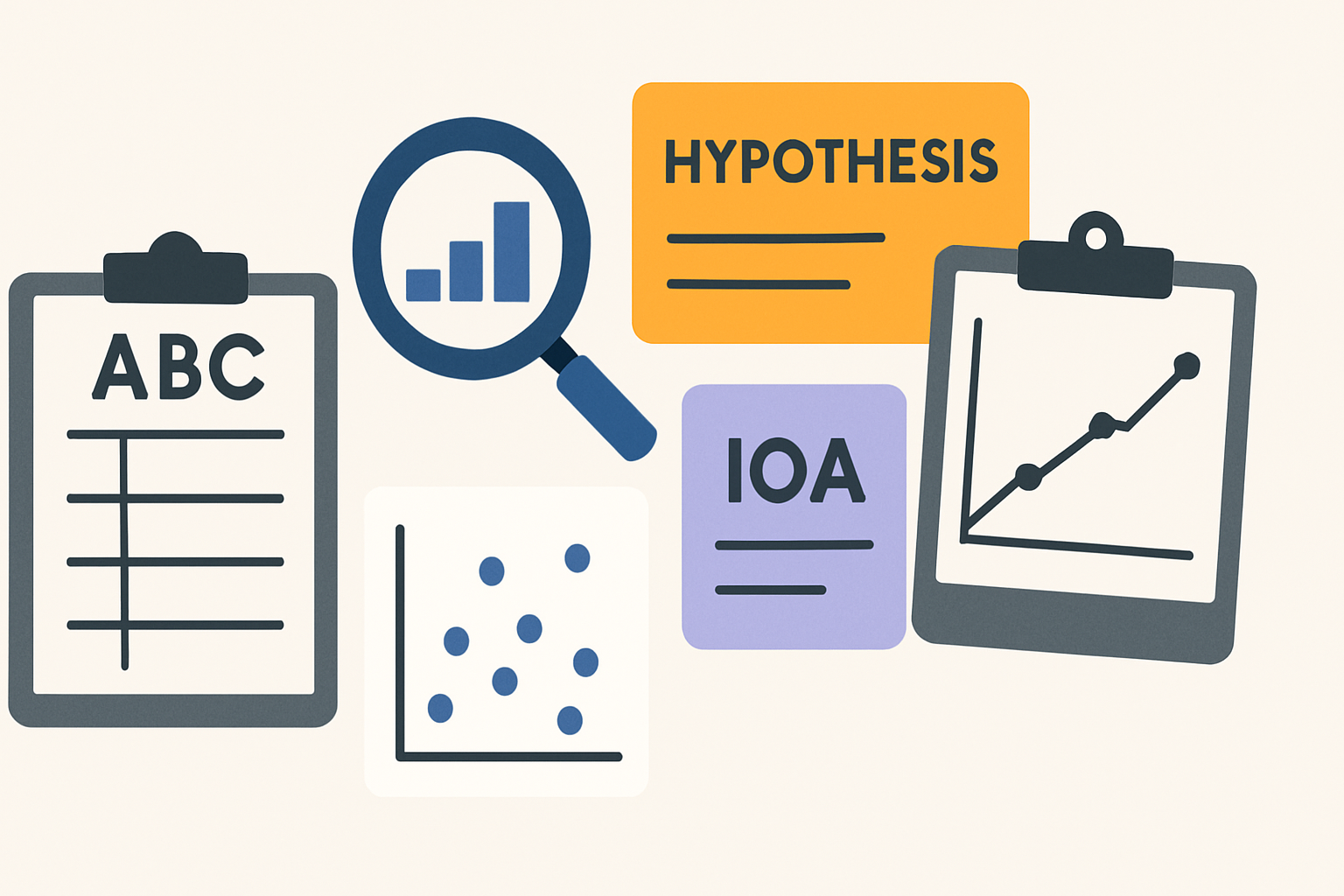
Different behavioral measurement systems require specific IOA calculation methods. Choosing the appropriate formula depends on your data collection method and the type of behavioral data you’re analyzing.
Total Count IOA for Frequency Data
This straightforward method works best for frequency data where you’re counting discrete occurrences. The formula is simple: (Smaller Count ÷ Larger Count) × 100. For example, if Observer A records 18 instances of hand-flapping and Observer B records 22 instances during the same session, your calculation would be (18 ÷ 22) × 100 = 81.8% IOA.
Use this method when you’re dealing with simple frequency counts of behaviors that have clear beginnings and endings. It’s particularly effective for behaviors like vocalizations, item destructions, or specific motor movements that occur as discrete events.
Mean Count-Per-Interval IOA for Complex Behaviors
When using interval recording systems (partial-interval, whole-interval, or momentary time sampling), mean count-per-interval IOA provides more accurate reliability estimates. This method involves comparing observers’ recordings interval by interval.
Here’s the step-by-step process:
- Calculate agreement for each individual interval (both observers recorded the behavior or both didn’t)
- Sum the total number of intervals with agreement
- Divide by the total number of intervals observed
- Multiply by 100 to get the percentage
For a 10-interval session where observers agreed on 8 intervals, your IOA would be (8 ÷ 10) × 100 = 80%. This method accounts for the temporal distribution of behaviors within sessions.
Trial-by-Trial IOA for Discrete Trial Training
In discrete trial training settings, trial-by-trial IOA evaluates agreement on correct/incorrect responses for each individual trial. This method is crucial for skill acquisition programs where precise measurement of response accuracy matters.
Calculate this by dividing the number of trials with agreement by the total number of trials, then multiplying by 100. If two observers agree on 45 out of 50 trials, your IOA is 90%. This approach ensures reliability in measuring acquisition progress and informs decisions about when to move to maintenance or generalization phases.
IOA on the BCBA Exam: Common Traps and How to Avoid Them
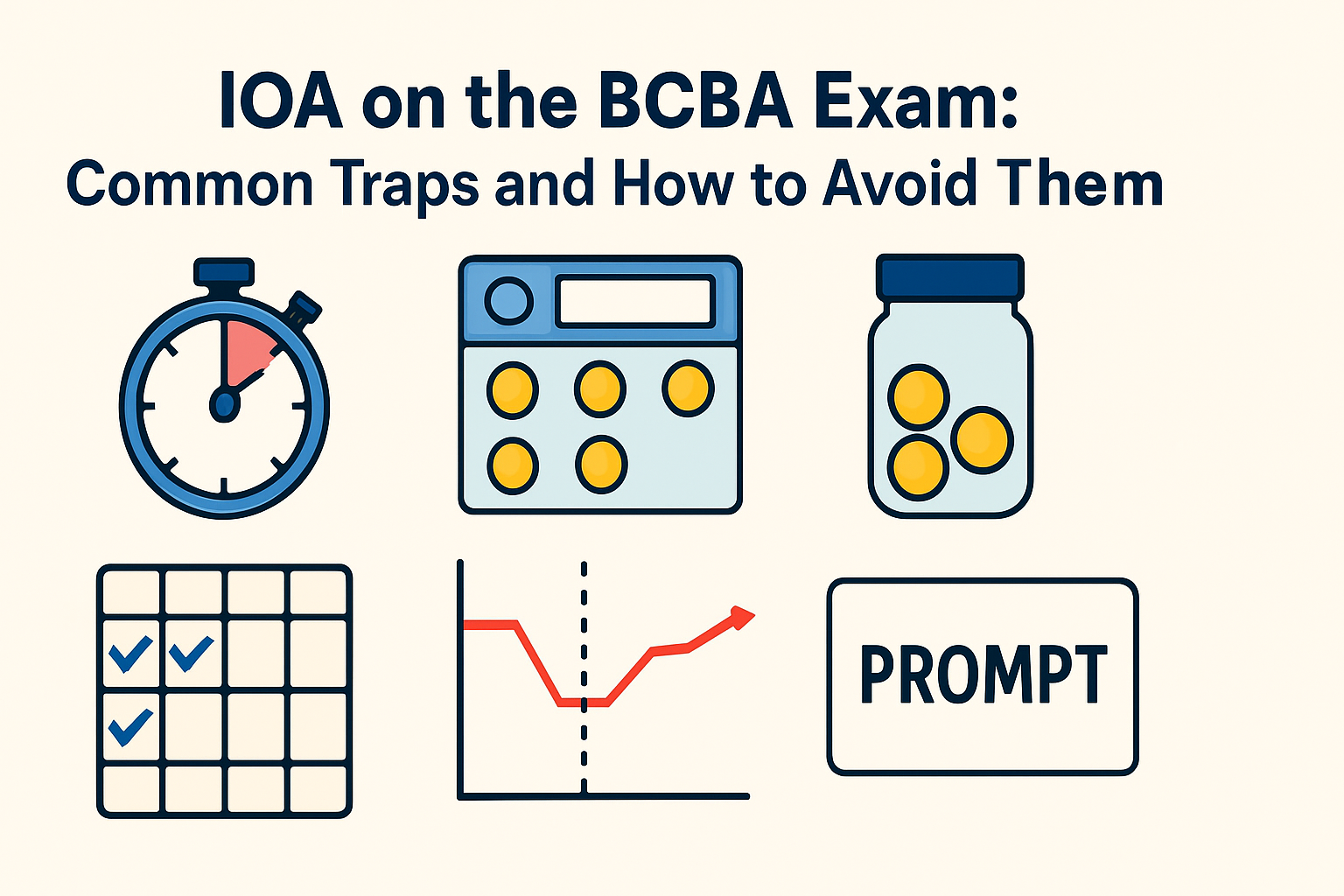
The BCBA exam frequently tests your understanding of IOA through scenario-based questions. Recognizing question patterns and avoiding common mistakes can significantly improve your exam performance.
Recognizing IOA-Related Question Stems
Exam questions about IOA often include specific phrases that signal what’s being tested. Watch for language about ensuring reliability, assessing measurement consistency, or evaluating observer drift. Questions might ask you to select the appropriate calculation method for given data or interpret IOA percentages in clinical scenarios.
Another common approach involves presenting data from two observers and asking you to calculate IOA or determine whether the data meet reliability standards. These questions test both your calculation skills and your understanding of when IOA is sufficient for clinical decision-making.
Frequent Exam Pitfalls
Many candidates lose points on IOA questions due to predictable errors. Here are the most common traps:
- Confusing reliability with validity: IOA measures reliability (consistency), not validity (accuracy of measuring what you intend to measure)
- Using the wrong calculation method: Applying total count IOA to interval data or vice versa
- Forgetting percentage conversion: Presenting IOA as a decimal rather than a percentage
- Misapplying thresholds: Not knowing that 80% is the typical minimum acceptable IOA, with higher standards for critical behaviors
- Overlooking observer training: Failing to recognize that low IOA requires observer retraining before continuing data collection
Remember that IOA questions often integrate with other concepts like data collection methods and treatment integrity, so consider the broader context of each question.
Quick-Reference IOA Checklist for Practitioners and Students
This actionable checklist serves both clinical practice and exam preparation. Use it to ensure you’re addressing all critical aspects of IOA implementation.
Before Data Collection
- Operationalize behaviors with clear, observable, and measurable definitions
- Train all observers to mastery criteria before independent data collection
- Develop standardized data sheets with clear recording instructions
- Establish IOA collection schedule (minimum 20-33% of sessions)
- Plan for observer recalibration sessions at regular intervals
During/After Data Collection
- Collect IOA data across all conditions and participants
- Calculate IOA promptly after sessions to identify issues early
- If IOA < 80%, immediately retrain observers and recollect data
- Report IOA percentages on graphs and in reports
- Document observer training and recalibration procedures
- Use IOA data to inform decisions about measurement system modifications
For comprehensive exam preparation, consider integrating this checklist with structured study frameworks that include regular practice with IOA calculations.
Summary and Key Takeaways
Interobserver Agreement represents a cornerstone of scientifically valid practice in applied behavior analysis. Mastering IOA requires understanding both the conceptual foundations and practical calculation methods. For BCBA exam success, focus on these essential points:
- IOA measures reliability, not validity, of behavioral measurements
- Different data types require specific calculation methods (total count, mean count-per-interval, trial-by-trial)
- The standard acceptable IOA threshold is 80% or higher
- Low IOA requires immediate observer retraining and potentially data recollection
- IOA should be collected for at least 20-33% of sessions across conditions
- Always report IOA percentages in clinical documentation and research reports
By thoroughly understanding IOA principles and practicing calculations with various data types, you’ll be well-prepared for both exam questions and clinical implementation. Remember that reliable data forms the foundation of effective behavior change programs, making IOA mastery essential for every behavior analyst’s professional toolkit.



