
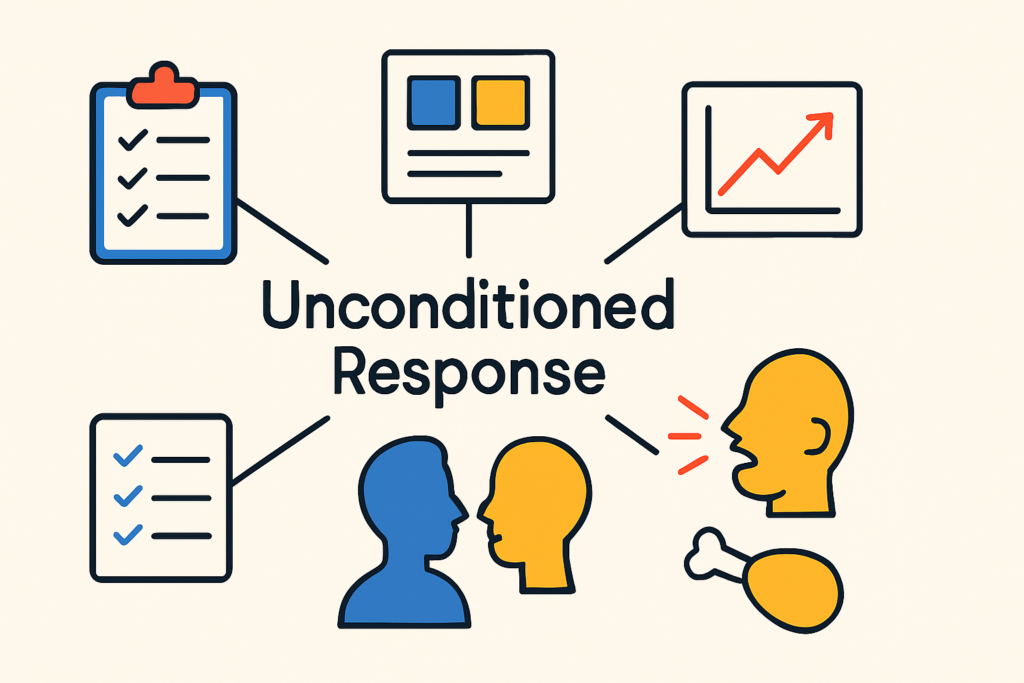
What is an Unconditioned Response? The Core Definition
An unconditioned response (UR) is an unlearned, reflexive reaction that occurs naturally when an organism encounters a specific unconditioned stimulus (US). These responses are biologically programmed and don’t require prior learning or conditioning to occur. Understanding this fundamental concept is essential for mastering respondent conditioning principles on the BCBA exam.
Table of Contents
- What is an Unconditioned Response? The Core Definition
- Unconditioned Response Examples in ABA and Everyday Life
- Unconditioned Responses and Respondent Conditioning
- Unconditioned Response on the BCBA Exam: Traps and Tips
- Summary and Key Takeaways
Key Characteristics of an Unconditioned Response
Several defining features distinguish unconditioned responses from other types of behavior:
- Unlearned and innate: URs are present from birth or develop through maturation without training
- Biologically based: These responses serve survival functions and are part of evolutionary adaptation
- Reflexive and automatic: URs occur involuntarily when the appropriate stimulus is presented
- Elicited by specific US: Each UR has a corresponding unconditioned stimulus that reliably produces it
- Evolutionary history: These responses have developed through natural selection to protect the organism
Unconditioned Response vs. Conditioned Response: The Critical Difference
The distinction between unconditioned and conditioned responses is fundamental to understanding learning processes. An unconditioned response exists before any conditioning occurs, while a conditioned response (CR) develops through the pairing of a neutral stimulus with an unconditioned stimulus. The UR serves as the biological foundation upon which conditioned responses are built through respondent conditioning procedures.
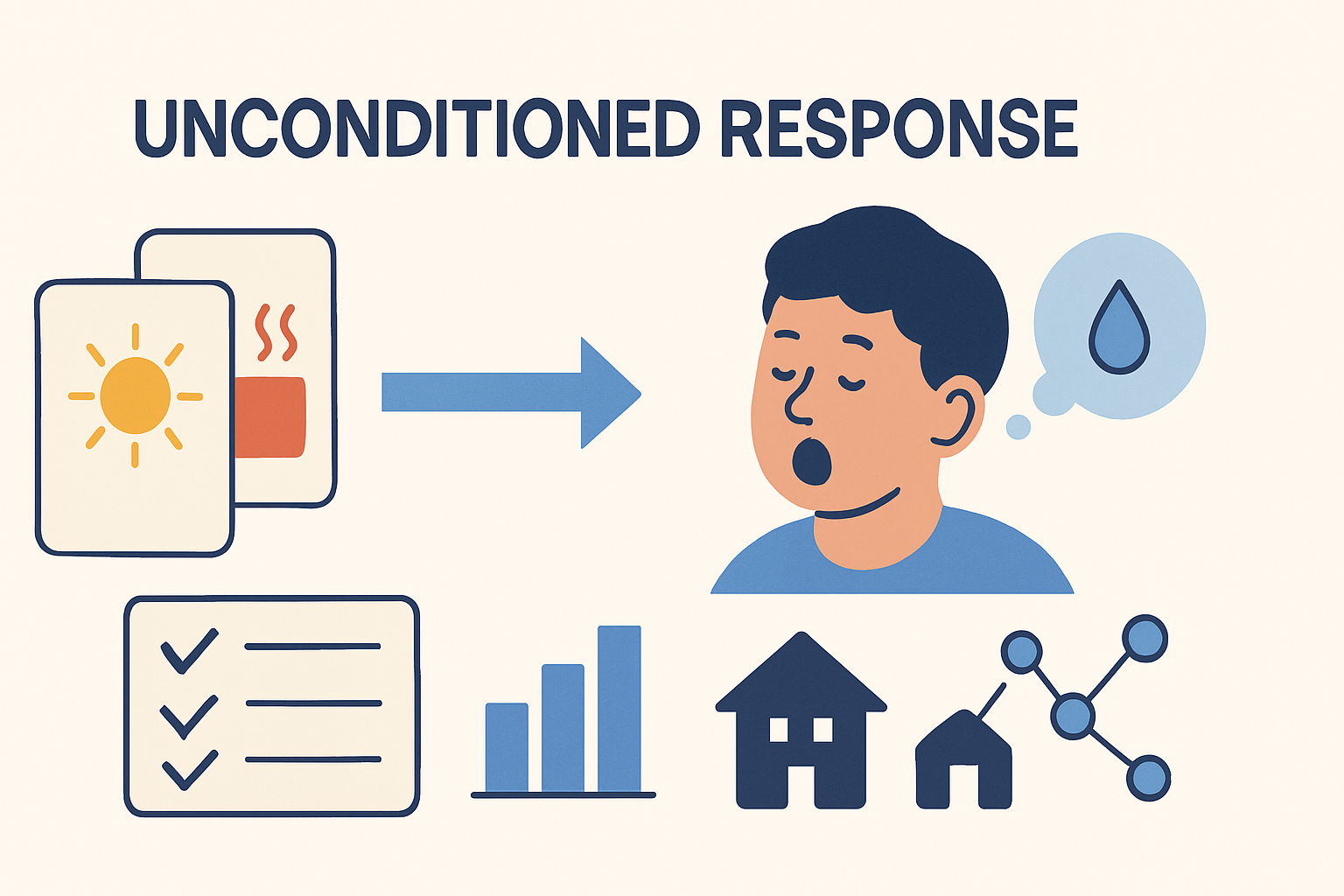
Unconditioned Response Examples in ABA and Everyday Life
Real-world examples help solidify your understanding of unconditioned responses. These examples demonstrate how URs operate across different stimulus-response relationships.
Example 1: The Startle Response to a Loud Noise
When a sudden, loud sound occurs, most people experience an immediate startle response. The unconditioned stimulus is the loud noise, while the unconditioned response includes jumping, increased heart rate, and muscle tension. This reflex serves a protective function, preparing the body for potential danger.
Example 2: Salivation to Food in the Mouth
This classic example from Pavlov’s research demonstrates a basic biological reflex. When food touches the tongue (US), salivation occurs automatically (UR). This digestive response helps break down food and represents a fundamental respondent behavior that forms the basis for conditioning experiments.
Example 3: Pupil Constriction to Bright Light
When exposed to bright light, the pupils automatically constrict to protect the retina from damage. This physiological reflex occurs without conscious control and demonstrates how unconditioned responses can involve autonomic nervous system functions. The bright light serves as the US, while pupil constriction is the UR.
Unconditioned Responses and Respondent Conditioning
Unconditioned responses play a crucial role in respondent conditioning, which is a key topic on the BCBA exam. This learning process involves creating new stimulus-response relationships based on existing biological reflexes.
How the UR Becomes the Foundation for a CR
The transformation from unconditioned to conditioned response follows a systematic process:
- A neutral stimulus (NS) is repeatedly paired with an unconditioned stimulus (US)
- The US reliably elicits the unconditioned response (UR)
- After sufficient pairings, the NS becomes a conditioned stimulus (CS)
- The CS now elicits a conditioned response (CR) that resembles the original UR
This process demonstrates how biological reflexes provide the raw material for learned associations. For more on this fundamental distinction, see our guide on respondent vs operant behavior.
Unconditioned Response on the BCBA Exam: Traps and Tips
Exam questions about unconditioned responses often test your ability to distinguish them from other behavioral concepts. Being aware of common pitfalls can improve your performance significantly.
Common Exam Traps and Misconceptions
Several misconceptions frequently trip up BCBA candidates:
- Confusing UR with CR: Remember that URs exist before conditioning, while CRs develop through pairing
- Misidentifying the US: The unconditioned stimulus must be biologically relevant and reliably elicit the response
- Assuming all reflexes are URs: Some reflexes (like knee jerk) can be influenced by conditioning
- Overlooking operant components: Some behaviors may appear reflexive but actually involve operant conditioning
- Ignoring biological constraints: Not all stimuli can become conditioned stimuli through pairing
Quick-Reference Checklist: Identifying an Unconditioned Response
Use this checklist when analyzing potential unconditioned responses:
- Is the response unlearned and innate?
- Does it occur automatically and reflexively?
- Is it elicited by a specific, biologically relevant stimulus?
- Does the response serve a survival or protective function?
- Would the response occur without prior learning?
For additional exam preparation strategies, explore our comprehensive BCBA exam prep guide.
Summary and Key Takeaways
Mastering unconditioned response concepts is essential for BCBA exam success and effective practice. Key points to remember include:
- Unconditioned responses are biologically programmed reflexes that occur without learning
- Each UR has a corresponding unconditioned stimulus that reliably elicits it
- These responses serve as the foundation for respondent conditioning processes
- Distinguishing URs from conditioned responses requires careful analysis of learning history
- Common exam traps involve confusing reflexive responses with learned behaviors
For authoritative information on behavior analysis concepts, refer to the Behavior Analyst Certification Board resources. Understanding these fundamental principles will help you excel on the BCBA exam and in your professional practice.



