

Extinction in ABA: What is Extinction in Applied Behavior Analysis?
Extinction in ABA is a fundamental procedure where reinforcement for a previously reinforced behavior is discontinued, resulting in a decrease in that behavior’s future frequency. This process targets the reinforcement contingency rather than the behavior itself. Many exam candidates confuse extinction with punishment, but they operate on different principles.
Table of Contents
- Extinction in ABA: What is Extinction in Applied Behavior Analysis?
- Applying Extinction: Worked Examples and Functional Analysis
- Extinction on the BCBA® Exam: Key Focus Areas and Common Traps
- Ethical Implementation and Your Quick-Action Checklist
- References
While punishment involves adding or removing a stimulus following behavior, extinction specifically involves withholding the maintaining reinforcer. Understanding this distinction is crucial for both clinical practice and exam success.
The Core Principle: Discontinuing Reinforcement
Operationally, extinction means breaking the connection between a specific behavior and its reinforcing consequence. The extinction procedure must match the function identified through functional behavior assessment. For attention-maintained behavior, extinction involves planned ignoring. For escape-maintained behavior, it means preventing escape from demands.
This principle emphasizes that extinction effectiveness depends entirely on accurately identifying and withholding the specific reinforcing consequence that maintains the target behavior.
Extinction Burst and Spontaneous Recovery
Two critical phenomena accompany extinction procedures. An extinction burst refers to the temporary increase in behavior frequency, intensity, or duration immediately after reinforcement is discontinued. This occurs because the individual escalates their effort to obtain the previously available reinforcer.
Spontaneous recovery describes the reappearance of the extinguished behavior after a period of time without reinforcement. Both phenomena are predictable and must be anticipated in intervention planning. Understanding these concepts helps explain why behavior might initially worsen before improving during extinction procedures.
Applying Extinction: Worked Examples and Functional Analysis
Effective extinction implementation requires precise functional analysis. Each example below demonstrates how to match the extinction procedure to the identified function.
Example 1: Extinction for Attention-Maintained Behavior
Consider a child who whines when a parent is on the phone. The antecedent is parent engagement with phone, the behavior is whining, and the consequence is parental attention through scolding. The function is social attention.
The extinction plan involves planned ignoring of all whining behavior while systematically reinforcing appropriate communication. Expect an initial extinction burst where whining increases in frequency and intensity before decreasing. Staff must be trained to maintain consistency during this critical phase.
Example 2: Extinction for Tangible-Maintained Behavior
A student shouts during independent work time, resulting in being sent to the hallway for a break. The function is escape from demands. The extinction procedure requires keeping the student engaged with the task while preventing escape.
Implement task continuation with appropriate prompting and reinforcement for work completion. This approach prevents the escape contingency from maintaining the shouting behavior. Ethical considerations include ensuring the student has necessary skills to complete the work and using differential reinforcement of alternative behaviors.
Example 3: Extinction for Automatically Reinforced Behavior
For behaviors maintained by automatic reinforcement (sensory consequences), pure extinction is often impractical or impossible. Since the reinforcement comes from the behavior itself, you cannot completely withhold it.
Common alternatives include response blocking, sensory substitution, or providing competing stimulation. This distinction is crucial for exam questions, as selecting extinction for automatically reinforced behavior without additional components represents a common error.
Extinction on the BCBA® Exam: Key Focus Areas and Common Traps
Exam questions frequently test your ability to distinguish extinction from other procedures and predict its effects. Understanding common pitfalls can significantly improve your performance.
Must-Know Terminology and Scenarios
Beyond extinction burst and spontaneous recovery, be prepared for these terms:
- Resurgence: The reappearance of previously extinguished behaviors when a more recently reinforced behavior is placed on extinction
- Extinction-induced aggression: Novel aggressive behaviors that emerge during extinction procedures
- Resistance to extinction: How persistent a behavior remains when reinforcement is discontinued
Typical exam vignettes present scenarios where you must identify whether extinction is appropriate, predict its effects, or select complementary procedures.
Frequent Exam Pitfalls to Avoid
Common errors include confusing extinction with time-out or response cost, which are punishment procedures. Another frequent mistake is implementing extinction without pairing it with reinforcement for alternative behaviors, which violates best practice guidelines.
Safety risks like extinction-induced aggression must be anticipated. Finally, selecting extinction for automatically reinforced behaviors without considering sensory consequences represents a critical conceptual error. Always review the ethics guidelines when extinction might pose risks.
Ethical Implementation and Your Quick-Action Checklist
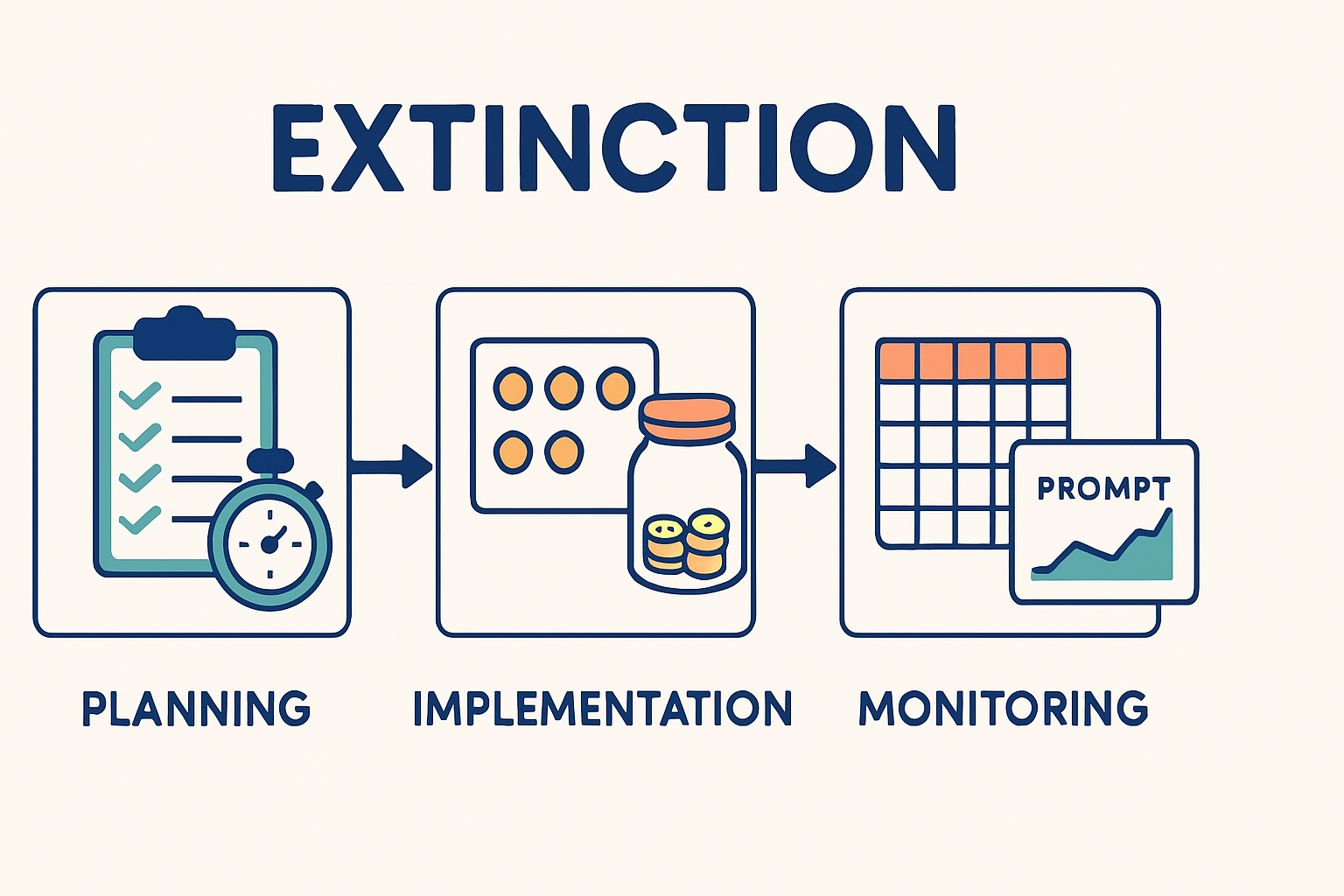
Ethical extinction procedures require systematic planning and safeguards. This checklist ensures you address critical considerations before implementation.
Pre-Implementation Ethical Safeguards
- Confirm function through reliable functional analysis before selecting extinction
- Obtain informed consent from all stakeholders, explaining potential side effects
- Plan for extinction burst with safety protocols and staff training
- Reinforce alternative behavior using differential reinforcement procedures
- Ensure environmental control to maintain procedural integrity
- Monitor side effects including aggression, emotional responding, or novel behaviors
Following this systematic approach ensures extinction procedures are implemented ethically and effectively while minimizing risks to clients and maintaining therapeutic progress.
For comprehensive exam preparation, explore our BCBA exam prep guide covering all essential topics.


