
Stimulus equivalence represents a fundamental concept in applied behavior analysis that explains how individuals form relationships between stimuli without direct training. This phenomenon occurs when a person demonstrates derived relational responding, meaning they can connect stimuli in ways that were never explicitly taught. Understanding stimulus equivalence ABA principles is essential for BCBA candidates and practitioners working with language development and complex learning.
Table of Contents
- Stimulus Equivalence ABA: Understanding Stimulus Equivalence
- The Three Core Properties Explained
- Practical ABA Examples
- BCBA Exam Relevance
- Common Exam Traps and How to Avoid Them
- Quick Checklist for Mastery
- Final Summary and Next Steps
Stimulus Equivalence ABA: Understanding Stimulus Equivalence
Stimulus equivalence refers to the emergence of untrained relationships between stimuli after training only a subset of those relationships. The concept originated from Sidman’s research in the 1970s and has since become a cornerstone of relational frame theory. This phenomenon demonstrates that humans can form equivalence classes where stimuli become functionally interchangeable.
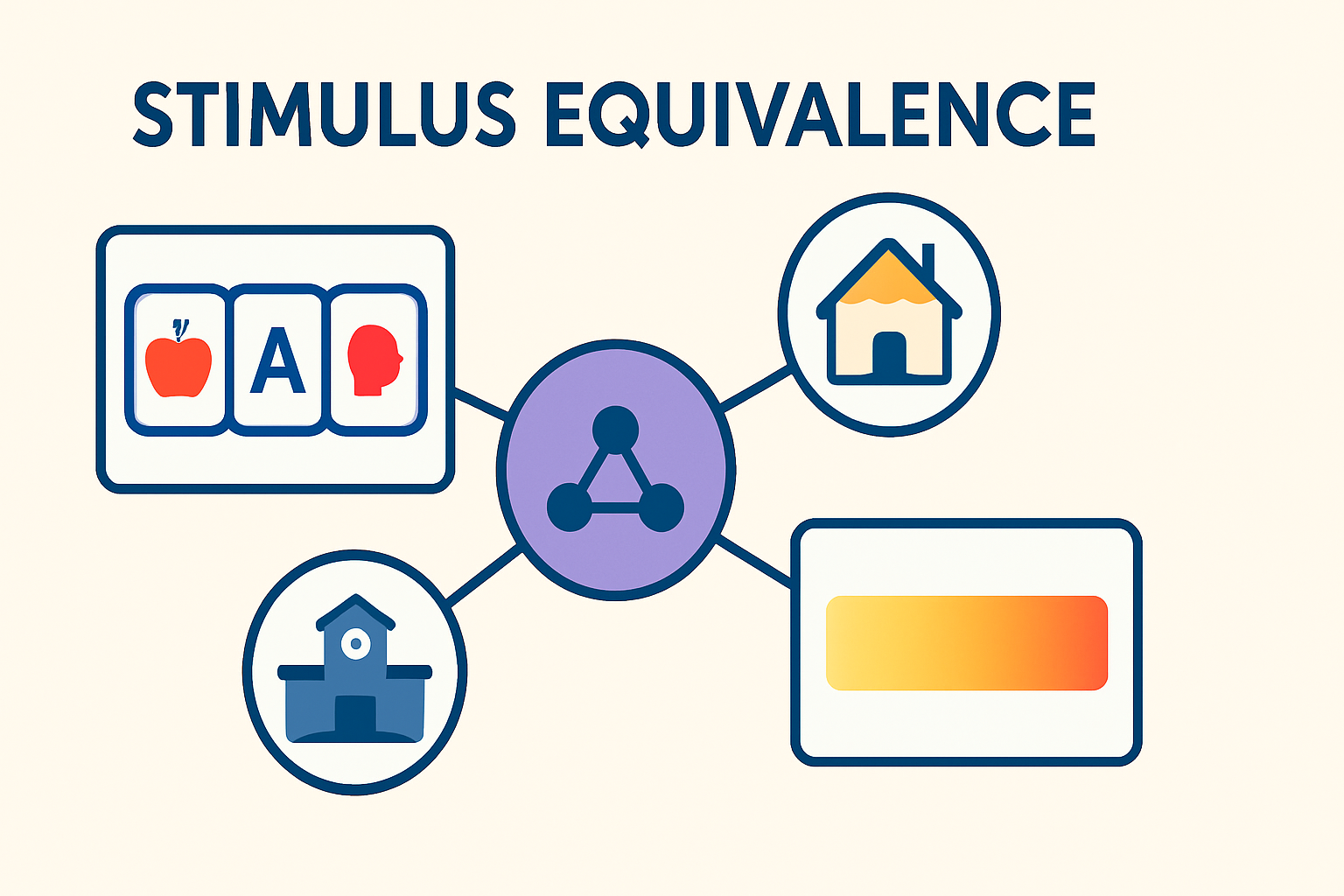
The three critical properties that define stimulus equivalence are reflexivity, symmetry, and transitivity. When all three properties are demonstrated, we can say that an equivalence class has formed. These properties work together to create complex networks of relationships that support language, categorization, and symbolic understanding.
The Three Core Properties Explained
Reflexivity: Matching to Sample
Reflexivity, also called identity matching, occurs when a stimulus is matched to itself. This represents the simplest form of equivalence and serves as the foundation for more complex relationships. In practical terms, reflexivity means recognizing that A equals A without any additional training.
- Example: Matching the word “apple” to a picture of an apple
- Example: Selecting an identical object from an array
- Example: Pointing to the same color swatch when shown a sample
Symmetry: Bidirectional Relationships
Symmetry involves demonstrating that if A leads to B, then B leads to A. This bidirectional relationship emerges without direct training on the reverse direction. Symmetry represents a crucial step in developing flexible relational networks.
- Example: If taught “apple” → picture of apple, then picture of apple → “apple”
- Example: If taught Spanish “manzana” → English “apple”, then English “apple” → Spanish “manzana”
- Example: If taught symbol → meaning, then meaning → symbol
Transitivity: Derived Relationships
Transitivity demonstrates that if A equals B and B equals C, then A equals C. This property allows for the emergence of relationships between stimuli that were never directly paired. Transitivity enables complex relational networks and symbolic understanding.
- Example: If A = B (apple = picture) and B = C (picture = red fruit), then A = C (apple = red fruit)
- Example: If taught A → B and B → C, then A → C emerges without training
- Example: Mathematical equivalence: if 2+2=4 and 4=IV, then 2+2=IV
Practical ABA Examples
Stimulus equivalence has numerous practical applications in ABA therapy and educational settings. These examples demonstrate how the principles work in real-world scenarios.
Language Development Example
Consider teaching a child with autism to associate words, pictures, and objects. The therapist might train three relationships: word “dog” → picture of dog, picture of dog → actual dog toy, and dog toy → spoken word “dog”. Through stimulus equivalence, the child should derive that the word “dog” equals the actual dog toy without direct training.
Academic Skill Building
In teaching mathematical concepts, a teacher might establish that the numeral “5” equals five dots, and five dots equals the word “five”. Through equivalence relations, the student should derive that the numeral “5” equals the word “five” without explicit instruction.
Social Skills Training
When teaching emotion recognition, a practitioner might train that a facial expression equals an emotion word, and that emotion word equals a social situation. Through derived relational responding, the client should recognize which facial expression matches which social situation.
BCBA Exam Relevance
Stimulus equivalence appears frequently on the BCBA examination because it represents a complex conceptual area that tests understanding of derived relations. The exam typically includes questions about the three properties, examples of equivalence classes, and applications in applied behavior analysis.
Exam questions often test your ability to identify whether a given scenario demonstrates reflexivity, symmetry, or transitivity. You might also encounter questions about equivalence-based instruction or how stimulus equivalence relates to language development. Understanding these concepts is crucial for Domain B: Concepts and Principles in the BCBA 6th edition exam.
Common Exam Traps and How to Avoid Them
Many BCBA candidates struggle with stimulus equivalence questions due to common misconceptions. Recognizing these traps can significantly improve your exam performance.
- Trap 1: Confusing symmetry with transitivity – remember symmetry is bidirectional (A→B and B→A), while transitivity involves three stimuli (A→B, B→C, therefore A→C)
- Trap 2: Assuming all three properties must be trained – stimulus equivalence emerges from training only some relationships
- Trap 3: Overlooking the requirement for all three properties – true equivalence requires reflexivity, symmetry, AND transitivity
- Trap 4: Confusing stimulus equivalence with simple discrimination – equivalence involves derived relations, not just trained ones
- Trap 5: Missing the functional interchangeability aspect – stimuli in an equivalence class become functionally equivalent
Quick Checklist for Mastery
Use this checklist to ensure you’ve mastered stimulus equivalence concepts for both clinical practice and exam preparation.
- ✓ Can define all three properties: reflexivity, symmetry, and transitivity
- ✓ Can provide at least two practical examples of each property
- ✓ Understand how equivalence classes form and function
- ✓ Recognize the difference between trained and derived relations
- ✓ Can explain how stimulus equivalence supports language development
- ✓ Identify common exam traps and how to avoid them
- ✓ Apply equivalence principles to verbal operants and other complex behaviors
Final Summary and Next Steps
Mastering stimulus equivalence requires understanding how reflexivity, symmetry, and transitivity work together to create equivalence classes. These principles explain how humans develop complex relational networks that support language, categorization, and symbolic thinking. For BCBA candidates, this knowledge is essential for both exam success and effective clinical practice.
To deepen your understanding, review the BACB’s resources on relational frame theory and consider how stimulus equivalence principles apply to your current cases. Practice identifying the three properties in everyday learning situations, and use mock exam questions to test your application skills. Remember that true mastery comes from both conceptual understanding and practical application in applied behavior analysis settings.


