
What Are Schedules of Reinforcement?
A schedule of reinforcement defines the rule that determines when a behavior will be reinforced. This fundamental concept in applied behavior analysis specifies the relationship between responses and their consequences.
Table of Contents
- What Are Schedules of Reinforcement?
- The Four Basic Intermittent Schedules
- Schedules of Reinforcement in Practice: ABA Examples
- Schedules on the BCBA Exam: Common Traps and Tips
- Quick-Review Checklist and Summary
There are two main categories: continuous reinforcement (CRF) and intermittent reinforcement. Continuous reinforcement delivers reinforcement after every single occurrence of the target behavior, making it ideal for skill acquisition. Intermittent reinforcement provides reinforcement only some of the time, which produces more persistent behavior that’s resistant to extinction.
The Basic Rule: Behavior Consequence Contingencies
Before diving into specific schedules, remember that reinforcement strengthens behavior. The schedule simply answers “when” reinforcement occurs. This contingency rule shapes how organisms learn and maintain behaviors over time.
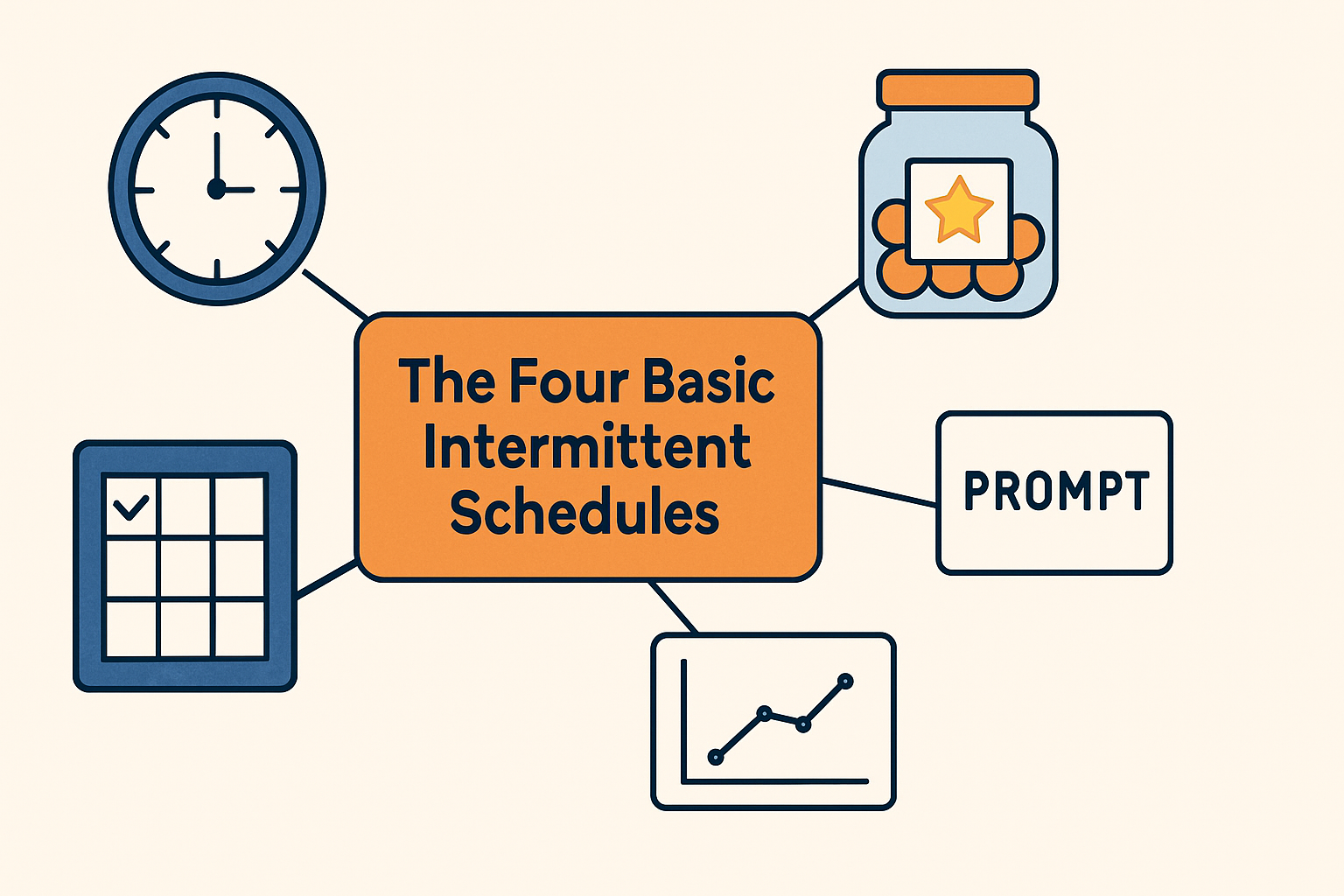
The Four Basic Intermittent Schedules
These four schedules form the foundation of reinforcement timing in ABA practice. Each produces distinct response patterns that you must recognize for both clinical application and exam success.
Ratio Schedules: Reinforcement After a Number of Responses
Fixed ratio (FR) schedules deliver reinforcement after a set number of responses. For example, FR5 means reinforcement occurs after every fifth response. This produces a high response rate with brief pauses after reinforcement (post-reinforcement pause). Real-world examples include piecework pay or completing a specific number of worksheets.
Variable ratio (VR) schedules provide reinforcement after an average number of responses, but the exact number varies unpredictably. VR10 means reinforcement occurs after an average of 10 responses. This creates high, steady response rates with minimal pauses and high resistance to extinction. Gambling machines operate on VR schedules.
Interval Schedules: Reinforcement After the First Response Following a Time Period
Fixed interval (FI) schedules deliver reinforcement for the first response after a fixed time period has elapsed. FI2 means reinforcement is available for the first response after 2 minutes. This produces a scalloped pattern with slow responding early in the interval and rapid responding as the interval ends.
Variable interval (VI) schedules provide reinforcement for the first response after variable time periods. VI5 means reinforcement becomes available after an average of 5 minutes. This generates moderate, steady response rates with good resistance to extinction. Checking for text messages or emails often follows VI schedules.
Schedules of Reinforcement in Practice: ABA Examples
Understanding theory is essential, but applying schedules to real scenarios is where clinical competence develops. These examples demonstrate how schedules function in actual ABA interventions.
Example 1: Building Academic Engagement with a VR Schedule
Scenario: A student frequently avoids academic tasks. The BCBA implements a reinforcement system where the student earns tokens for raising their hand and participating in class discussions.
- Antecedent: Teacher asks a question to the class
- Behavior: Student raises hand and provides answer
- Consequence: Token delivered on VR3 schedule (average of every 3 responses)
- Function: Access to teacher attention and tangible reinforcement
- Schedule effect: The VR schedule maintains steady participation without predictable pauses
Example 2: Reducing Stereotypy with a DRO on a FI Schedule
Scenario: A client engages in hand-flapping during independent work. The team implements Differential Reinforcement of Other Behavior (DRO) with a fixed interval component.
- Antecedent: Independent work time begins
- Target behavior: Hand-flapping (to be reduced)
- Alternative behavior: Any behavior except hand-flapping
- Consequence: If no hand-flapping occurs for 5 minutes (FI5), client receives access to preferred item
- Schedule within DRO: The FI schedule within the DRO procedure creates predictable reinforcement opportunities
Schedules on the BCBA Exam: Common Traps and Tips
Exam questions often test your ability to identify schedules in described scenarios. Watch for these common mistakes that can cost you valuable points.
Trap #1: Confusing Schedule Definitions with Reinforcement Types
Remember that a schedule describes when reinforcement occurs, not what the reinforcer is. The reinforcer could be praise, tokens, or access to activities, but the schedule remains the same regardless. For example, both “praise after every 3 math problems” and “token after every 3 math problems” are FR3 schedules.
Trap #2: Overlooking the ‘First Response After’ Rule for Intervals
For interval schedules, only the first response after the time period gets reinforced. Subsequent responses before the next interval begins have no effect. This is crucial for distinguishing interval from ratio schedules on exam questions.
Additional Exam Strategies
- Look for time-based language (minutes, seconds) to identify interval schedules
- Watch for response-counting language (number of times, each occurrence) for ratio schedules
- Remember that variable schedules produce more persistent behavior than fixed schedules
- Practice identifying schedules within compound schedules like DRL or DRO procedures
Quick-Review Checklist and Summary
Use this checklist to reinforce your understanding before the exam or clinical application.
- Ratio schedules reinforce based on number of responses (FR = fixed number, VR = variable number)
- Interval schedules reinforce first response after time period (FI = fixed time, VI = variable time)
- FR produces high rates with pauses; VR produces high, steady rates with minimal pauses
- FI produces scalloped pattern; VI produces moderate, steady rates
- Variable schedules create greater resistance to extinction than fixed schedules
- Always identify whether the schedule is based on response count or time passage
- Remember that schedules apply to reinforcement delivery rules, not the reinforcer itself
- Practice applying schedules to differential reinforcement procedures
Mastering schedules of reinforcement requires understanding both the theoretical definitions and practical applications. These rules govern how behavior is maintained in natural environments and clinical settings. For additional study on related concepts, review matching law principles. Remember that effective behavior change depends on selecting appropriate reinforcement schedules based on your clinical goals and the individual’s learning history.


