
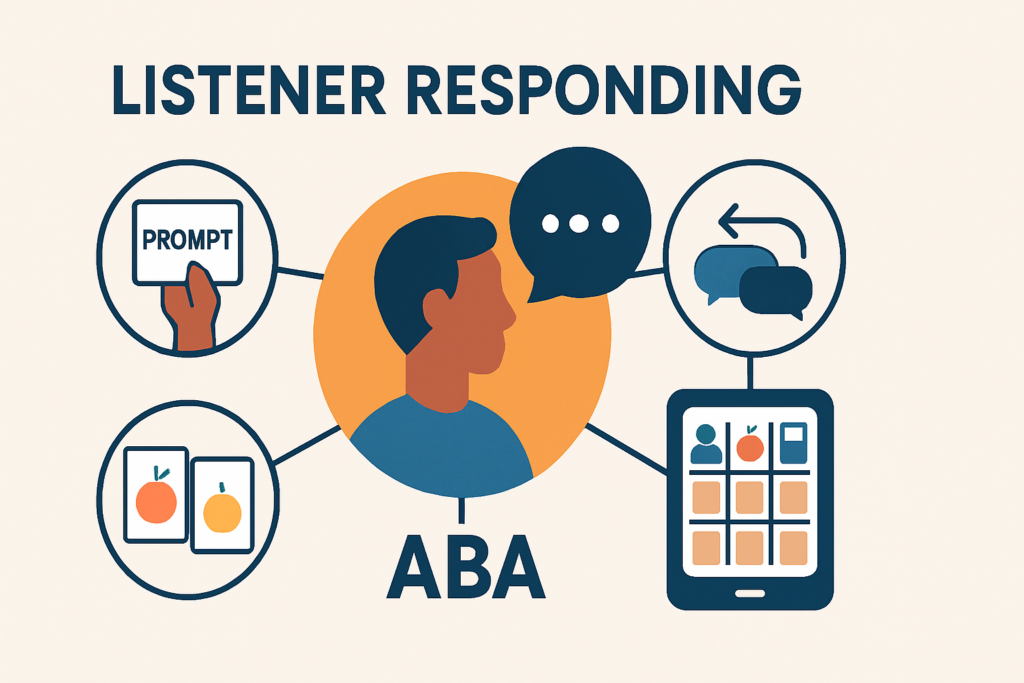
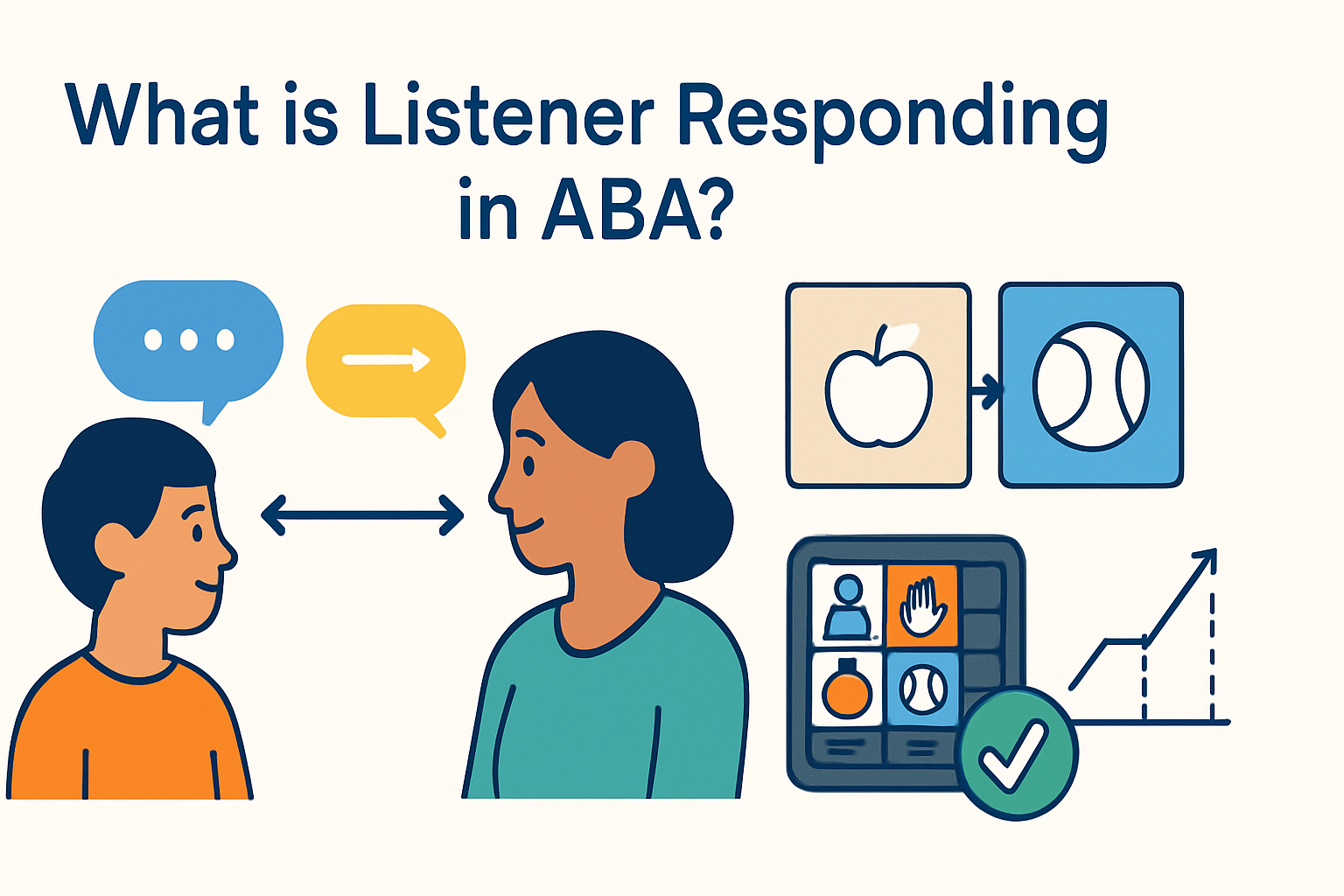
Listener Responding ABA: What is Listener Responding in ABA?
Listener responding is a verbal operant where the response is controlled by a verbal discriminative stimulus (SD) from another person. The behavior is reinforced by generalized conditioned reinforcers like praise, approval, or compliance with social expectations. This foundational concept in Skinner’s analysis of verbal behavior distinguishes the listener’s role from the speaker’s.
Table of Contents
- Listener Responding ABA: What is Listener Responding in ABA?
- Listener Responding in Practice: Worked Examples
- Listener Responding on the BCBA Exam
- Quick-Study Checklist and Summary
The Core Definition and Key Features
Listener responding occurs when someone follows directions, answers questions, or responds appropriately to verbal instructions. The antecedent stimulus must be verbal, and the consequence typically involves social reinforcement. This differs from other verbal operants in its controlling variables.
Key characteristics include:
- The SD is always verbal (spoken, signed, or written words from another person)
- The response is reinforced by generalized conditioned reinforcement
- There’s no specific motivating operation required (unlike mands)
- The behavior demonstrates stimulus control by verbal antecedents
- It forms the basis for instructional control and classroom learning
Listener Responding vs. Other Verbal Operants
Understanding how listener responding differs from other verbal operants is crucial for BCBA exam success. Each operant has distinct controlling variables that determine classification.
- Listener Responding: Controlled by verbal SD, reinforced socially
- Mand: Controlled by motivating operations, reinforced by specific consequences
- Tact: Controlled by nonverbal stimuli, reinforced socially
- Intraverbal: Controlled by verbal SD, but response doesn’t match form
- Echoic: Controlled by verbal SD with point-to-point correspondence
For more on verbal operants, see our comprehensive verbal operants guide.
Listener Responding in Practice: Worked Examples
Moving from theory to application, these examples demonstrate how listener responding appears in real-world scenarios. Each example uses ABC analysis to model exam-style thinking.
Example 1: Following a Basic Instruction
This simple scenario illustrates fundamental listener responding. The child demonstrates compliance behavior under verbal stimulus control.
- Antecedent: Parent says “Give me the cup” (verbal SD)
- Behavior: Child hands the cup to parent (listener response)
- Consequence: Parent says “Thank you!” (social reinforcement)
The function here is typically social reinforcement through praise and compliance with social expectations. This demonstrates basic instructional control.
Example 2: Selecting an Item from an Array
This more complex example involves discrimination training and demonstrates advanced listener responding skills.
- Antecedent: Therapist presents three picture cards (cat, dog, bird) and says “Touch the dog”
- Behavior: Child touches the dog card
- Consequence: Therapist provides praise and a token
This scenario requires stimulus discrimination and demonstrates conditional discrimination skills. The reinforcement maintains the discriminative control of the verbal instruction.
Example 3: Identifying a Potential Problem
Sometimes listener responding breaks down. Analyzing why helps identify intervention targets and demonstrates analytical thinking for the BCBA exam.
- Antecedent: Teacher says “Put your book away and line up”
- Behavior: Student continues reading (no response)
- Consequence: Teacher repeats instruction louder
Potential issues include weak stimulus control, competing reinforcers (book is engaging), or instructional history where non-compliance was reinforced. This demonstrates the importance of analyzing antecedent variables.
Listener Responding on the BCBA Exam
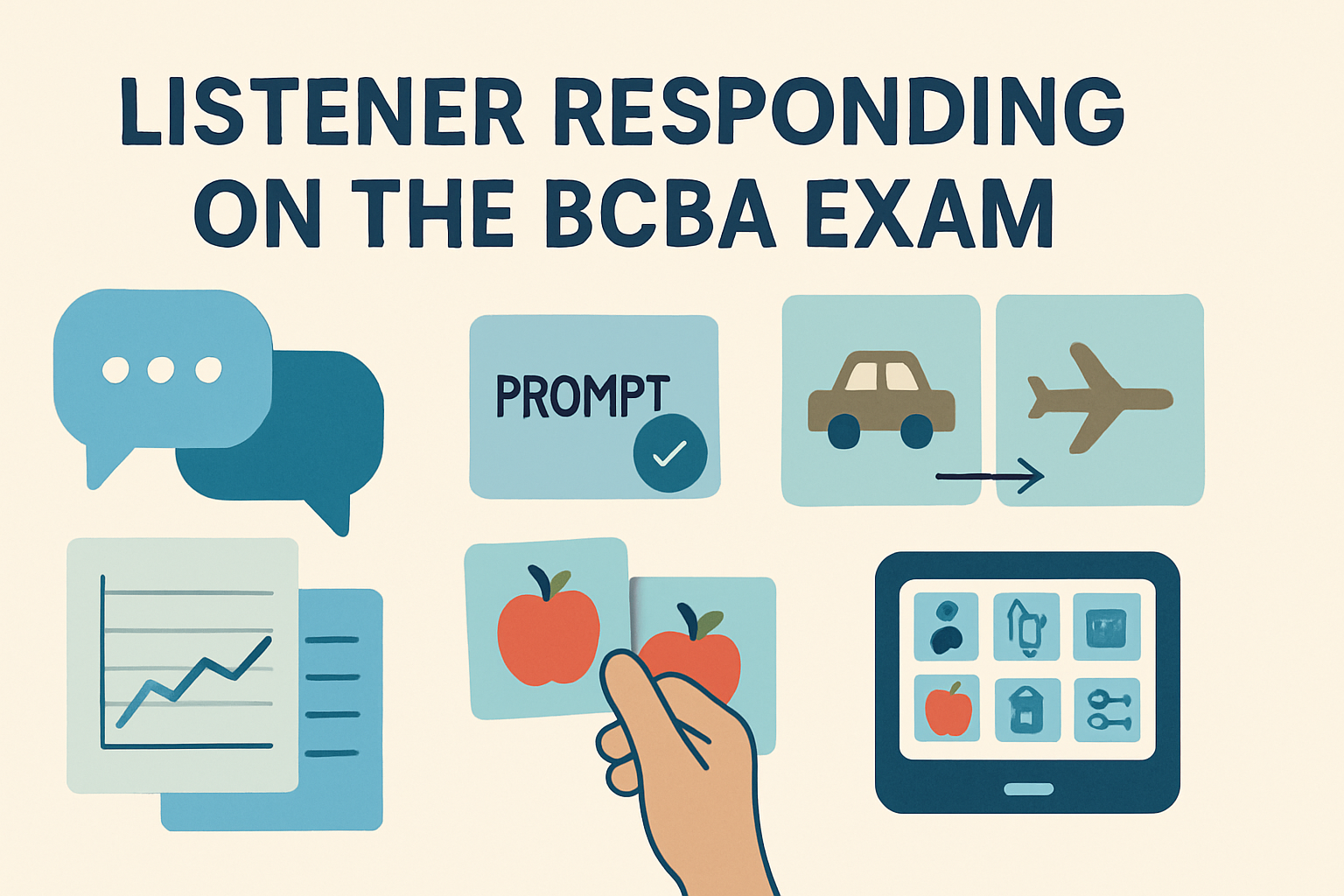
The BCBA exam frequently tests your ability to identify and analyze listener responding. Understanding common traps and practicing application is essential for success.
Common Exam Traps and How to Avoid Them
Several misconceptions regularly appear on the BCBA exam. Recognizing these traps can improve your accuracy.
- Confusing with motor imitation: Motor imitation involves non-verbal SDs; listener responding requires verbal SDs
- Misidentifying as a tact: Tacts are controlled by non-verbal stimuli, not verbal instructions
- Over-applying to all instruction-following: Some compliance may be under control of other variables
- Ignoring the verbal SD requirement: The antecedent must be verbal from another person
- Forgetting generalized reinforcement: Listener responding uses social, not specific, reinforcement
Practice Application Prompts
Test your understanding with these exam-style scenarios. For each, determine if listener responding is occurring and justify your answer.
Scenario 1: A child sees a cookie on the counter and says “cookie.” Parent gives the cookie. Is this listener responding?
Answer: No. This is a mand controlled by a motivating operation (hunger) and reinforced by a specific consequence (cookie).
Scenario 2: Therapist says “clap your hands” and demonstrates clapping. Child claps hands. Therapist praises. Is this listener responding?
Answer: No. This is motor imitation with a non-verbal SD (the demonstration). The verbal instruction alone doesn’t control the behavior.
Scenario 3: Teacher says “What color is the apple?” Student says “red.” Teacher says “Good job!” Is this listener responding?
Answer: No. This is an intraverbal where the verbal response doesn’t match the form of the verbal SD.
Quick-Study Checklist and Summary
This concise checklist helps you self-test your understanding of listener responding concepts before the BCBA exam.
Listener Responding Study Checklist
- ✓ The SD is always verbal from another person
- ✓ Reinforcement involves generalized conditioned reinforcers
- ✓ I can distinguish it from a mand (MO-controlled)
- ✓ I can distinguish it from a tact (non-verbal SD)
- ✓ I understand the role of social reinforcement
- ✓ I recognize examples of discrimination training in LR
- ✓ I can analyze ABC data for listener responding
- ✓ I understand common exam traps and how to avoid them
Key Takeaways
Listener responding is fundamental to verbal behavior and essential for BCBA exam success. Remember these critical points:
- Listener responding involves verbal stimulus control from another person
- It’s reinforced by social consequences rather than specific reinforcers
- Distinguishing it from other verbal operants requires analyzing controlling variables
- Practice with ABC analysis improves identification accuracy
- Understanding discrimination training applications is crucial
For more on related concepts, explore our guide on SD vs MO differences and stimulus control principles. The BACB Task List provides additional guidance on verbal behavior requirements.


